How Many Blogs Is a Good Amount? A Simple SEO Blogging Guide
Introduction
Many website owners ask the same question: how many blogs is a good amount for SEO?
The simple answer is: most websites should publish 4 to 8 blog posts per month. That means around 1 to 2 blog posts per week.
But this number is not fixed for every business. A new website may need more blogs to build topical authority. A small local business may grow well with 2 to 4 strong blogs per month. A competitive B2B, SaaS, finance, health, legal, or ecommerce website may need 8 to 16 blogs per month if the team can keep quality high.
The goal is not to publish more content just for the sake of it. Google’s guidance is clear that content should be helpful, reliable, and created for people first, not mainly to manipulate rankings.
So, the better question is not only “how many blogs should I publish?” The better question is:
How many useful blogs can you publish consistently while answering your audience better than your competitors?
Quick Answer: How Many Blogs Is a Good Amount for SEO?
For most websites, 4 to 8 blogs per month is a good amount.
Here is a simple breakdown:
| Website Type | Good Blog Amount |
|---|---|
| New website | 6 to 8 blogs per month |
| Small business website | 2 to 6 blogs per month |
| Local service website | 4 to 6 blogs per month |
| B2B website | 6 to 12 blogs per month |
| Ecommerce website | 4 to 12 blogs per month |
| Competitive SEO niche | 8 to 16 blogs per month |
| Established website | 2 to 4 new blogs + regular updates |
If your website is new, start with 6 to 8 blogs per month. HubSpot also recommends that blogs under one year old publish 6–8 posts per month around important topic clusters.
If your website already has many blogs, you do not always need more new posts. You may need to update old blogs, improve internal links, and remove weak content.
Not sure how many blogs your business actually needs? Let TVS create an SEO-focused content strategy that drives traffic, rankings, and leads—not just more content. Get in touch today for a free consultation.
Why There Is No One Perfect Blog Number?
There is no magic number that works for every website.
Some websites rank with 2 blogs per month. Some publish 20 or more. The right number depends on your:
- Website age
- Industry competition
- Keyword difficulty
- Content quality
- Budget
- Writing team
- SEO goals
- Existing blog library
- Internal linking strategy
For example, a local plumber may not need 16 blogs per month. But a national SaaS company competing for high-value keywords may need a much larger content plan.
Search Engine Journal also explains that the ideal blog amount depends on niche, audience, and goals, and suggests starting with 1 to 2 posts per week before scaling.
So, instead of copying a competitor’s schedule, build a schedule that matches your business.
How Many Blog Posts Per Month Should You Publish?
A good target for how many blog posts per month depends on your growth goal.
If You Want Slow but Stable Growth
Publish 2 to 4 blogs per month.
This works well for small businesses, local companies, consultants, coaches, and service providers. 2–4 blog posts per month is a good starting point if the content meets quality standards.
This schedule gives you time to research, write, edit, publish, and promote each post properly.
If You Want Steady SEO Growth
Publish 4 to 8 blogs per month.
This is the best middle-ground plan for most websites. It gives your site fresh content every week and helps you target more keywords without losing quality.
This is also the best recommendation for businesses asking how many blogs per month they should post for SEO.
Ready to grow your organic traffic? Our SEO content specialists create keyword-driven blog posts designed to improve search rankings and generate qualified leads. Speak with TVS today.
If You Want Faster Growth in a Competitive Niche
Publish 8 to 16 blogs per month.
This can work if you have a strong content team. Many small to medium businesses aim for 8–12 posts per month, while highly competitive industries may need 16 or more.
But be careful. More content only helps when the content is useful, original, and well-structured.
How Often Should You Blog for SEO?

If you are asking how often should you blog, a safe answer is once or twice per week.
For most websites, the best blog posting frequency is:
- 1 blog per week for small teams
- 2 blogs per week for steady SEO growth
- 3 to 4 blogs per week for competitive websites
- Daily blogging only for news, media, or very large content teams
At least one post per week is a useful guideline for keeping a website fresh and engaging, while also noting that frequency depends on the website, industry, and audience.
The key is consistency. Publishing 8 blogs in one week and then staying silent for two months is not a strong strategy. A steady schedule is easier to manage and better for long-term growth.
How Many Blogs Should a New Website Have?
A new website should aim for at least 30 to 50 strong blog posts during the first year.
If you are wondering how many blogs should a new website have, start with this plan:
- First 3 months: 18 to 24 blogs
- First 6 months: 30 to 40 blogs
- First 12 months: 50 to 75 blogs
This does not mean you should publish random content. Every blog should belong to a clear topic cluster.
For example, if your website offers SEO services, your clusters may include:
SEO Basics
- What is SEO?
- How does SEO work?
- How long does SEO take?
- SEO vs Google Ads
- Why is SEO important for small businesses?
Blogging for SEO
- How often should you blog?
- How many blog posts per month are good?
- Blog post length for SEO
- How to write SEO blogs
- Blog content calendar examples
Local SEO
- Local SEO tips
- Google Business Profile optimization
- Local SEO for service businesses
- Location page SEO
- Local keyword research
This kind of structure helps search engines understand your topical focus. It also helps users move from one helpful article to another.
Is One Blog Per Week Enough for SEO?
Yes, one blog per week is enough for SEO if the content is strong.
Many small businesses can grow with one well-written blog per week. That equals around 4 blogs per month and 48 blogs per year.
But one blog per week must be done properly. Each blog should:
- Target one clear keyword
- Answer the main search intent
- Include useful headings
- Add internal links
- Include examples
- Be easy to read
- Have a clear call to action
- Be updated when needed
If your niche is low or medium competition, one blog per week can work well. If your niche is competitive, one blog per week may be slow, but it is still better than publishing poor content daily. Consistency matters more than trying to publish every day if you cannot maintain that schedule.
How Many Blog Posts Before Traffic Starts?
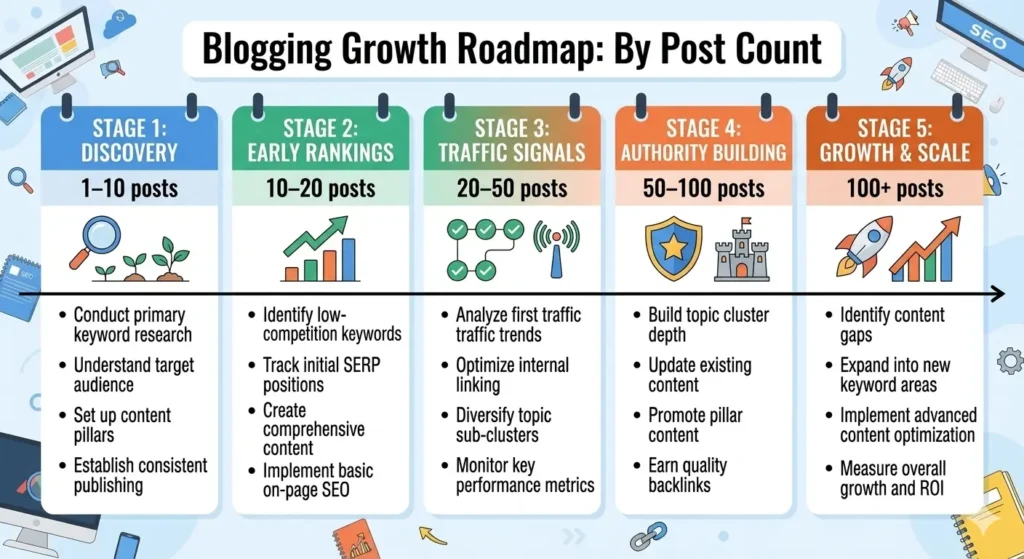
Many websites start seeing early traffic after publishing around 15 to 30 quality blog posts. But real SEO growth often takes longer.
If you are asking how many blog posts before traffic, here is a simple guide:
| Blog Count | What Usually Happens |
|---|---|
| 1 to 10 blogs | Google starts discovering your topics |
| 10 to 20 blogs | Some long-tail keywords may start ranking |
| 20 to 50 blogs | Traffic patterns become clearer |
| 50 to 100 blogs | Topical authority becomes stronger |
| 100+ blogs | Bigger SEO growth is possible with updates and links |
It is recommended that 15 high-quality blog posts can be a useful starting point for meaningful traffic, but results still depend on quality, niche, and strategy.
Do not expect every blog to rank quickly. Some posts may take weeks or months. Some may not rank at all. That is why tracking performance in Google Search Console is important.
Blog Frequency by Website Type
Different websites need different publishing plans.
Small Business Websites
A small business should publish 2 to 6 blogs per month.
This is enough to answer customer questions, support service pages, and build local visibility.
Good topics include:
- Common customer problems
- Service comparisons
- Pricing guides
- Local guides
- FAQs
- Mistakes to avoid
- Buying guides
Local Service Websites
A local service business should publish 4 to 6 blogs per month.
For example, a plumbing, roofing, HVAC, cleaning, or repair company can target location-based and service-based questions.
Good blog examples:
- Signs you need emergency plumbing repair
- How often should you clean your air ducts?
- Roof repair vs roof replacement
- Best time to service your AC
- Common drain problems in older homes
B2B Websites
A B2B website should publish 6 to 12 blogs per month if the goal is lead generation.
B2B buyers often research before contacting a company. Blogs can answer their questions and move them closer to a decision.
Useful B2B topics include:
- Comparison posts
- Problem-solving guides
- Industry trends
- Case studies
- Buyer guides
- Product education
- Cost breakdowns
Ecommerce Websites
An ecommerce website should publish 4 to 12 blogs per month.
The goal is to support product categories and answer buying questions.
Good ecommerce blog topics include:
- Best products for a specific use
- Product comparison guides
- How to choose guides
- Care tips
- Gift guides
- Size guides
- Seasonal buying guides
Established Websites
An established website may only need 2 to 4 new blogs per month, but it should update old content regularly.
If your website already has many posts, do not only chase new topics. Look for old blogs that have lost traffic, outdated information, weak titles, poor internal links, or missing FAQs.
Whether you need four blogs a month or twenty, TVS creates content that supports your SEO strategy and delivers measurable results. Let’s build your content plan together.
Quality vs Quantity: What Google Really Wants
Publishing more blogs can help you cover more keywords. But quantity alone does not guarantee rankings.
Google’s systems are designed to reward helpful and reliable content made for people.
That means your blog should not be written only to hit a keyword count. It should solve a real problem.
A high-quality blog usually has:
- A clear answer
- Accurate information
- Helpful examples
- Simple language
- Strong structure
- Internal links
- Original insight
- Updated details
- A useful next step
A low-quality blog usually has:
- Repeated ideas
- Thin content
- No clear answer
- Too many keywords
- Generic wording
- No examples
- Weak headings
- No real value
If you can write 8 strong blogs per month, do it. If you can only write 4 strong blogs, stay with 4. It is better to publish fewer useful blogs than many weak ones.
Best 90-Day Blog Posting Schedule
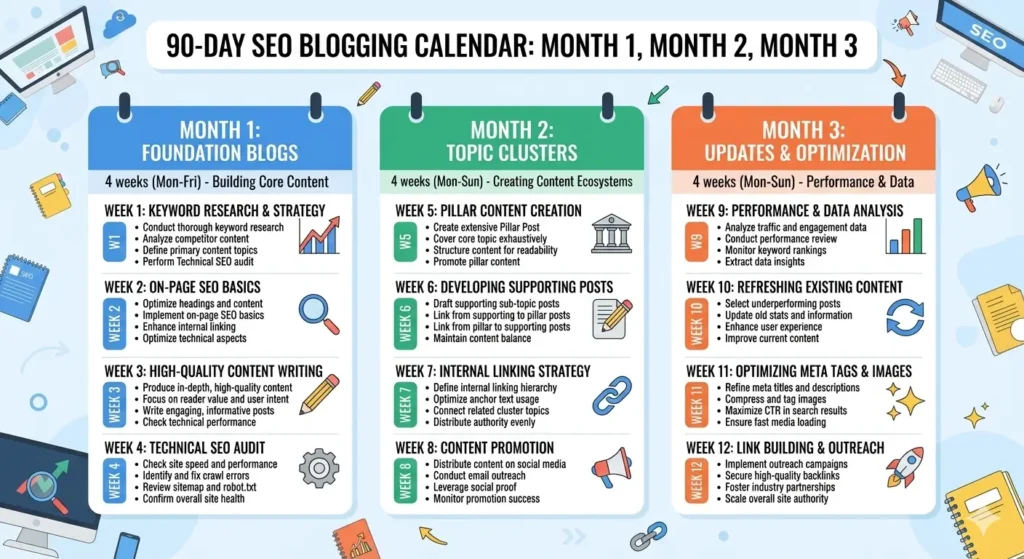
Here is a simple 90-day SEO blogging plan.
Month 1: Build the Foundation
Publish 6 to 8 blogs.
Focus on basic topics your audience searches for often. These should be simple, helpful, and closely related to your main services.
Example:
- What is SEO?
- How does SEO work?
- How long does SEO take?
- How much does SEO cost?
- SEO vs PPC
- Local SEO tips
- Why your business needs a blog
- How often should you blog?
Month 2: Build Topic Clusters
Publish 6 to 8 blogs.
Group your posts into clusters. Add internal links between related posts.
Example cluster:
- Blog frequency for SEO
- How many blog posts per month
- How many blog posts per week
- Blog post length for SEO
- Content calendar for SEO
- How to update old blog posts
Month 3: Optimize and Improve
Publish 4 to 6 new blogs and update 4 to 6 old posts.
Check Google Search Console. Find posts with impressions but low clicks. Improve titles, meta descriptions, introductions, FAQs, and internal links.
This approach gives you new content and better performance from existing content.
Common Blog Frequency Mistakes
Mistake 1: Publishing Without a Strategy
Do not publish blogs randomly. Every blog should target a keyword, search intent, and business goal.
Mistake 2: Choosing Quantity Over Quality
Publishing daily weak posts can hurt your content quality. Focus on helpful posts that answer real questions.
Mistake 3: Ignoring Old Content
Old blogs can lose rankings. Update them with fresh examples, better headings, stronger internal links, and clearer answers.
Mistake 4: Not Building Topic Clusters
One blog alone may not be enough. Build groups of related posts to show topical depth.
Mistake 5: Not Tracking Results
Use Google Search Console to see which pages get impressions, clicks, and ranking movement. Then improve the posts that show potential.
Final Recommendation
So, how many blogs is a good amount?
For most websites, the best answer is 4 to 8 blogs per month.
If your website is new, aim for 6 to 8 blogs per month.
If you run a small business, start with 2 to 6 blogs per month.
If you want faster SEO growth, publish 8 to 16 blogs per month if quality stays high.
If your website is established, publish fewer new blogs and update old posts more often.
The best blog frequency for SEO is not about posting as much as possible. It is about posting useful, clear, search-focused content consistently.
One strong blog per week can beat five weak blogs per week.
Start with what you can maintain. Track results. Improve old content. Build topic clusters. Over time, your blog can become one of the strongest traffic sources for your website.
Get Your Free Content Strategy
FAQs
How many blogs is a good amount for SEO?
For most websites, 4 to 8 blogs per month is a good amount for SEO. New websites can aim for 6 to 8 blogs per month, while small businesses can start with 2 to 6.
How often should you blog?
Most websites should blog once or twice per week. This gives you a consistent publishing schedule without reducing quality.
How many blog posts per month should a small business publish?
A small business should publish 2 to 6 blog posts per month. If the niche is competitive, 4 to 8 posts per month may work better.
Is one blog per week enough for SEO?
Yes, one blog per week can be enough for SEO if the blog is useful, well-structured, and matched to search intent.
How many blog posts before traffic starts?
Many websites begin seeing early traffic after 15 to 30 high-quality blog posts, but stronger SEO growth often needs 50 or more posts plus regular updates.
Should I blog every day?
Daily blogging is not needed for most businesses. It works better for news websites, media sites, and large teams. For most businesses, quality and consistency matter more.
Can too many blogs hurt SEO?
Yes, too many blogs can hurt SEO if they are thin, repeated, or not helpful. Google rewards helpful content, not content volume alone.
Should I update old blogs or write new ones?
Do both. New blogs help you target new keywords. Updating old blogs helps you improve rankings, fix outdated information, and increase clicks.