AI SEO Strategy for Businesses: Outranking Giants with GEO
In the rapidly evolving digital landscape of 2026, a quiet revolution is taking place. While legacy corporate giants continue to pour millions into traditional backlink strategies and high-volume keyword hoarding, agile service-based brands are finding a “backdoor” to the top of search results. This backdoor is called Generative Engine Optimization (GEO).
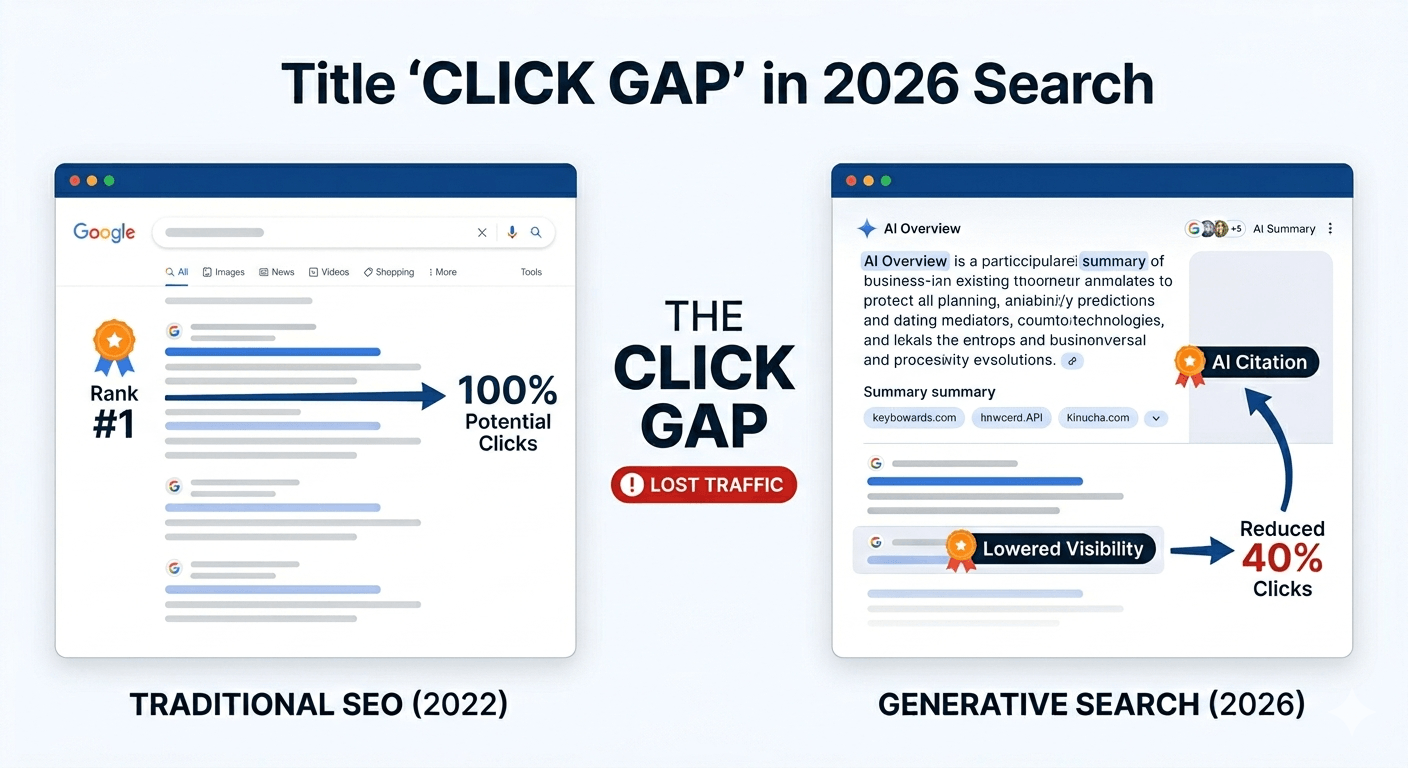
If you have noticed your organic traffic stagnating despite maintaining your rankings, you are witnessing the “Click Gap.” Google’s AI Overviews and platforms like ChatGPT are now answering queries directly, bypassing the traditional list of blue links. To grow your website today, you don’t need to be bigger than the corporations; you need to be smarter. You need an AI SEO strategy for businesses that prioritizes authority over sheer volume.
The Shift from Keywords to Entities
For two decades, SEO was a game of matching words on a page to words in a search bar. In 2026, search engines have evolved into “Answer Engines.” They no longer look for keywords; they look for Entities.
An entity is a well-defined concept—a person, a business, or a specific service. When a user in the United States asks Gemini, “Who is the best technical SEO consultant for an e-commerce brand?”, the AI doesn’t just look for a website with those keywords. It scans the web for a trusted entity that has a verified footprint of expertise.
Why Corporate Giants are Vulnerable?
Large corporations are like massive tankers: they are hard to steer. Their websites are often weighed down by:
-
Legacy Content:
Thousands of pages of “thin” content that lack modern E-E-A-T (Experience, Expertise, Authoritativeness, Trust).
-
Slow Adaptation:
Corporate legal and marketing loops prevent them from adopting new Schema 2.0 structures quickly.
-
Lack of Personality:
AI engines prefer content that shows “Information Gain”—unique insights that only a specialist can provide.
For a service provider, this is your opening. By focusing on a specialized AI SEO strategy for businesses, you can establish entity authority in weeks, whereas a corporation might take years to pivot.
During a recent audit for a client in the recruitment sector, we discovered that by simply restructuring their service headers for LLM readability, their brand mentions in Gemini increased by 30% within three weeks.
Whether you are a Lahore-based exporter looking to dominate the US market, or a UK firm struggling with AI traffic drops, our 2026 GEO Audit is your roadmap.
5 GEO Strategies to Capture High-Intent Traffic
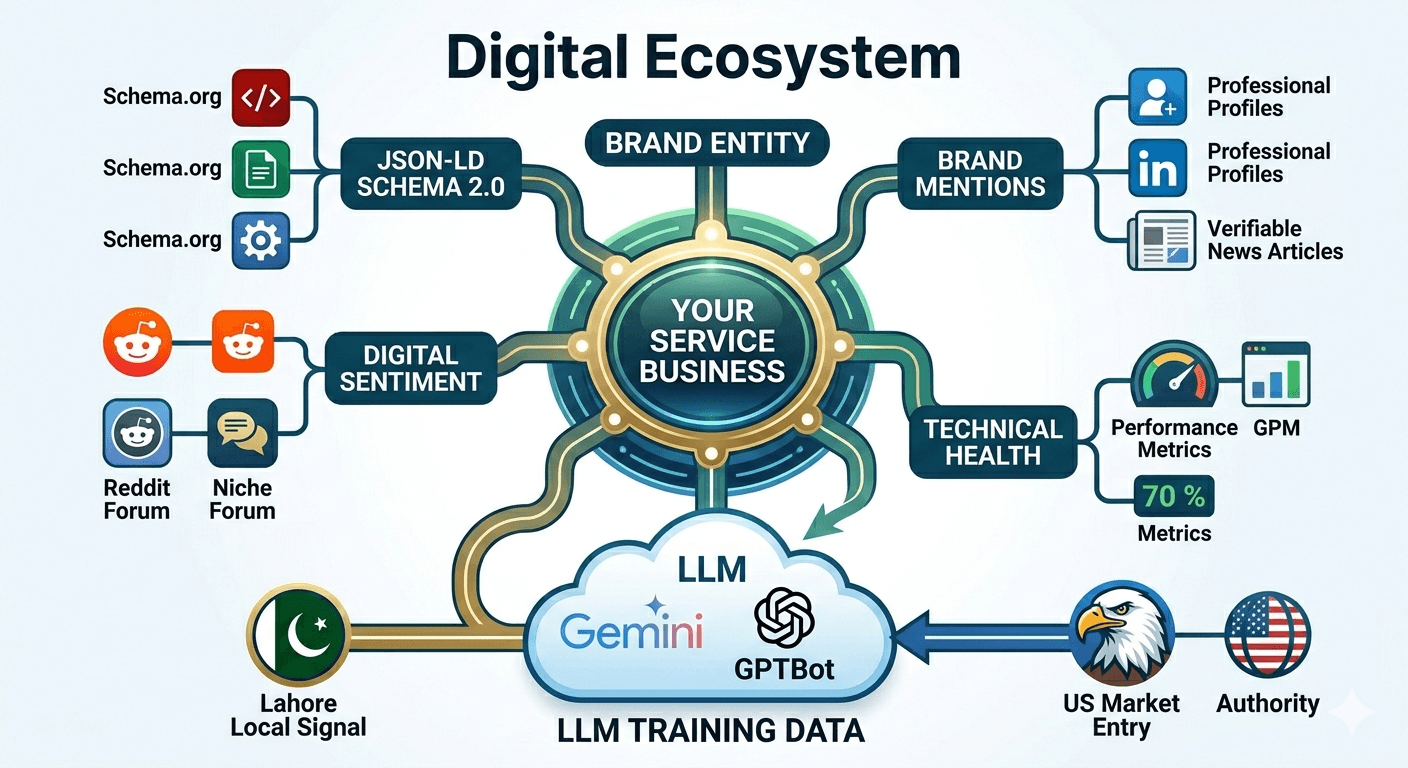
To outrank the giants, your website must become “Machine-Readable” and “Human-Trusted.” Here is the 2026 playbook for service-based growth.
1. Optimize for the “Citation Core”
AI models generate responses based on a “Core” of trusted sources. To get cited, your content must follow the Direct-Response Architecture.
- The Technique: Place a “Summary Box” at the top of your service pages. This box should contain a 50-word definition of your service and the specific problem it solves. This makes it incredibly easy for an LLM (Large Language Model) to scrape and credit your site.
2. Leverage Advanced JSON-LD Schema 2.0
In 2026, standard “Organization” schema is the bare minimum. To compete globally, you must use Linked Data.
- Use sameAs tags to connect your website to your professional contributions, verified social profiles, and industry citations.
- Use Service schema to define exactly what you do, the geographic area you serve (e.g., Lahore, London, or Remote), and the specific “outputs” of your service.
- For example, schema should explicitly define your service as an ‘Entity’ rather than just ‘WebPage’ content.
3. Build “Off-Page” Brand Sentiment
AI engines verify your authority by looking at what the rest of the web says about you. This is particularly vital for businesses in Pakistan looking to secure US-based clients.
- The Strategy: Focus on “Digital PR.” A mention in a niche industry forum or a guest appearance on a technical podcast carries more weight in 2026 than a hundred low-quality backlinks. AI perceives these as “Human Endorsements.”
4. Solve the “Zero-Click” Problem with High-Intent Content
Instead of targeting broad terms like “Digital Marketing,” target “Result-Oriented” queries.
- US Focus: Target keywords like “ROI of GEO for Law Firms” or “AI SEO Audit for SaaS.”
- Pakistan Focus: Target keywords like “Digital Export Strategies 2026” or “SEO for Pakistani Manufacturers.”
By solving a specific, high-stakes problem, you attract customers who are ready to hire, rather than students who are just researching.
5. Technical Accessibility for AI Crawlers
If GPTBot or Google-Extended is blocked by your firewall or slowed down by a heavy website, you will never be cited.
- Perform a “Bot Audit.” Ensure your site loads in under 1.5 seconds and that your most valuable insights are not hidden behind complex JavaScript.
Navigating the Global Market: Pakistan & The USA
A major advantage of an AI SEO strategy for businesses is its ability to break geographical barriers.
In the United States, the market is hyper-competitive. Corporations dominate the “Blue Links” through sheer spending. However, GEO allows a specialist agency from Pakistan to appear as a “Top Recommended Expert” in an AI summary because the AI values the technical accuracy of the content over the physical location of the office.
In Pakistan, the market is currently in a transition phase. Most local competitors are still stuck in the “Backlink Era.” By adopting GEO strategies now, you aren’t just winning today; you are building a wall around your niche that will be impossible for others to climb in 2027.
The Verdict: Adapt or Disappear
The “Competitive Edge” in 2026 belongs to those who understand that search is no longer a list of links—it is a conversation. Corporate giants are still trying to win a game that is no longer being played.
By implementing a specialized AI SEO strategy for businesses, you are not just optimizing a website; you are building a digital legacy. You are ensuring that when the world’s most powerful AI engines are asked for a solution, they provide your name. Stop fighting for clicks and start winning citations.
[Ready to see your AI Visibility Score? Book your 2026 GEO Audit with The Vital Solutions.]
Frequently Asked Questions (FAQs)
Will my traffic drop if I optimize for AI instead of Google?
Actually, the two are now the same. Google’s search algorithm and its AI (Gemini) use the same underlying data. Optimizing for AI citation naturally improves your traditional rankings because both reward high-authority, structured, and helpful content.
How do I track my success in GEO?
Traditional “Rank Tracking” is only half the story. In 2026, we use “Citation Tracking.” You should regularly prompt AI engines to see if your brand is mentioned in recommendations. At The Vital Solutions, we include “AI Share of Voice” reports in our audits.
Does GEO require me to write more content?
No. It requires you to write better content. One 2,000-word deep dive with original data and clear schema is worth more than fifty 500-word “SEO articles.” Quality is the only metric that matters to an LLM.
Can a new website outrank an established corporate site using GEO?
Yes. AI models have a “recency bias.” They want the most up-to-date, accurate information. A new site that explains a 2026 concept (like GEO) better than an old site will often be cited as the primary source.
Is an AI SEO Audit different from a regular SEO Audit?
A regular audit checks for “Search Engine Friendliness.” An AI SEO Audit checks for “Entity Clarity.” We look at your Knowledge Graph presence, your machine-readability, and your sentiment across the web to ensure you are “Citation-Ready.”