How Long Does SEO Take to Show Results? A Realistic SEO Timeline
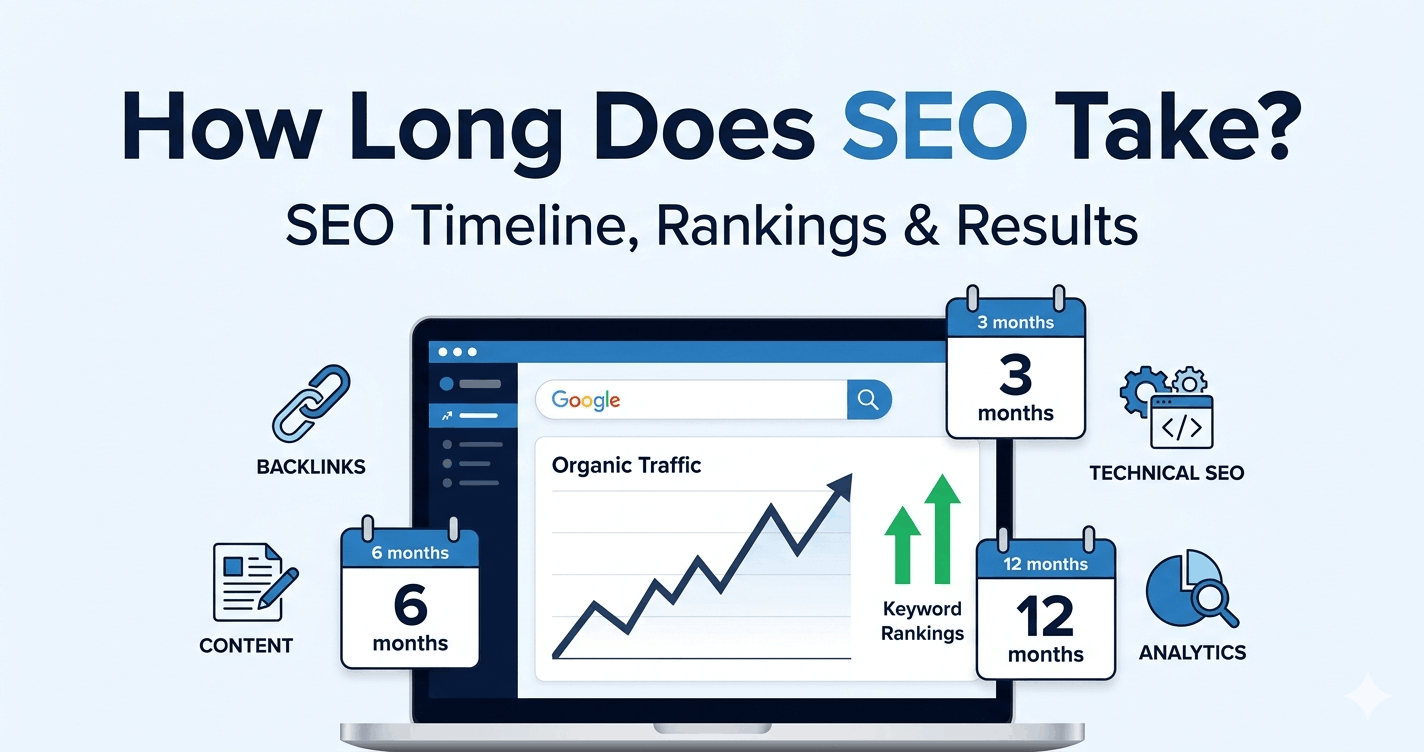
If you are asking how long does SEO take, the honest answer is this: most websites start seeing early SEO movement within 3 to 6 months, while stronger rankings, traffic, and leads usually take 6 to 12 months or longer.
Some small changes can happen faster. A page may get indexed in days. A technical fix may improve crawling quickly. An old page may move up after a good update. But stable SEO results usually take time because Google needs to crawl your pages, understand your content, compare it with competitors, and build trust in your website.
SEO is not like paid ads. Paid ads can bring clicks the same day, but the traffic stops when you stop paying. SEO works differently. It builds long-term visibility through useful content, technical health, backlinks, topical authority, user experience, and trust.
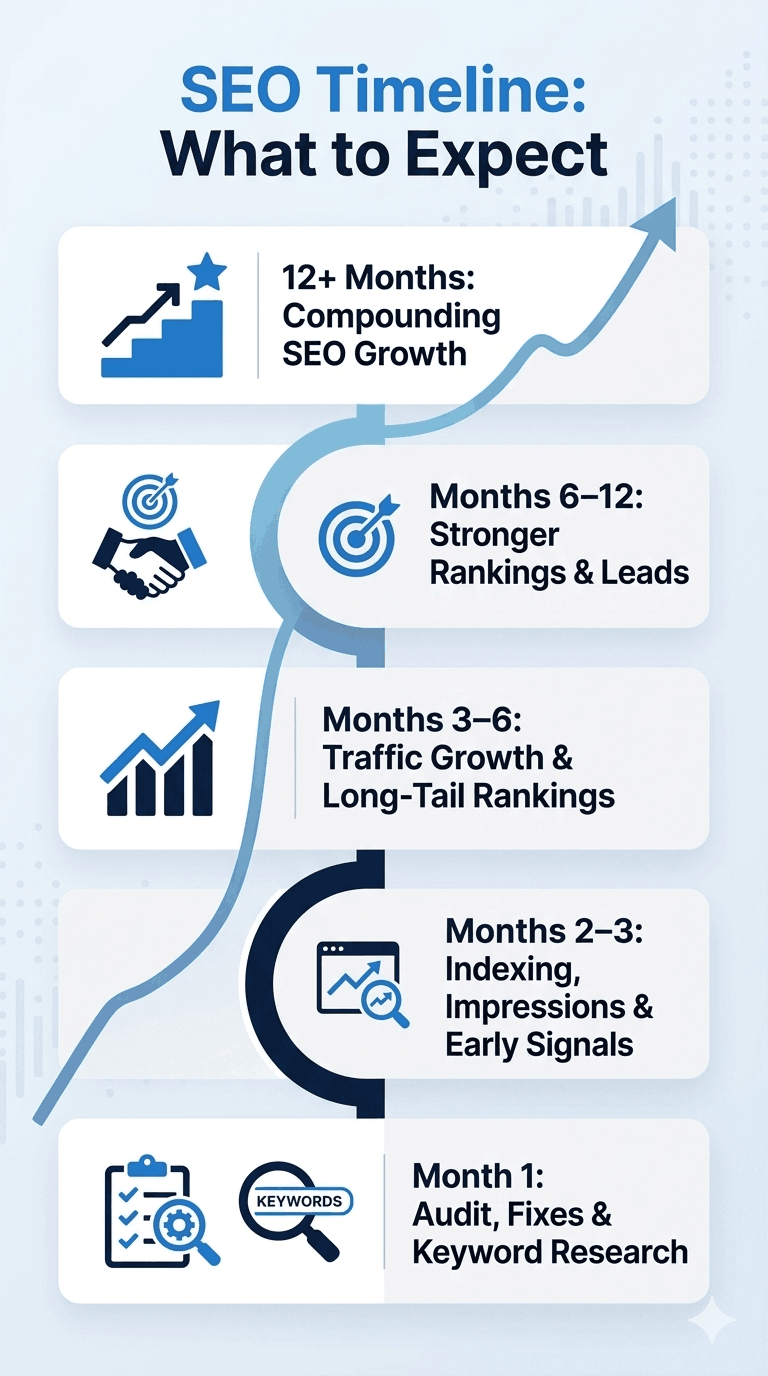
For most businesses, a realistic SEO timeline looks like this:
| Timeline | What Usually Happens | What to Track |
|---|---|---|
| 0 to 30 days | SEO audit, technical fixes, keyword research, indexing checks | Crawl errors, indexed pages, page speed |
| 1 to 3 months | Early impressions, some keyword movement, content updates | Google Search Console impressions and average position |
| 3 to 6 months | Noticeable traffic growth for easier keywords | Organic clicks, rankings, engagement |
| 6 to 12 months | Stronger rankings, more leads, better authority | Leads, conversions, organic revenue |
| 12+ months | Compounding growth and stronger topical authority | ROI, top 3 rankings, repeat traffic |
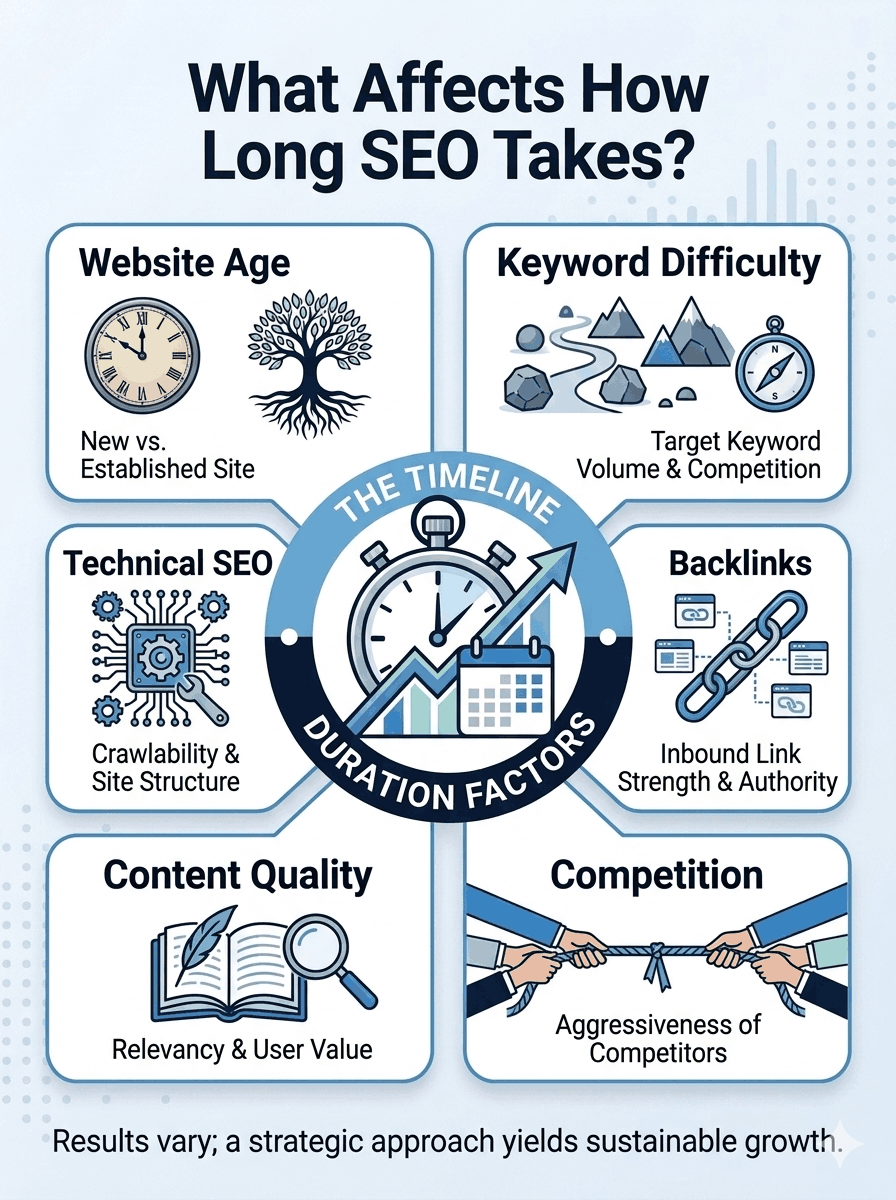
The exact timeline depends on your website, industry, competition, content quality, backlinks, and how consistently SEO work is done.
Quick Answer: How Long Does SEO Take?
For most websites:
- 1 to 3 months: Early improvements, indexing, technical fixes, and first ranking signals
- 3 to 6 months: Better keyword movement, more impressions, and early traffic growth
- 6 to 12 months: Stronger rankings, more organic traffic, and more leads
- 12+ months: Better authority, competitive rankings, and compounding growth
If your website is brand new, has no backlinks, has weak content, or targets very competitive keywords, SEO may take longer. If your website already has some authority and good technical health, results may come sooner.
What Counts as an SEO Result?
Many business owners think SEO results only mean sales. Sales matter, but they are not the first sign that SEO is working.
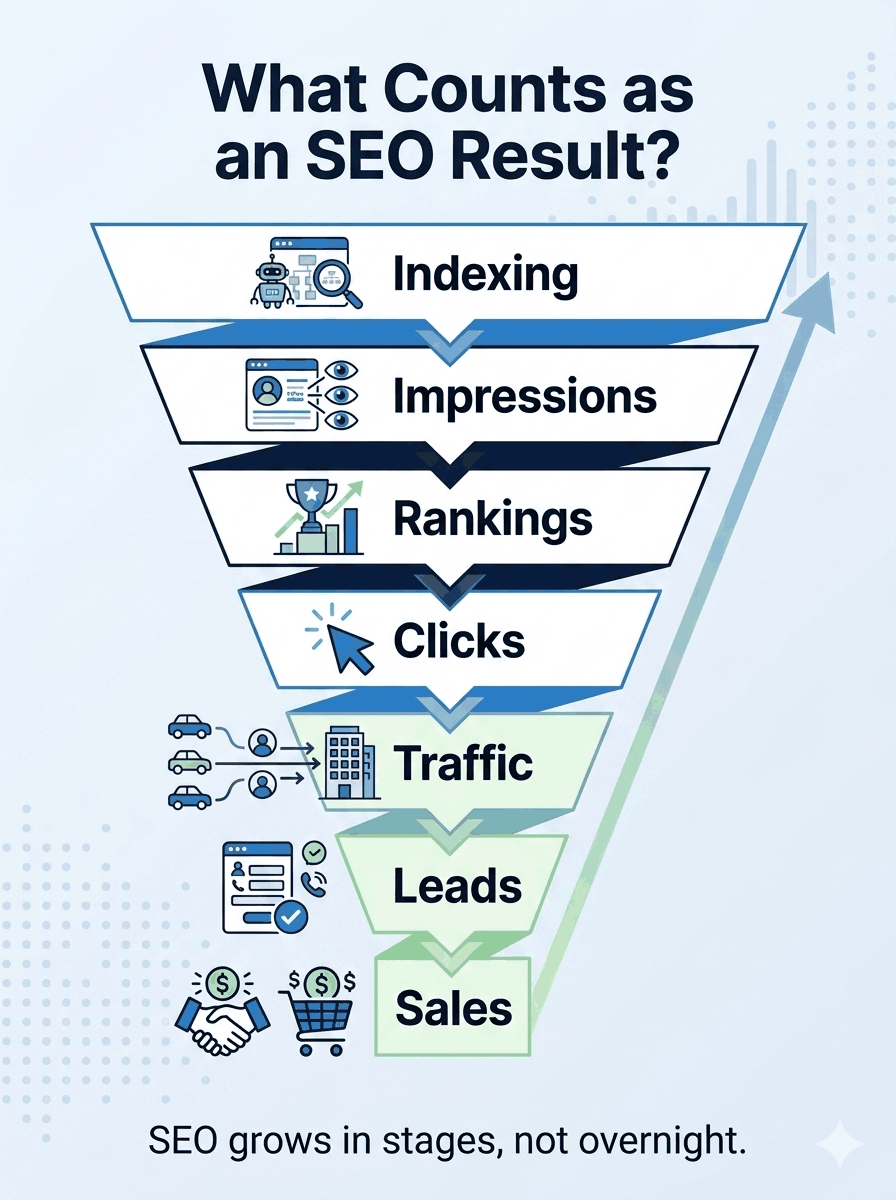
SEO usually improves in stages.
First, Google discovers and indexes your pages. Then impressions increase. After that, keyword positions improve. Once rankings move higher, clicks and traffic grow. Leads and sales usually come after that.
Here are the main signs of SEO progress:
- More pages indexed in Google
- More impressions in Google Search Console
- Better average keyword positions
- More keywords ranking on page 1 or page 2
- More organic clicks
- More organic traffic
- Better engagement on important pages
- More calls, form fills, bookings, or sales from organic search
A website may be improving even before traffic grows. For example, if impressions are increasing but clicks are still low, it means Google is testing your pages for more searches. That is often an early positive sign.
Start Your SEO Growth Today with TVS
Why SEO Takes Time?
SEO takes time because Google does not rank websites only because they exist. It evaluates pages based on relevance, quality, trust, authority, and user satisfaction.
Here are the main reasons SEO is not instant.
1. Google Needs Time to Crawl and Index Pages
When you publish a new page or update an existing one, Google needs to discover it first. After that, Google decides whether the page should be indexed and where it may fit in search results.
This process can be fast for strong websites, but slower for new or weak websites.
2. Google Needs to Understand Your Website
One blog post is not enough to prove authority. Google looks at your overall website structure, internal links, service pages, blog content, author signals, and topic coverage.
If your website has only one page about SEO, Google may not see you as a strong source. But if you have a full topic cluster around SEO timelines, SEO audits, technical SEO, backlinks, local SEO, and SEO reporting, your topical authority becomes stronger.
3. Trust Builds Slowly
Google wants to show reliable sources. Trust is built through helpful content, expert input, quality backlinks, real business information, reviews, brand mentions, and consistent publishing.
This is why an older website with good authority may rank faster than a brand-new domain.
4. Search Intent Must Match
A page can be well-written and still fail if it does not match search intent.
5. Competition Matters
If you are trying to rank against websites that have strong backlinks, older content, expert authors, and hundreds of related articles, it will take longer.
This does not mean you cannot compete. It means your content must be more useful, more specific, and more trustworthy.
Start Your SEO Growth with TVS
SEO Timeline: What to Expect Month by Month
Month 1: Audit, Research, and Technical Fixes
The first month is usually about finding and fixing problems.
Common SEO work includes:
- Full SEO audit
- Keyword research
- Competitor analysis
- Technical SEO checks
- Indexing review
- Google Search Console setup
- Google Analytics setup
- Page speed review
- Metadata optimization
- Internal linking plan
- Content gap analysis
What you may see:
Usually, you will not see big ranking changes in month one. That is normal. This month is about building the foundation.
What to track:
- Crawling errors
- Indexed pages
- Sitemap status
- Broken links
- Page speed
- Mobile usability
- Existing keyword positions
Months 2 to 3: Indexing, Content Updates, and Early Signals
During months two and three, Google starts processing your updates more clearly.
Common SEO work includes:
- Publishing new optimized content
- Updating old pages
- Improving service pages
- Adding internal links
- Creating FAQs
- Fixing thin content
- Improving headings and titles
- Building early backlinks or citations
What you may see:
You may start seeing more impressions in Google Search Console. Some keywords may move from nowhere to page 5, page 4, or page 3. Existing keywords may move closer to page 1.
This is not always enough to bring strong traffic yet, but it shows that Google is starting to test your content.
What to track:
- Search impressions
- Average ranking position
- Number of ranking keywords
- Pages getting indexed
- Click-through rate
- Early page 2 keyword opportunities
Months 3 to 6: Noticeable SEO Movement
This is when many websites start seeing real SEO progress.
Common SEO work includes:
- Building topic clusters
- Improving pages already ranking on page 2
- Publishing supporting blogs
- Strengthening internal links
- Improving calls to action
- Earning relevant backlinks
- Updating underperforming content
What you may see:
You may see more traffic from long-tail keywords. Some pages may reach page 1 for easier searches. Local businesses may start getting more map visibility and calls.
What to track:
- Organic clicks
- Long-tail keyword growth
- Page 1 and page 2 keywords
- Organic leads
- Form submissions
- Phone calls
- Local map rankings
Months 6 to 12: Stronger Rankings and Lead Growth
By this stage, your website should have more content, better structure, and stronger signals.
Common SEO work includes:
- Refreshing top pages
- Building stronger backlinks
- Expanding location pages
- Improving conversion rates
- Adding case studies
- Improving author and trust signals
- Creating comparison and buyer-intent content
What you may see:
You may start ranking for more competitive keywords. Organic traffic may become more stable. Leads may increase if your pages match business intent.
What to track:
- Top 3 rankings
- Organic conversion rate
- Qualified leads
- Organic revenue
- Assisted conversions
- Branded searches
- Backlink growth
12 Months and Beyond: Compounding SEO Results
SEO becomes more powerful when your website has built enough authority.
At this stage, your content can rank faster because Google already understands your website better. New pages may get indexed more quickly. Existing pages may hold rankings longer. Your brand may also receive more searches and mentions.
What you may see:
- More stable traffic
- Stronger authority
- Better ranking speed for new content
- More organic leads
- Higher return on SEO investment
- Broader keyword visibility
This is why SEO should be seen as a long-term asset, not a short campaign.
How Long Does SEO Take for a New Website?
For a new website, SEO usually takes longer because there is no history, authority, or trust yet.
A realistic timeline for a new website is:
- 0 to 3 months: Setup, indexing, technical fixes, and early content
- 3 to 6 months: First keyword movement and long-tail traffic
- 6 to 12 months: Stronger rankings and more consistent traffic
- 12+ months: Better authority and stronger competitive visibility
A new website should not start by chasing only high-volume keywords. It should first target long-tail keywords, local keywords, and low-competition topics.
For example, instead of only targeting SEO services, a new site may target:
- how long does SEO take for a new website
- how long does local SEO take
- how long does SEO take for small business
- SEO timeline for a new website
- when should I expect SEO results
How Long Does SEO Take for Local Businesses?
Local SEO can sometimes work faster than national SEO because the competition is limited to a city or service area.
For local businesses, SEO may show movement in:
- 1 to 3 months for Google Business Profile improvements
- 3 to 6 months for local organic traffic
- 6 to 12 months for stronger map rankings and steady leads
Local SEO depends on:
- Google Business Profile optimization
- Reviews
- Local citations
- Service pages
- Location pages
- Local backlinks
- NAP consistency
- Photos and business updates
- Local content
For example, a plumber in one city may rank faster than a national finance website because the search area is smaller. But if the local market is crowded, it can still take longer.
How Long Does SEO Take for Competitive Industries?
Some industries take longer because the competition is stronger.
These include:
- Legal
- Finance
- Insurance
- Healthcare
- Real estate
- SaaS
- E-commerce
- National service businesses
For competitive industries, a realistic timeline is:
- 3 to 6 months: Early movement and low-competition keyword wins
- 6 to 12 months: Meaningful traffic and lead growth
- 12 to 18+ months: Stronger rankings for competitive terms
In these industries, content quality alone is not enough. You also need expert review, trust signals, strong backlinks, technical SEO, helpful resources, and clear proof of experience.
How Long Does It Take to Rank on Google?
Ranking on Google can take days, weeks, or months depending on the keyword and website.
An established website may rank a new page faster because Google already trusts the domain. A new website may need more time because Google has less information about it.
For easy long-tail keywords, you may see ranking movement within a few weeks. For competitive keywords, it can take several months or longer.
The more competitive the keyword, the more Google needs to trust your page before ranking it near the top.
What Factors Affect How Long SEO Takes?
1. Website Age and Authority
Older websites with strong content and backlinks often rank faster. New websites need more time to build trust.
2. Technical SEO Health
Technical problems can slow SEO down. Common issues include:
- Pages blocked from crawling
- Noindex tags
- Broken internal links
- Slow loading pages
- Poor mobile experience
- Duplicate pages
- Missing sitemap
- Poor site structure
A technically clean website gives Google a better chance to crawl and understand your content.
3. Content Quality
Helpful content ranks better than thin content.
Good SEO content should:
- Answer the question clearly
- Match search intent
- Use simple language
- Include real examples
- Cover related questions
- Show experience
- Avoid fluff
- Be easy to scan
- Help users make decisions
4. Keyword Difficulty
Not all keywords are equal.
A keyword like SEO is very broad and hard to rank for. A keyword like how long does SEO take for a local business is more specific and easier to target.
Long-tail keywords often bring better early results because they match a clearer search intent.
5. Backlink Profile
Backlinks still matter because they help build authority. A website with strong, relevant backlinks usually has a better chance of ranking faster.
But backlink quality matters more than quantity. One relevant backlink from a trusted website can be more useful than many low-quality links.
6. Internal Linking
Internal links help Google understand which pages are important.
If your blog about SEO timelines links to related pages like SEO audit, local SEO, technical SEO, and content strategy, it creates a stronger topic structure.
7. User Experience
If users click your page and leave quickly because the content is hard to read, slow, or unhelpful, your SEO results may suffer.
Good user experience includes:
- Fast loading
- Mobile-friendly design
- Clear headings
- Short paragraphs
- Helpful tables
- Clear calls to action
- Easy navigation
8. Consistency
SEO is not a one-time task. A single blog post rarely changes everything.
Consistent SEO work builds momentum. This includes content updates, technical fixes, internal links, backlinks, and performance tracking.
Can SEO Work Faster?
Yes, SEO can work faster, but it does not mean overnight rankings.
You can speed up SEO results by focusing on the right actions first.
Improve Pages Already Ranking on Page 2
This is one of the fastest SEO wins. If a page is already ranking between positions 11 and 20, it may need better content, stronger internal links, improved title tags, or more useful FAQs to move to page 1.
Target Long-Tail Keywords First
Long-tail keywords are easier to rank for and often have stronger intent.
Examples:
- how long does SEO take for a new website
- how long does SEO take to show results
- how long does local SEO take
- SEO timeline for small business
- when do SEO results start
- how long does it take to rank on Google
- why does SEO take so long
- how to know if SEO is working
Fix Technical SEO Problems
Technical fixes can remove barriers that stop Google from crawling or understanding your site.
Important fixes include:
- Submit XML sitemap
- Fix broken links
- Improve Core Web Vitals
- Remove duplicate pages
- Fix redirect chains
- Improve mobile usability
- Check robots.txt
- Fix noindex issues
Update Existing Content
Updating old pages can be faster than creating new ones. If a page already has impressions, Google knows it exists. Improving that page can lead to faster ranking movement.
Build Topic Clusters
A topic cluster helps Google see that your website covers a subject deeply.
For example, a strong SEO timeline cluster may include:
- How long does SEO take?
- How long does local SEO take?
- How long does technical SEO take?
- How long does it take to rank on Google?
- SEO checklist for new websites
- SEO audit checklist
- SEO reporting guide
- How to track SEO results
Earn Relevant Backlinks
Backlinks can speed up authority growth when they come from relevant and trusted websites.
Avoid spammy backlink packages. They can hurt trust and waste money.
What Delays SEO Results?
Some websites take longer because of avoidable problems.
Common reasons SEO takes longer include:
- New domain with no authority
- Poor technical setup
- Weak or copied content
- No clear keyword strategy
- Targeting only difficult keywords
- Poor internal linking
- Slow website speed
- Weak backlink profile
- No Google Business Profile optimization
- Poor mobile experience
- Inconsistent publishing
- No conversion tracking
- Thin service pages
- No topical authority
If these issues exist, SEO can still work, but the first few months may be spent fixing the foundation.
When Should You Worry If SEO Is Not Working?
SEO takes time, but there should still be signs of progress.
You may need to review your SEO strategy if:
- Your pages are not indexed after several weeks
- Search impressions are not increasing after 2 to 3 months
- No keywords are moving after 3 to 4 months
- Organic traffic is flat after 6 months
- Leads are not improving after 6 to 12 months
- Your content is published but not internally linked
- Your website has technical errors that remain unfixed
- Your SEO report only shows rankings, not business results
A good SEO campaign should show early signals before major traffic growth. If there are no signals at all, something may be wrong.
How to Know If SEO Is Working
SEO should be measured with the right tools and metrics.
Use Google Search Console to track:
- Impressions
- Clicks
- Average position
- Click-through rate
- Indexed pages
- Queries
- Pages gaining visibility
Use Google Analytics to track:
- Organic traffic
- Engagement
- Conversions
- Leads
- Revenue
- Landing page performance
Use rank tracking tools to monitor:
- Keyword movement
- Page 1 rankings
- Page 2 opportunities
- Local rankings
- Competitor movement
The best SEO reports do not only show rankings. They show whether SEO is helping the business grow.
SEO Timeline by Business Type
Small Business SEO Timeline
Small businesses may see early results in 3 to 6 months if they target local and low-competition keywords first.
Best early focus:
- Local service pages
- Google Business Profile
- Reviews
- FAQs
- Location pages
- Internal links
E-commerce SEO Timeline
E-commerce SEO can take 6 to 12 months because product pages, category pages, duplicate content, filters, and technical issues often need more work.
Best early focus:
- Category page optimization
- Product schema
- Internal linking
- Product descriptions
- Collection page content
- Image optimization
- Technical crawl control
SaaS SEO Timeline
SaaS SEO often takes 6 to 12+ months because many keywords are competitive and require strong content quality.
Best early focus:
- Use-case pages
- Comparison pages
- Alternative pages
- Feature pages
- Bottom-funnel blogs
- Product-led content
- Case studies
Local Service Business SEO Timeline
Local service businesses can often see movement faster, especially when the city competition is not too high.
Best early focus:
- Service pages
- City pages
- Reviews
- Local citations
- Google Business Profile
- Local backlinks
- Before-and-after project content
Example SEO Timeline for a New Website
Let’s say a new local cleaning business launches a website.
In month one, the site is submitted to Google Search Console. The sitemap is added. The homepage, service pages, and contact page are optimized. Basic technical issues are fixed.
In months two and three, the website publishes pages for house cleaning, deep cleaning, end-of-lease cleaning, and local service areas. Google starts showing more impressions, but traffic is still low.
By months three to six, some long-tail keywords start ranking. The business may get traffic from searches like end of lease cleaning checklist or house cleaning service near me.
By months six to twelve, stronger local rankings may appear if the business gets reviews, builds local citations, earns backlinks, and keeps improving content.
This is a realistic SEO path. It does not happen overnight, but each step builds momentum.
What Google Wants to See
Google’s direction is simple: content should be helpful, reliable, and made for people first.
That means your SEO content should:
- Answer the main question quickly
- Give complete information
- Show real experience
- Be easy to understand
- Include clear examples
- Avoid copied or generic content
- Be updated when information changes
- Include author or business trust signals
- Help the reader make a better decision
This matters even more now because Google Search includes AI features. Clear, direct, well-structured answers are easier for search systems to understand and summarize.
How to Improve Your Chances of Ranking Faster
1. Start With Realistic Keywords
Do not only chase high-volume keywords. Start with keywords that match your website’s authority level.
2. Build Supporting Content
One article is not enough. Support your main article with related pages and blogs.
3. Improve Internal Links
Link from your homepage, service pages, and related blogs to your most important SEO pages.
4. Add Trust Signals
Add author bio, business details, case studies, testimonials, client examples, and updated dates.
5. Use Clear On-Page SEO
Use a strong title, meta description, headings, FAQs, image alt text, and simple URL structure.
6. Update Content Regularly
SEO timelines change as Google updates search. Review important pages every few months.
7. Track Leads, Not Only Rankings
Rankings matter, but leads and revenue matter more. A keyword ranking is only useful if it brings the right traffic.
Is SEO Worth the Wait?
Yes, SEO is worth the wait if you want long-term traffic and steady business growth.
Paid ads can bring faster traffic, but you pay for every click. SEO takes longer, but it can keep bringing visitors after the work has been done.
Good SEO builds:
- Better visibility
- More trust
- More organic traffic
- More qualified leads
- Lower long-term cost per lead
- Stronger brand authority
SEO is not the fastest marketing channel, but it can become one of the most valuable.
Final Answer: How Long Does SEO Take?
So, how long does SEO take?
For most websites, SEO takes 3 to 6 months to show early results and 6 to 12 months to create stronger traffic, rankings, and leads. For new websites or competitive industries, it may take 12 months or longer.
The key is to understand what progress looks like. Indexing, impressions, keyword movement, traffic, and leads do not all happen at the same time. SEO grows in stages.
If you build a technically strong website, publish helpful content, target realistic keywords, earn quality backlinks, and track the right metrics, SEO can become a long-term growth asset for your business.
Talk to Our SEO Experts and Get free Consultation Now
FAQs
How long does SEO take to show results on Google?
Most websites start seeing early SEO results within 3 to 6 months. Stronger rankings and leads usually take 6 to 12 months or longer.
Can SEO work in 30 days?
SEO can show small signs in 30 days, such as indexing, impressions, or keyword movement. But major traffic and lead growth usually take longer.
Why does SEO take so long?
SEO takes time because Google needs to crawl, index, understand, compare, and trust your website before ranking it higher.
How long does SEO take for a new website?
A new website often needs 3 to 6 months for early traction and 6 to 12 months or more for stronger results.
How long does local SEO take?
Local SEO can show early movement in 1 to 3 months, but stronger map rankings and consistent leads usually take 3 to 6 months or longer.
How long does it take to rank on Google?
It depends on the keyword. Easy long-tail keywords may rank in weeks, while competitive keywords can take several months or longer.
How do I know if SEO is working?
Check Google Search Console for more impressions, clicks, keyword growth, and indexed pages. Also track leads and conversions in Google Analytics.
Does posting more content speed up SEO?
Posting more content can help if the content is useful, original, and connected to a clear topic strategy. Thin or low-quality content will not help.
What is the fastest way to improve SEO results?
The fastest wins often come from improving pages already ranking on page 2, fixing technical issues, updating old content, and targeting long-tail keywords.
Is SEO better than paid ads?
SEO and paid ads work differently. Paid ads are faster, but SEO can bring long-term traffic without paying for every click.