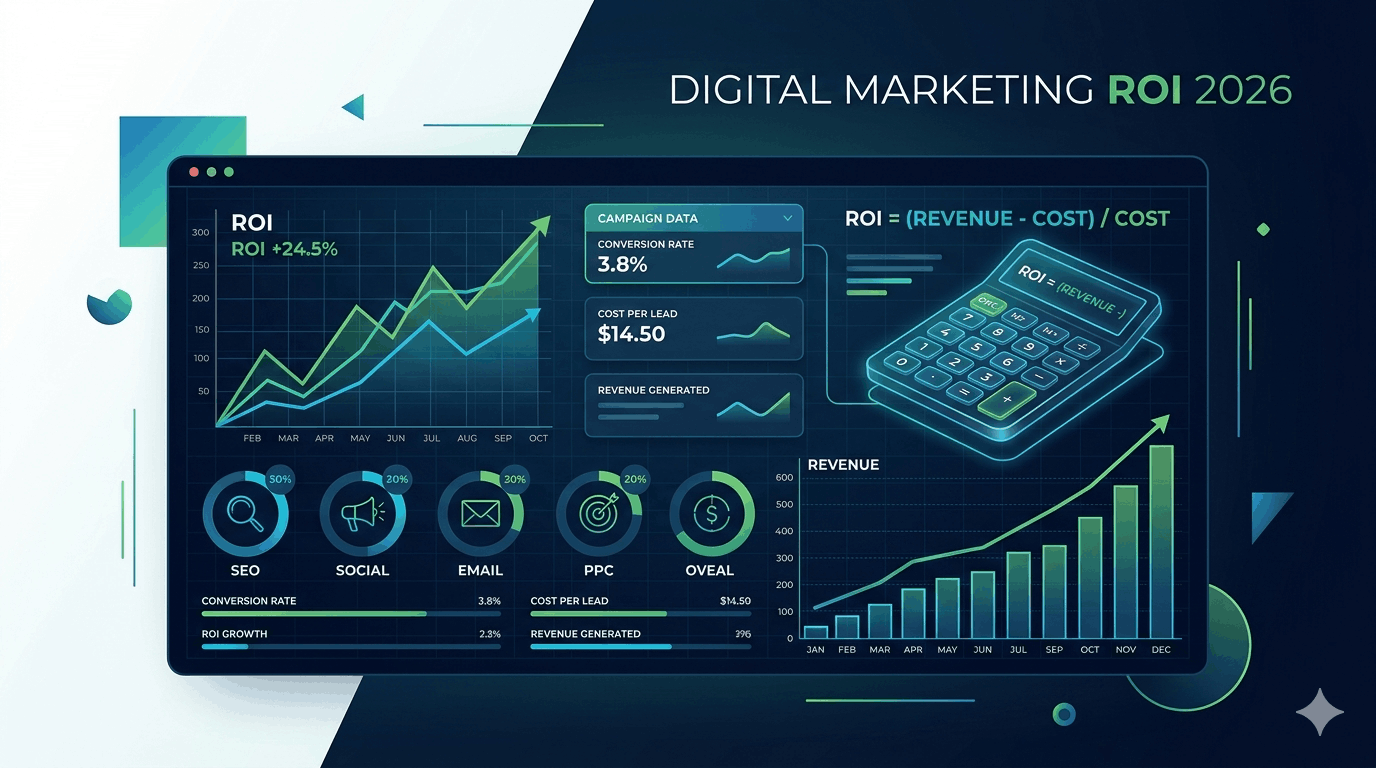
What Is Digital Marketing ROI?
Digital marketing ROI is the return your business earns from online marketing compared with the money spent on campaigns. It helps you understand whether your SEO, PPC, email, content, social media, and paid advertising efforts are producing real business value.
In 2026, digital marketing ROI matters more because customer journeys are no longer simple. A buyer may click a Google ad, read a blog, join an email list, visit your social profile, and then convert days or weeks later. That is why businesses need proper tracking, not just traffic reports.
Want to know where your marketing budget is working or leaking?
Get a free digital marketing ROI audit and discover which channels are ready to scale.
Key Takeaways
Digital marketing ROI shows whether your marketing spend creates revenue or profit.
The basic formula is:
ROI = Revenue from campaign minus marketing cost / marketing cost x 100
A 5:1 ROI is generally strong, while 10:1 is excellent. But the right benchmark depends on your profit margin, industry, offer, and sales cycle.
For better accuracy, use both revenue based ROI and profit based ROI.
Digital Marketing ROI Formula
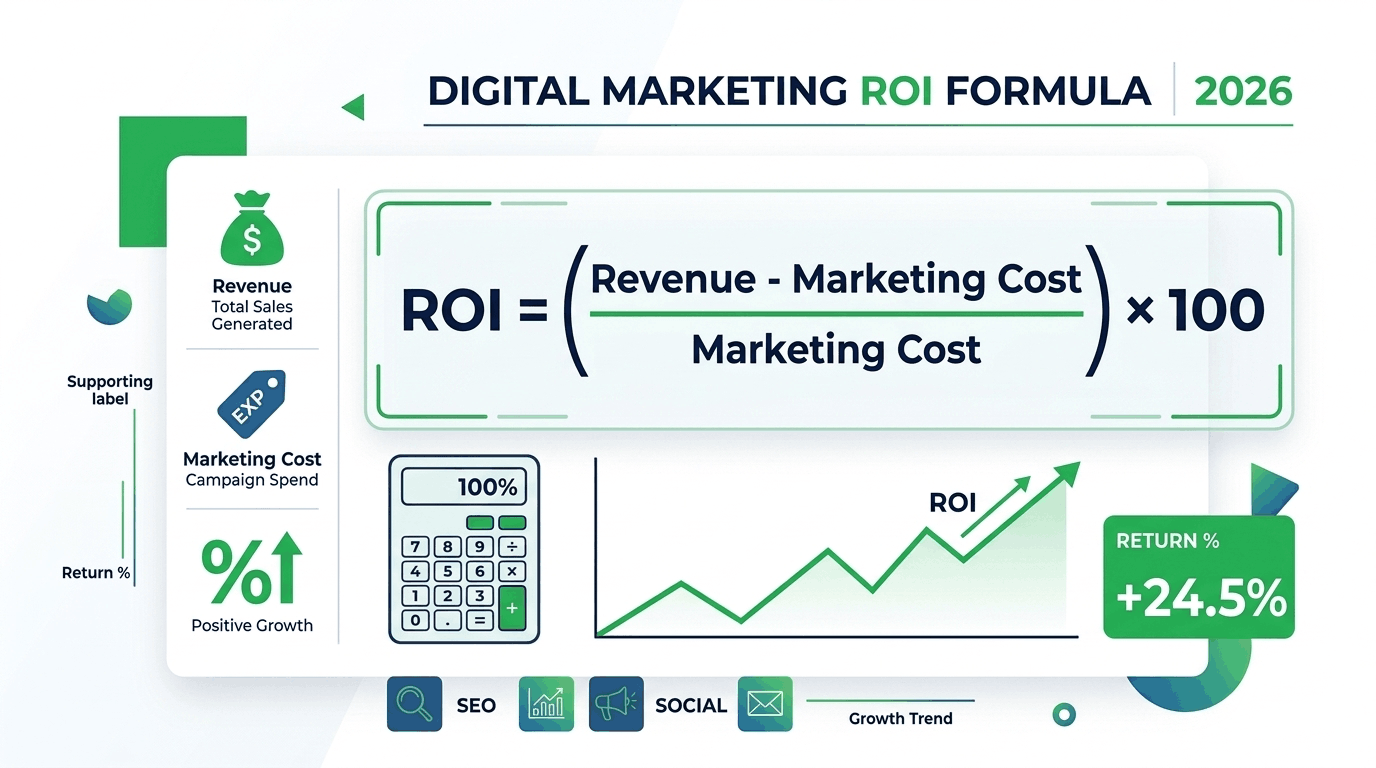
The standard formula is:
ROI = (Revenue – Marketing Cost) / Marketing Cost x 100
Example:
Campaign revenue: $10,000
Marketing cost: $2,000
ROI = ($10,000 – $2,000) / $2,000 x 100
ROI = 400%
This means the campaign returned $4 for every $1 spent.
Profit Based ROI Formula
Revenue does not always show the full picture. A campaign can generate sales but still deliver weak profit if margins are low.
Use this formula:
Profit ROI = Gross Profit – Marketing Cost / Marketing Cost x 100
Example:
Campaign revenue: $20,000
Gross profit: $8,000
Marketing cost: $3,000
Profit ROI = ($8,000 – $3,000) / $3,000 x 100
Profit ROI = 166%
This gives a more honest view of campaign performance.
Stop Guessing. Start Measuring Growth.
Predicted ROI Example Before Launch
You can estimate digital marketing ROI before spending the full budget.
Campaign budget: $5,000
Expected leads: 100
Lead to customer rate: 10%
Expected customers: 10
Average sale value: $1,200
Expected revenue: $12,000
Predicted ROI = ($12,000 – $5,000) / $5,000 x 100
Predicted ROI = 140%
This helps your team decide if a campaign is worth testing.
What Is a Good Digital Marketing ROI?
A good digital marketing ROI depends on your business model.
As a general guide:
2:1 may be weak for many businesses.
3:1 can be acceptable.
5:1 is strong.
10:1 is excellent.
But these numbers are not fixed rules. A law firm, SaaS company, or B2B consultant may accept a higher customer acquisition cost because one client has high lifetime value. An ecommerce store with low margins may need tighter ROI targets.
ROI vs ROAS vs CAC vs CLV
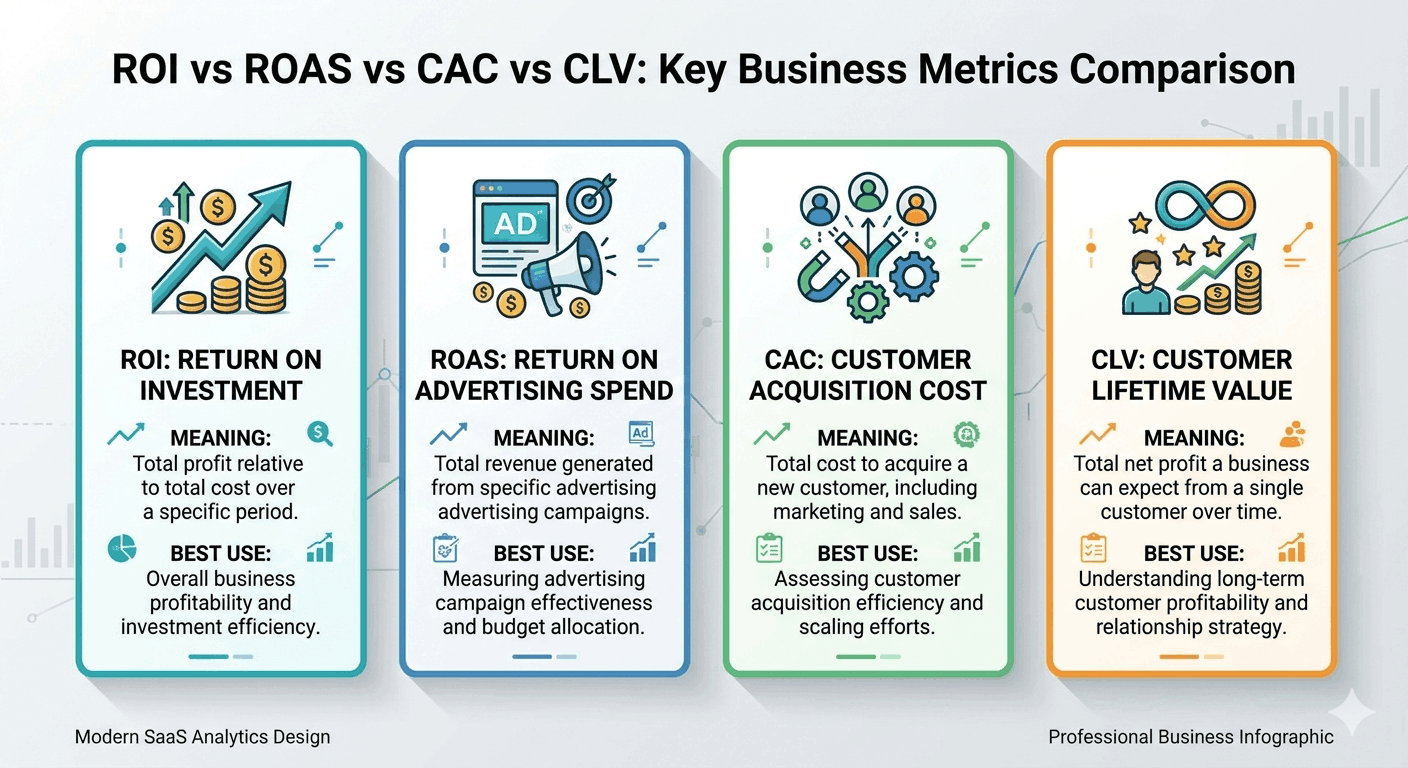
| Metric | Meaning | Best Use |
|---|---|---|
| ROI | Total return after marketing cost | Overall profitability |
| ROAS | Revenue from ad spend | Paid ads performance |
| CAC | Cost to acquire one customer | Sales efficiency |
| CLV | Lifetime value of a customer | Long term growth |
ROAS is useful for ads, but ROI gives a wider business view.
Key Metrics That Affect Digital Marketing ROI
Track these metrics to understand what is helping or hurting ROI:
- Conversion rate
- Cost per lead
- Cost per acquisition
- Average order value
- Customer lifetime value
- Lead to customer rate
- Sales close rate
- Traffic quality
- Retention rate
- Attribution accuracy
These metrics show where your campaign is leaking money.
How to Measure ROI by Channel
SEO ROI:
SEO ROI includes track organic traffic, keyword rankings, organic leads, assisted conversions, and revenue from search.
PPC ROI:
Track ad spend, cost per click, conversion rate, cost per lead, cost per sale, and landing page performance.
Email ROI:
Track open rate, click rate, conversion rate, revenue per email, automation results, and repeat purchases.
Content Marketing ROI:
Track blog traffic, leads, assisted conversions, backlinks, rankings, and sales influenced by content.
Social Media ROI:
Track referral traffic, leads, paid social conversions, assisted conversions, and audience quality.
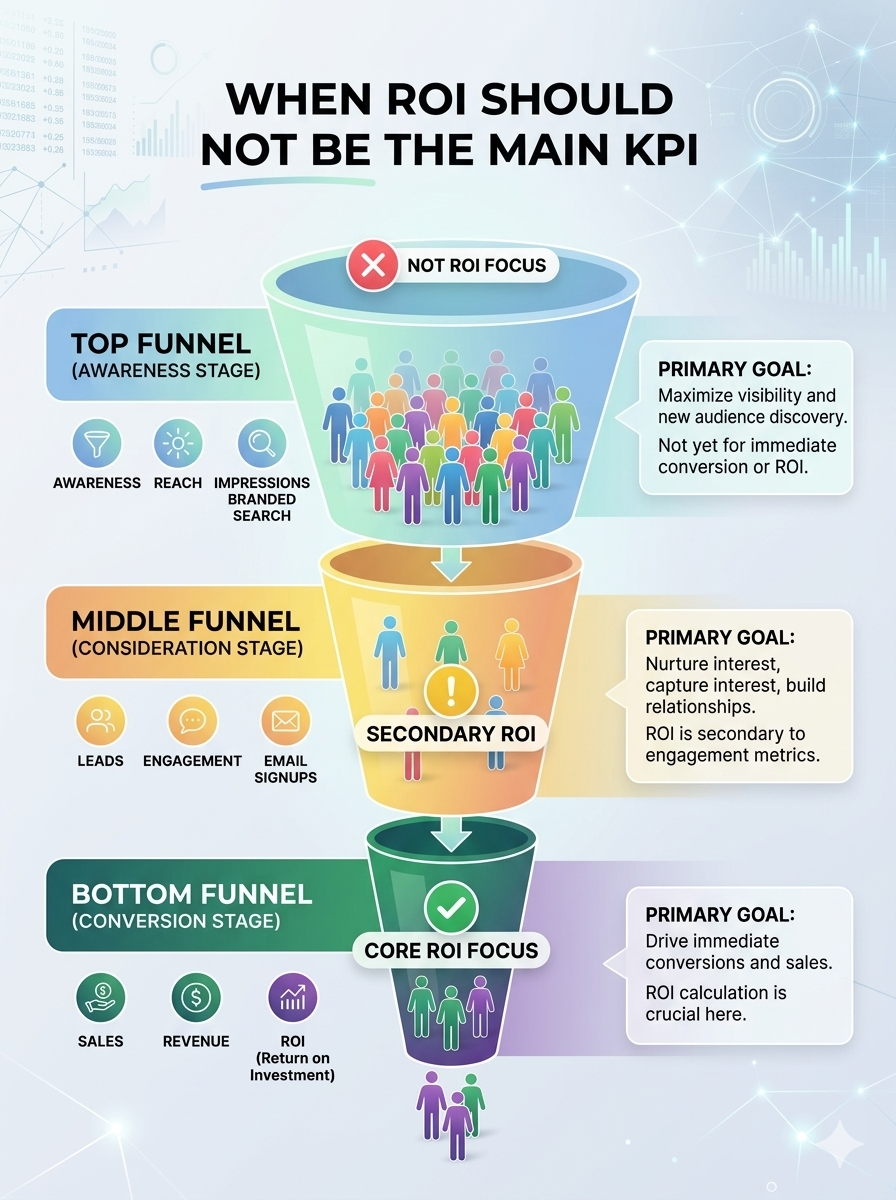
When ROI Should Not Be Your Main KPI?
- ROI is important, but it is not always the first metric to judge.
- For brand awareness, track reach, branded search growth, engagement, and direct traffic.
- For SEO, ROI can take months because rankings and traffic build over time.
- For B2B campaigns, leads may take weeks or months to turn into revenue.
- For top funnel content, the goal may be trust, education, and demand generation before sales.
In these cases, use ROI with supporting KPIs such as qualified leads, pipeline value, demo requests, returning visitors, and assisted conversions.
Common ROI Tracking Problems
Many businesses get weak ROI data because their tracking is incomplete.
Common issues include:
- No UTM links
- Missing GA4 key events
- No Google Ads conversion tracking
- CRM not connected to lead source
- Phone calls not tracked
- Offline sales not imported
- Sales team not updating deal value
- Too much focus on clicks and impressions
- No separation between lead quantity and lead quality
Fixing these problems often improves decision making before campaign performance even changes.
Practical Tracking Checklist
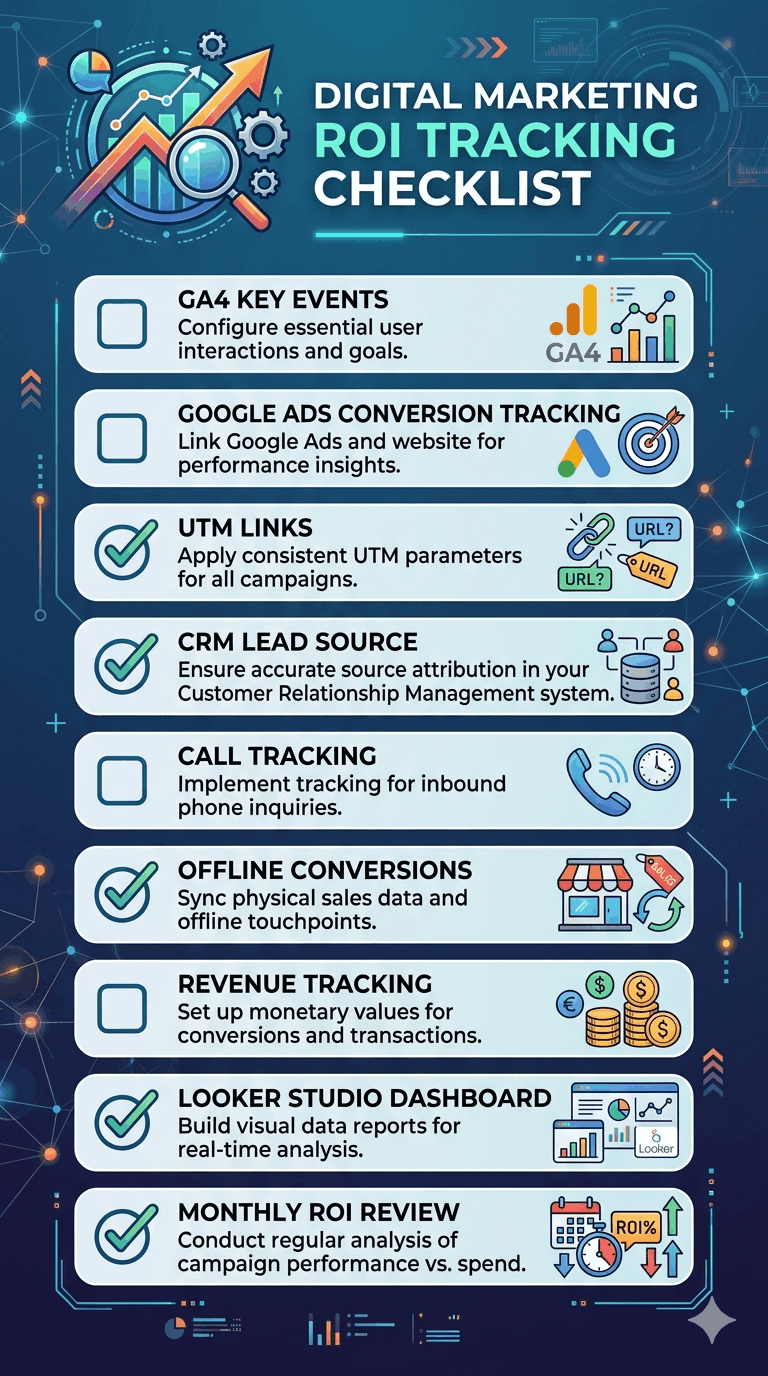
Before judging digital marketing ROI, make sure this setup is complete:
- Set up GA4 properly.
- Mark important actions as key events.
- Install Google Ads conversion tracking.
- Use UTM parameters for every campaign.
- Connect website forms with your CRM.
- Track phone calls from ads and landing pages.
- Record lead source inside the CRM.
- Add deal value or revenue to closed leads.
- Import offline conversions where possible.
- Create a Looker Studio dashboard.
- Review ROI by channel, campaign, and audience every month.
ROI Limitations Funnel
Mini Case Study Example
A local service business spends $3,000 on Google Ads in one month.
The campaign generates 90 leads.
The sales team closes 18 jobs.
Average job value is $450.
Total revenue is $8,100.
Gross profit is $5,670.
Revenue based ROI:
($8,100 – $3,000) / $3,000 x 100 = 170%
Profit based ROI:
($5,670 – $3,000) / $3,000 x 100 = 89%
After reviewing the campaign, the business finds that mobile landing page conversions are weak. They reduce form fields, add reviews, improve the headline, and pause low quality keywords. The next month, the same budget produces more qualified leads and a stronger ROI.
How to Improve Digital Marketing ROI?
- Improve targeting so your campaigns reach buyers, not just browsers.
- Focus on high intent keywords that show purchase or enquiry intent.
- Improve landing pages with clear headlines, faster loading, stronger CTAs, trust signals, and shorter forms.
- A/B test ads, offers, landing pages, and email subject lines.
- Reduce wasted spend by pausing weak keywords, audiences, and placements.
- Improve lead nurturing through email, retargeting, and sales follow ups.
- Use first party data to target better audiences.
- Measure lifetime value, not just first purchase revenue.
FAQ
What is digital marketing ROI?
Digital marketing ROI measures the return generated from online marketing compared with the cost of running those campaigns.
How do you calculate digital marketing ROI?
Use this formula: Revenue from campaign minus marketing cost, divided by marketing cost, multiplied by 100.
What is a good digital marketing ROI?
A 5:1 ROI is generally strong, while 10:1 is excellent. But the right benchmark depends on margin, industry, and customer value.
What is the difference between ROI and ROAS?
ROI measures total profitability. ROAS only measures revenue from ad spend.
Why is digital marketing ROI hard to track?
It is hard because customers often interact with many channels before buying. Poor tracking, long sales cycles, phone calls, and offline sales can also affect accuracy.
Conclusion
Digital marketing ROI helps you see which campaigns create real business value. The formula is simple, but accurate ROI needs proper tracking, CRM data, revenue reporting, and attribution context.
In 2026, the best marketing teams will not judge success by clicks alone. They will connect marketing activity with leads, sales, profit, customer lifetime value, and long term growth.