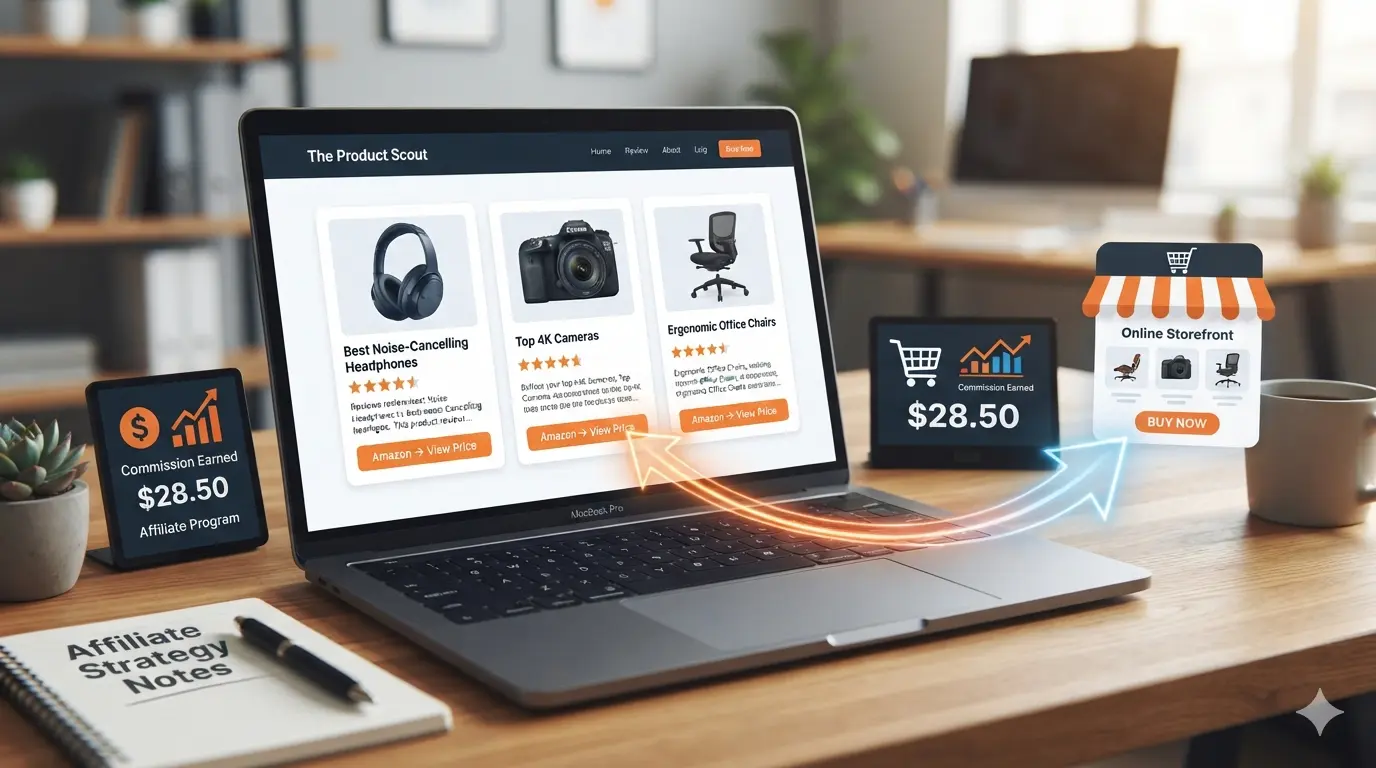
How to Become an Amazon Affiliate in 2026: Complete Step-by-Step Guide
To become an Amazon affiliate in 2026, join Amazon Associates, provide a qualifying website, app, or social media presence, complete your account and payment information, create Amazon affiliate links, and generate qualifying purchases while following Amazon’s program policies. Amazon reviews your account based on your activity and compliance requirements.
Want to learn how to become an Amazon affiliate and start earning commissions by recommending products? Amazon Associates lets eligible website owners, content creators, social media publishers, and other qualifying participants earn commission income from qualifying purchases made through properly tagged Amazon affiliate links.
The process is straightforward, but getting approved and staying compliant requires more than simply adding Amazon links to a website. You need an established online presence, original content, qualifying sales, proper disclosures, and compliance with Amazon’s current Associates policies.
This guide explains how to be an Amazon affiliate in 2026, from eligibility and application to affiliate links, commissions, SEO, your first sales, and compliance.
What Is the Amazon Associates Program?
Amazon Associates is Amazon’s affiliate marketing program. It allows qualifying participants to monetize websites, social media user-generated content, online applications, and other eligible properties by sending customers to Amazon through special tagged links.
When someone clicks your Amazon affiliate link and makes a qualifying purchase, you may earn commission income according to the applicable Amazon commission schedule and program rules.
How Amazon affiliate marketing works?
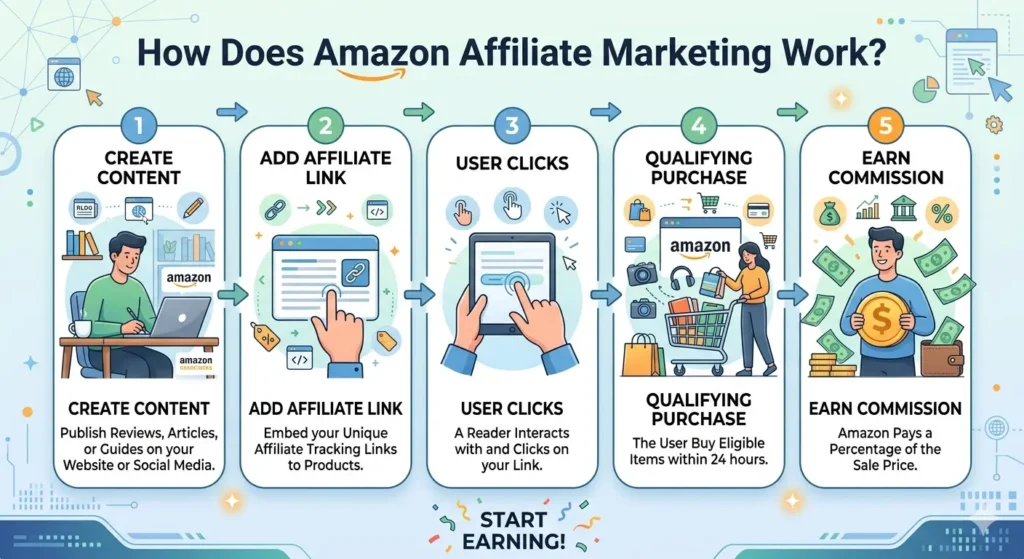
The basic model is:
Useful content → Amazon affiliate link → Customer click → Qualifying purchase → Commission
For example, a website publishing a guide about home coffee equipment might recommend several coffee makers. A reader clicks an Amazon affiliate link, purchases an eligible product, and the publisher receives commission income if the transaction qualifies.
Amazon provides linking tools such as SiteStripe, which can create tagged links directly from Amazon product pages.
Who Can Become an Amazon Affiliate?
You don’t necessarily need a large audience to apply. Amazon’s current review process focuses on whether your submitted properties provide a suitable customer experience and contain substantial original content.
Amazon specifically says it reviews websites, mobile apps, social network pages, and other submitted properties. It also says submitted sites should have robust original content and be publicly available.
Potential starting points include:
- A niche website or blog
- A YouTube channel
- A qualifying social media presence
- A mobile application
- Other properties permitted under the Associates Program
Do you need a website to become an Amazon affiliate?
No, a traditional website isn’t necessarily the only possible route. Amazon’s current agreement recognizes websites, social media user-generated content, online software applications, and other qualifying properties. However, the specific property and promotional method must comply with Amazon’s current rules.
The important question isn’t simply whether you have a website. It’s whether your submitted property has useful, original, publicly accessible content and meets Amazon’s requirements.
Amazon Affiliate Program Requirements
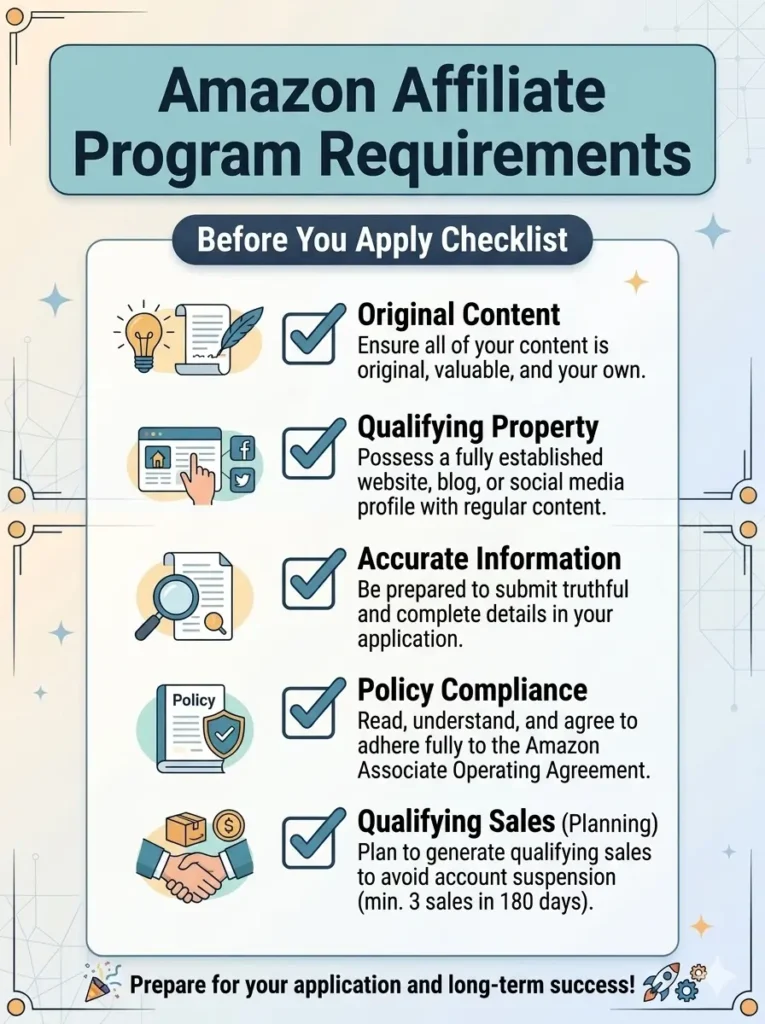
Before applying, make sure your online presence is ready.
| Requirement | What it means |
|---|---|
| Original content | Your site or property should provide genuine value |
| Public accessibility | Submitted properties should be publicly available |
| Accurate information | Account and property information must be complete and accurate |
| Qualifying traffic | Your links must generate legitimate qualifying activity |
| Policy compliance | Your content and promotion must follow Amazon’s rules |
| Affiliate disclosure | You must clearly identify your Amazon relationship |
| Qualifying sales | Amazon currently requires at least three qualifying sales within the first 180 days for application review |
Amazon states that applicants have 180 days to refer a sale, and that at least three qualifying sales are required for review. Personal orders do not qualify.
Amazon also recommends having established original content before applying; its application guidance says a good rule of thumb is at least 10 posts.
What happens if you don’t make three qualifying sales?
If you don’t generate enough qualifying sales within the applicable 180-day period, Amazon says your application can be withdrawn. You can reapply after establishing your site, but Amazon says a rejected Associates ID cannot simply be reinstated.
Do your own purchases count?
No. Amazon’s application review guidance explicitly states that personal orders do not qualify. Don’t attempt to generate commissions through your own purchases or artificial activity.
How to Become an Amazon Affiliate Step by Step?
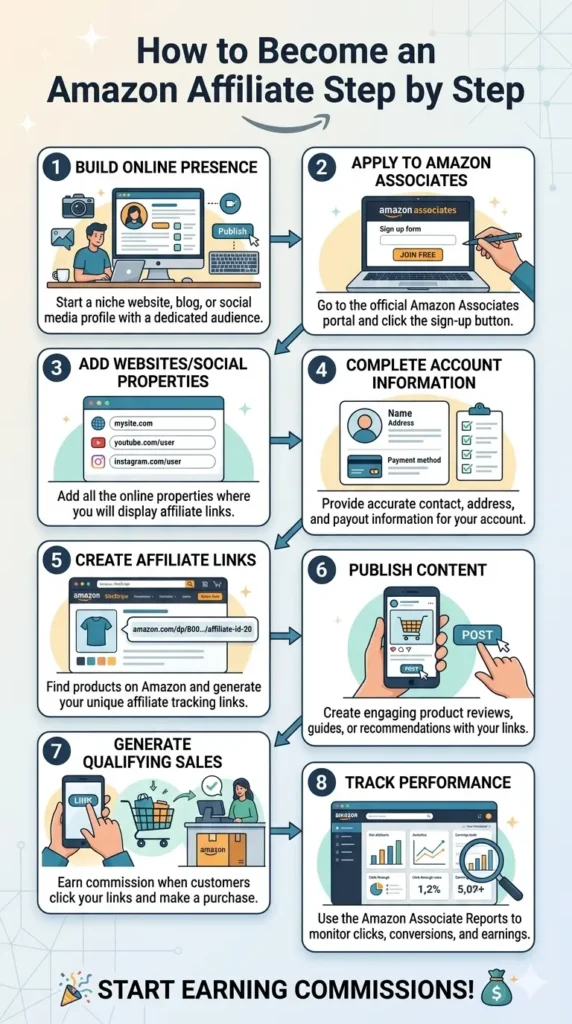
Step 1: Build your online presence
Before applying, create a useful property around a specific topic or audience.
For example:
- Fitness equipment
- Home office products
- Kitchen equipment
- Outdoor gear
- Pet products
- Technology accessories
Don’t build a site consisting of hundreds of thin product pages. Establish useful content that demonstrates your ability to help visitors.
Step 2: Create or use your Amazon account
You’ll need the relevant Amazon account and Associates registration information to begin the application process.
Step 3: Apply to Amazon Associates
Submit your application through Amazon Associates and provide the properties where you intend to use affiliate links.
Be accurate about your websites, social profiles, applications, and traffic sources.
Step 4: Describe your content and audience
Amazon may ask about your content, audience, traffic sources, and the types of products you intend to promote.
Be specific rather than writing generic descriptions.
Step 5: Complete payment and tax information
Provide the requested payment and tax information according to the Amazon marketplace and account you’re using.
Step 6: Create Amazon affiliate links
Once you’re participating, use Amazon’s approved linking tools to generate properly tagged Special Links.
Amazon’s SiteStripe tool allows Associates to create links directly from Amazon pages and includes the Associate ID and tracking ID in generated links.
Step 7: Publish useful content
Create content that naturally helps people make purchasing decisions.
Examples include:
- Product reviews
- Product comparisons
- Buying guides
- “Best” product lists
- Tutorials
- Product alternatives
- Problem-solving guides
Step 8: Generate qualifying sales
Focus on legitimate buyer-intent traffic rather than trying to manipulate clicks or purchases.
Step 9: Monitor performance and compliance
Track which content attracts visitors and clicks, then improve pages based on genuine user behavior.
At the same time, regularly review Amazon’s current policies because the program terms can change. Amazon’s current policies were updated in April 2026.
How to Create Amazon Affiliate Links?
An Amazon affiliate link is a special tagged link that identifies your Associate account and attributes qualifying activity to you.
One of the simplest methods is SiteStripe.
How SiteStripe works?
- Sign in to Amazon using the account associated with your Associates account.
- Open the Amazon product or page you want to promote.
- Use SiteStripe’s link-generation option.
- Select the appropriate link format.
- Copy the generated link.
- Add it to your qualifying content.
Amazon says SiteStripe can create links to Amazon pages and automatically incorporate your Associate ID and tracking ID into generated links.
Don’t manually alter affiliate links in ways that break Amazon’s tracking or policy requirements.
Where Can You Promote Amazon Affiliate Links?
Amazon’s current agreement permits monetization through qualifying properties, but the exact rules vary by promotional method. Always check the current Associates policies before using a particular platform.
| Channel | Potential use | Good content format |
|---|---|---|
| Website | Strong SEO opportunity | Reviews, guides, comparisons |
| Blog | Organic search | Buying guides, tutorials |
| YouTube | Product discovery | Reviews, demonstrations |
| Social media | Audience recommendations | Short-form content |
| Mobile app | Product-related experiences | Relevant recommendations |
| Other approved properties | Depends on Amazon’s rules | Context-specific content |
The key principle is don’t assume that because a platform technically allows links, every Amazon promotional method is automatically permitted.
Amazon’s current participation requirements restrict certain promotional activities and require Associates to follow the applicable agreement and program policies.
How Much Do Amazon Affiliates Make?
There is no guaranteed Amazon affiliate income.
Your potential earnings depend on factors such as:
- Traffic volume
- Buyer intent
- Conversion rate
- Average order value
- Product category
- Applicable commission rate
- Content quality
- Audience trust
A simple way to understand the economics is:
Traffic × Conversion Rate × Qualifying Revenue × Commission Rate = Commission Potential
For example, a page attracting highly targeted visitors who are actively comparing products can be more valuable than a page receiving substantially more traffic from people with no purchasing intent.
Amazon itself does not guarantee any particular level of traffic or commission income.
Amazon Affiliate Commission Rates
Amazon commission rates vary by product category and can change. For the U.S. Associates program, Amazon’s current commission schedule lists different rates for different categories.
| Example category | Current standard rate |
|---|---|
| Luxury Beauty | 10% |
| Digital Music / Physical Music / Handmade / Digital Videos | 5% |
| Physical Books / Kitchen / Automotive | 4.5% |
| Many Fashion and selected device categories | 4% |
| Home / Home Improvement / Toys / Beauty / Sports and other listed categories | 3% |
| PC / PC Components / DVD & Blu-ray | 2.5% |
| Televisions / Digital Video Games | 2% |
| Grocery / Health & Personal Care / Physical Video Games & Consoles | 1% |
| Certain excluded categories | 0% |
Important: Commission schedules are marketplace- and policy-dependent. Check Amazon’s current official commission statement before publishing or making earnings calculations.
How to Get Your First 3 Amazon Affiliate Sales?
For new affiliates, getting the first qualifying sales is often harder than creating an Associates account.
A better strategy is to focus on specific buyer problems rather than publishing generic product lists.
1. Choose products you understand
Your recommendations should be useful and credible.
2. Target long-tail keywords
Instead of:
Best headphones
Target:
Best wireless headphones for small ears under $100
The second query reveals a much clearer problem and purchasing context.
3. Create comparison content
Examples:
- Product A vs Product B
- Best alternatives to Product A
- Product A for beginners
- Is Product A worth it?
4. Create problem-solving content
Instead of constantly saying “buy this product,” help users solve problems that naturally lead to relevant products.
5. Build trust before asking for the click
Explain who a product is suitable for, who should avoid it, important limitations, and relevant alternatives.
6. Don’t manipulate purchases
Amazon prohibits artificial activity, incentivized use of Special Links, and other methods intended to circumvent its commission rules.
How to Build an Amazon Affiliate Website?
A successful Amazon affiliate website shouldn’t be a collection of unrelated product links.
Build topical authority around a focused niche.
For example:
Home coffee niche
→ Coffee makers
→ Espresso machines
→ Coffee grinders
→ Filters
→ Cleaning equipment
→ Brewing guides
→ Product comparisons
→ Buying guides
This creates a connected content ecosystem.
Recommended Amazon affiliate content funnel
| Search intent | Content | Example |
|---|---|---|
| Informational | How-to | How to clean a coffee maker |
| Commercial | Best-of | Best coffee makers for small kitchens |
| Commercial | Comparison | Product A vs Product B |
| Commercial | Review | Product A review |
| Transactional | Buying guide | Best coffee maker under $100 |
This structure lets informational content attract users while commercial pages capture stronger purchasing intent.
Amazon Affiliate SEO Strategy for 2026
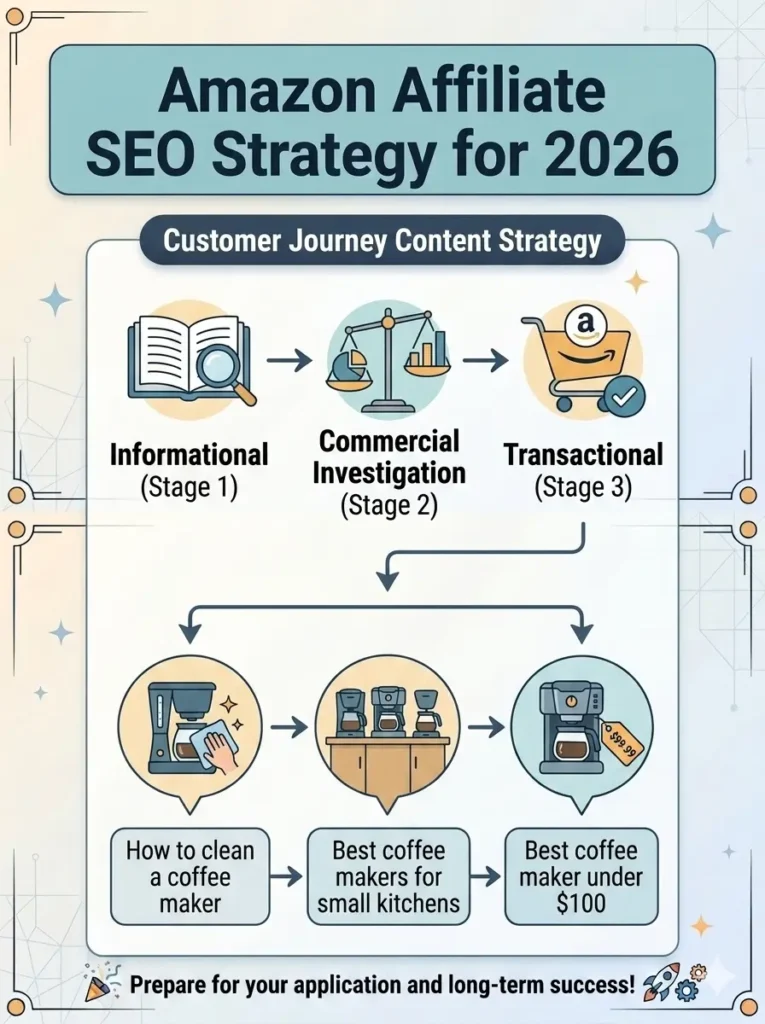
SEO is becoming more than ranking for individual keywords. Your site should demonstrate topical depth, satisfy user intent, and provide information that search engines and AI systems can understand clearly.
Focus on search intent
Look beyond search volume.
A keyword such as:
“coffee maker”
is broad.
A query such as:
“best coffee maker for a small apartment”
shows much stronger commercial intent.
Build topic clusters
Create related content around a central product category rather than publishing random affiliate articles.
Optimize for AI Overviews
Use:
- Direct answers
- Question-based headings
- Concise definitions
- Comparison tables
- Original insights
- Clear entities
- Factual claims
- Authoritative sources
- Structured explanations
For important questions, use an answer-first format:
Question → Direct answer → Explanation → Example/table → Related question
This makes your content easier for users to scan and gives search systems clearly defined information units.
Optimize for AI search
The same principles can support visibility across AI-powered search experiences such as Google AI Overviews, ChatGPT Search, Gemini, and Perplexity.
Don’t stuff these terms into the article. Instead, make your content genuinely useful, factual, well-structured, and easy to interpret.
Amazon Affiliate Rules and Compliance
Compliance is one of the most important parts of Amazon affiliate marketing.
Amazon’s current Operating Agreement requires Associates to comply with its agreement and incorporated program policies. Violations can result in suspension, termination, or withholding of commission income.
Affiliate disclosure
Amazon requires Associates to clearly identify their relationship.
Its current agreement requires the statement:
“As an Amazon Associate I earn from qualifying purchases.”
Amazon also says disclosures near affiliate links should be clear and conspicuous. For social media, Amazon provides additional guidance on identifying yourself as an Associate and disclosing affiliate relationships.
Avoid prohibited practices
Don’t:
- Buy through your own affiliate links
- Artificially generate clicks
- Incentivize people to use Special Links
- Misrepresent your relationship with Amazon
- Use Amazon trademarks outside permitted uses
- Manipulate commission attribution
- Use prohibited paid-search tactics involving Amazon trademarks
- Automatically redirect users to Amazon
- Publish misleading affiliate claims
Amazon’s current policies specifically prohibit artificial clicks, incentives for Special Links, certain paid-search activity, and automatic redirection.
Don’t copy Amazon content carelessly
Amazon provides specific rules around the use of its product content, images, customer reviews, trademarks, and other program materials. Use only the content and tools permitted under the applicable program terms.
Common Amazon Affiliate Mistakes
Avoid these mistakes when starting:
- Applying before publishing useful content
- Creating thin AI-generated product pages
- Copying Amazon product descriptions
- Ignoring affiliate disclosures
- Buying through your own links
- Encouraging artificial clicks
- Targeting only high-volume keywords
- Ignoring buyer intent
- Publishing unrelated products across one site
- Relying entirely on Google traffic
- Making unsupported product claims
- Failing to review Amazon’s updated policies
The goal should be helping users make better purchasing decisions, not simply placing as many affiliate links as possible.
Amazon Associates vs Amazon Influencer Program
These programs are related but shouldn’t be treated as identical.
| Amazon Associates | Amazon Influencer |
|---|---|
| Broad affiliate program | Influencer-focused program |
| Websites and qualifying properties can be used | Designed around eligible influencer activity |
| Affiliate links are central | Influencer content/storefront features may be involved |
| Suitable for publishers and content creators | Particularly relevant to qualifying social creators |
If you’re primarily building an SEO-driven affiliate website, Amazon Associates is the program most directly relevant to your strategy.
International Amazon Affiliate Marketing
Amazon operates Associates programs across multiple marketplaces.
If your audience comes from different countries, consider whether you need country-specific programs, tracking IDs, or link-localization solutions.
Examples include:
- Amazon.com
- Amazon.co.uk
- Amazon.ca
- Amazon.in
- Amazon.de
- Amazon.fr
- Amazon.it
- Amazon.es
- Amazon.com.au
Don’t assume that one Amazon affiliate account or link automatically provides identical attribution across every marketplace. Review the relevant marketplace’s current Associates terms before building an international strategy.
Is Amazon Affiliate Marketing Worth It in 2026?
It can be—but it isn’t a guaranteed passive-income model.
Amazon Associates can make sense if you have:
- Strong SEO skills
- Product expertise
- An established audience
- Useful content
- A focused niche
- The ability to create content that helps people make purchase decisions
It is less attractive if your strategy is simply:
Publish hundreds of low-quality AI articles → add Amazon links → wait for commissions.
Search engines and users increasingly reward useful, trustworthy content. Your competitive advantage should therefore come from expertise, original analysis, helpful comparisons, first-hand experience where available, and strong topical coverage.
Which Amazon affiliate path should you choose?
| Your situation | Best starting approach |
|---|---|
| Strong SEO skills | Niche affiliate website |
| Existing YouTube audience | Product-focused videos |
| Strong social audience | Social content + compliant links |
| Product expertise | Reviews and comparisons |
| Starting from zero | Focused niche + SEO |
| International audience | Multi-market strategy |
Amazon Affiliate Launch Checklist
Before launching, make sure you can check each box:
- ☐ Choose a focused niche
- ☐ Create a qualifying online presence
- ☐ Publish original content
- ☐ Establish your traffic sources
- ☐ Apply to Amazon Associates
- ☐ Provide accurate account information
- ☐ Complete payment and tax information
- ☐ Create properly tagged affiliate links
- ☐ Add the required Amazon disclosure
- ☐ Create buyer-intent content
- ☐ Track clicks and conversions
- ☐ Work toward qualifying sales
- ☐ Review Amazon policies regularly
- ☐ Update outdated product information
- ☐ Expand into related content clusters
Frequently Asked Questions About Becoming an Amazon Affiliate
Can I become an Amazon affiliate without a website?
Potentially, yes. Amazon’s current agreement recognizes several types of qualifying properties, including social media user-generated content and online applications. Your specific property and promotional activity must comply with Amazon’s current policies.
Do I need followers to become an Amazon affiliate?
A large follower count is not the central requirement described in Amazon’s application guidance. Amazon evaluates submitted properties and their content and requires qualifying sales for application review.
How many sales do I need?
Amazon currently requires at least three qualifying sales within the first 180 days for application review. Personal orders don’t qualify.
Can I use Amazon affiliate links on YouTube?
Amazon’s program can be used with qualifying online properties, but you must follow both Amazon’s Associates policies and the rules of the platform you’re using.
Can I use Amazon affiliate links on Pinterest?
Potentially, but don’t assume every type of Pinterest promotion is automatically permitted. Check Amazon’s current policies and Pinterest’s current rules before implementation.
How do I create Amazon affiliate links?
Amazon’s SiteStripe allows Associates to generate tagged links from Amazon pages.
How much does Amazon pay affiliates?
Commission rates depend on the product category and applicable Amazon marketplace. Rates can change, so use Amazon’s current commission schedule when calculating potential earnings.
Why was my Amazon Associates application rejected?
Possible reasons include insufficient original content, unsuitable properties, inaccurate information, or failure to meet Amazon’s program requirements. Amazon says submitted sites should have robust original content and be publicly available.
What happens if I don’t make three sales?
Amazon says an application can be withdrawn if there aren’t enough qualifying sales during the applicable 180-day period. You can reapply after establishing your site.
Can I buy products through my own affiliate links?
No. Personal orders don’t qualify toward Amazon’s application review requirements, and attempting to manipulate commissions can violate the program policies.
What disclosure should Amazon affiliates use?
Amazon’s Operating Agreement requires Associates to clearly identify themselves with the statement “As an Amazon Associate I earn from qualifying purchases.” Amazon also recommends clear, conspicuous link-level disclosures.
Can beginners make money with Amazon Associates?
Yes, beginners can potentially earn commissions, but income isn’t guaranteed. Success depends on factors including content quality, traffic, purchasing intent, conversion rates, product categories, and applicable commission rates.
Is Amazon Associates the same as Amazon Influencer?
No. They are related but distinct programs with different participation models and features.
Can I use other affiliate programs with Amazon Associates?
You may be able to participate in other affiliate programs, but you must comply with each program’s terms and avoid manipulating or combining attribution in ways prohibited by Amazon.
Is Amazon affiliate marketing worth it in 2026?
It can be worthwhile for publishers and creators who can consistently produce useful, trustworthy content and attract relevant audiences. It is not a guaranteed passive-income strategy.
Final Takeaway
Learning how to become an Amazon affiliate is relatively straightforward. Building a sustainable Amazon affiliate business is harder.
The strongest approach in 2026 is to combine:
Focused niche + original content + search intent + buyer-focused topics + SEO + trustworthy recommendations + compliant affiliate links + ongoing content improvement.
Don’t build an affiliate site simply to place links. Build a resource that helps people research, compare, understand, and confidently choose products.
That approach gives you a stronger foundation for traditional search rankings while also making your content easier for AI-powered search systems to understand, extract, and potentially cite.
Always check Amazon’s current Associates Operating Agreement, participation requirements, commission schedule, and program policies immediately before publishing or changing your affiliate strategy, because Amazon can update its terms and rates.