Three Pillars of SEO: Technical, On-Page & Off-Page SEO Explained
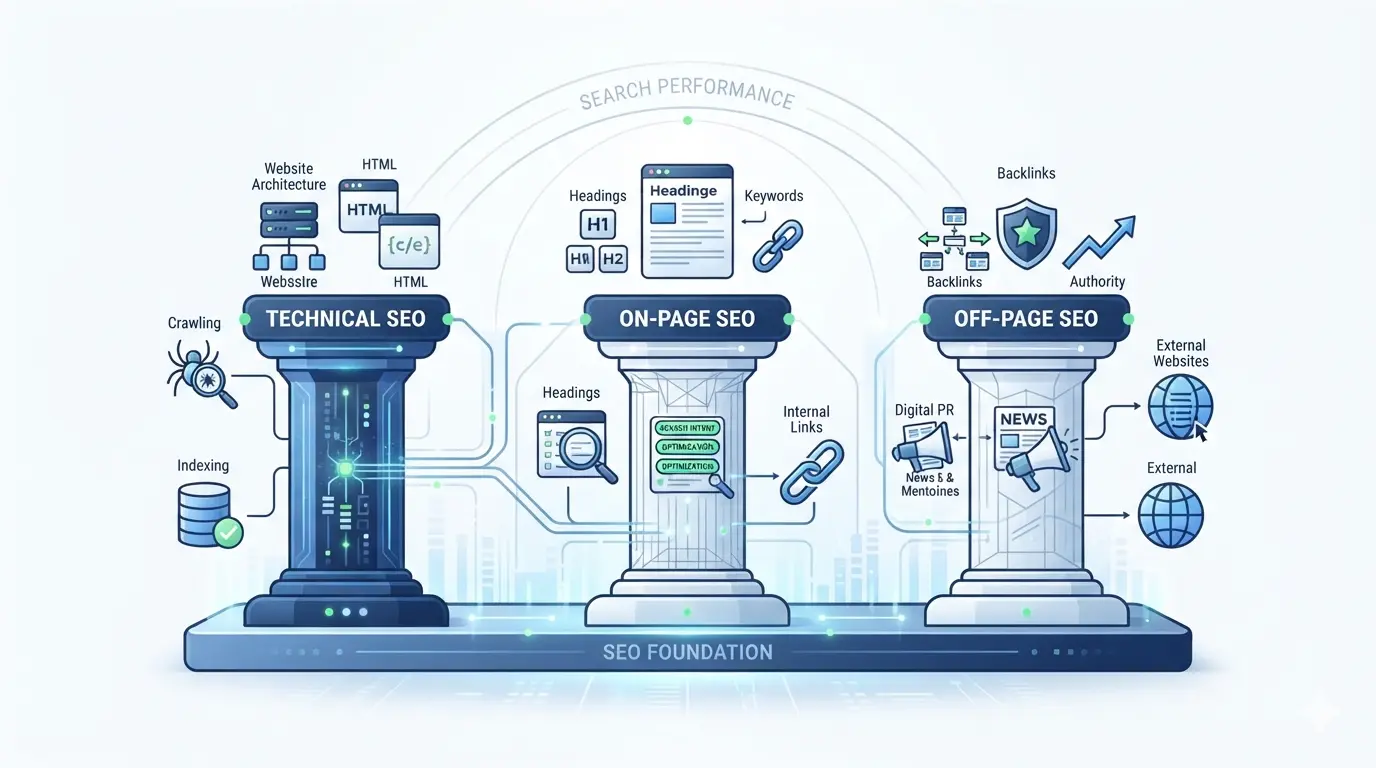
The three pillars of SEO are technical SEO, on-page SEO, and off-page SEO.
Each pillar solves a different problem:
- Technical SEO helps search engines find, crawl, render, and index your website.
- On-page SEO helps search engines and users understand your content and its relevance to a search query.
- Off-page SEO builds authority, reputation, and external trust through backlinks, mentions, digital PR, reviews, and other signals outside your website.
Technical SEO makes your website accessible. On-page SEO makes it relevant. Off-page SEO makes it authoritative.
You need all three because rankings rarely depend on a single optimization.
A website may have excellent content but struggle because important pages cannot be indexed. Another website may be technically perfect but have weak content. A third may earn backlinks but send that authority to pages that do not adequately satisfy search intent.
The strongest SEO strategy connects all three.
Three Pillars of SEO: Technical, On-Page and Off-Page at a Glance
| SEO Pillar | Primary Purpose | Typical Activities | Main Question |
|---|---|---|---|
| Technical SEO | Accessibility and performance | Crawling, indexing, site architecture, Core Web Vitals, HTTPS, canonicalization, sitemaps | Can search engines properly access and process the website? |
| On-Page SEO | Relevance and usefulness | Content, search intent, titles, headings, internal links, images, entities | Is this page a strong answer to the query? |
| Off-Page SEO | Authority and reputation | Backlinks, digital PR, brand mentions, citations, reviews | Does the wider web provide evidence that this site or page is credible? |
This distinction makes the three pillars of SEO technical, on-page, off-page framework much easier to understand.
They are not three competing SEO strategies. They are three connected layers of the same organic search strategy.
Pillar 1: Technical SEO
What Is Technical SEO?
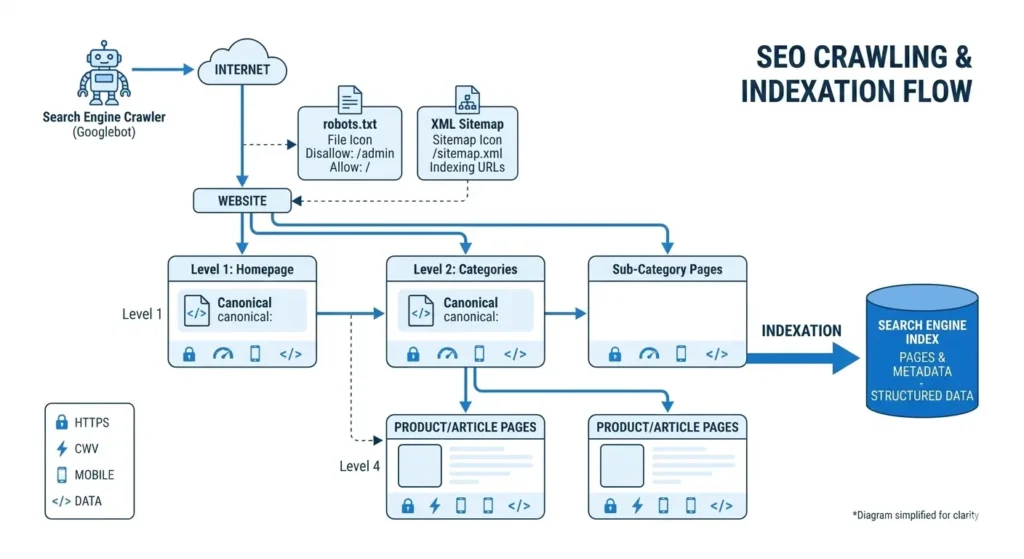
Technical SEO is the process of improving a website’s technical infrastructure so search engines can efficiently discover, crawl, render, understand, and index its pages.
Google explains that crawling and indexing determine how its systems find and process content, while technical elements such as internal links, URL structure, canonicalization, robots directives and sitemaps can affect that process.
Think of your website as a library.
Great articles are the books. On-page SEO correctly labels and organizes those books.
But technical SEO ensures the library is open, the doors work, the shelves are accessible, and the catalog points visitors to the right place.
Without that foundation, excellent content may remain difficult to discover.
Important Elements of Technical SEO
1. Crawlability
Search engines need a path to your important URLs.
Common crawlability issues include:
- Important pages blocked in robots.txt
- Broken internal links
- Orphan pages
- Poor site architecture
- JavaScript-generated links that crawlers cannot reliably follow
- Excessive unnecessary URLs
Google specifically recommends crawlable HTML links with useful anchor text to help its systems discover and understand pages.
2. Indexability
Being crawled does not automatically mean that a URL will appear in Google’s index.
Technical SEO should review:
- noindex directives
- Canonical tags
- Duplicate URLs
- HTTP status codes
- Redirect chains
- Soft 404s
- Parameter URLs
- Faceted navigation
- Sitemap accuracy
The objective is simple: the URLs you want ranking should be easy for search engines to identify as the preferred, indexable versions.
3. Website Architecture
Your site structure should make relationships between pages obvious.
A logical architecture normally moves from broad topics to more specific pages:
Home → Main Service → Specific Service → Supporting Resource
For example:
SEO Services → Technical SEO → Technical SEO Audit
This helps users navigate the website and gives crawlers clear paths between related content.
4. XML Sitemap
An XML sitemap can help search engines discover important URLs, particularly on larger, newer, or more complex websites.
However, a sitemap is not a replacement for proper internal linking.
5. Mobile Optimization
Google uses the mobile version of a site’s content for mobile-first indexing and ranking, so important content, links, images, metadata, and structured information should remain available on mobile.
6. Page Experience and Core Web Vitals
Performance matters both to users and SEO.
Google’s Core Web Vitals evaluate real-world aspects of:
- Loading performance
- Interactivity
- Visual stability
Google recommends good Core Web Vitals as part of providing a strong overall page experience, while also making clear that achieving perfect scores alone does not guarantee top rankings.
That distinction is important.
Page speed optimization supports SEO; it does not replace relevance, useful content or authority.
7. HTTPS and Website Security
Your website should use HTTPS and provide a secure browsing experience.
Security also supports user confidence, particularly for ecommerce, lead-generation and account-based websites.
8. Structured Data
Structured data gives search engines standardized information about eligible content types.
Depending on the website, that may include information about:
- Products
- Organizations
- Breadcrumbs
- Articles
- Local businesses
- Events
- Videos
- Recipes
Structured data can support search appearance and eligibility for certain rich results, but it does not make weak content rank simply because schema has been installed.
Pillar 2: On-Page SEO
What Is On-Page SEO?
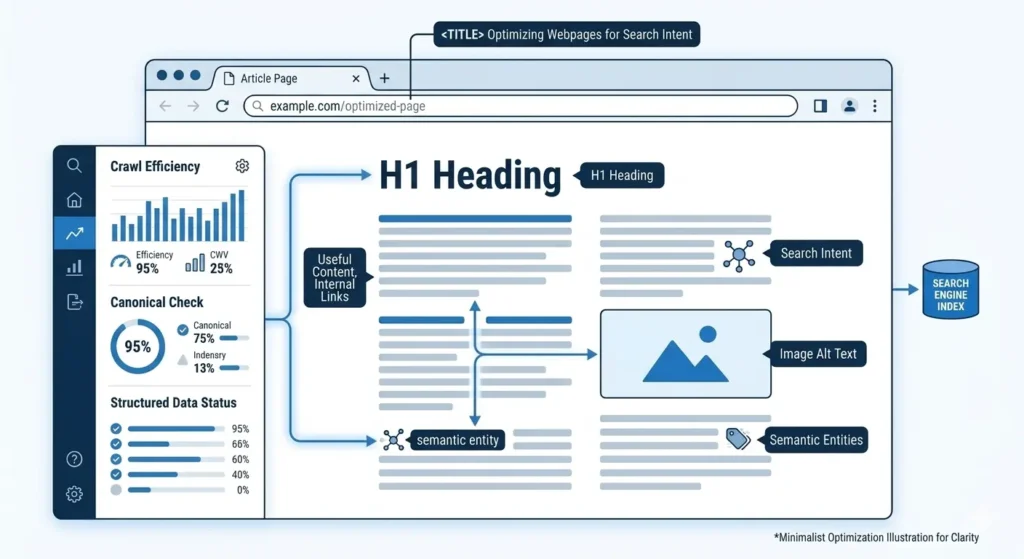
On-page SEO is the optimization of the content and page-level elements you control directly on your website to better satisfy search intent and communicate relevance.
This includes much more than placing a keyword in the title.
Modern on-page SEO involves:
- Understanding search intent
- Answering the searcher’s actual problem
- Creating useful content
- Covering relevant subtopics and entities
- Structuring information logically
- Optimizing title tags and headings
- Improving internal linking
- Optimizing images
- Creating clear URLs
- Improving content usability
Google recommends creating helpful, reliable, people-first content that gives users enough information to achieve their goals rather than creating pages primarily to manipulate rankings.
Important Elements of On-Page SEO
1. Search Intent
Before optimizing keywords, understand why the person searched.
Most searches broadly fall into intents such as:
- Informational
- Commercial investigation
- Transactional
- Navigational
- Local
For example, someone searching:
“three pillars of SEO”
probably wants education.
Someone searching:
“technical SEO services”
is more commercially oriented.
Someone searching:
“technical SEO agency near me”
has stronger service and local intent.
A page needs to match the intent behind its target query rather than simply mention the query repeatedly.
2. Useful and Complete Content
Content should answer the core question quickly and then provide the depth needed by someone who wants to learn more.
For this article, the direct answer appeared near the beginning:
Technical + On-page + Off-page SEO.
The rest of the page then expands that answer.
That structure works well for humans because impatient readers receive an immediate answer while deeper readers can continue.
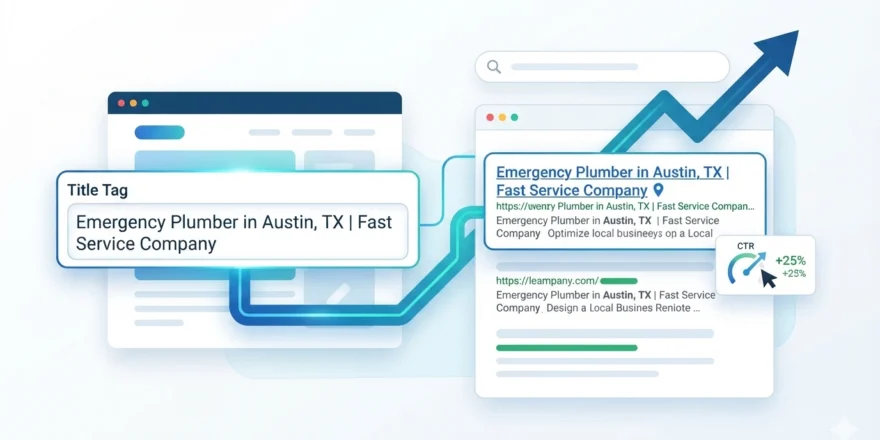
3. Title Tag
Your title should accurately describe the page and make the search result worth considering.
Google can use the HTML title and other prominent text when generating a search-result title, and recommends clear, concise, descriptive titles.
For example:
Three Pillars of SEO: Technical, On-Page & Off-Page
is clearer than:
Everything You Need to Know About SEO
4. Heading Structure
Use headings to make information scannable.
A logical hierarchy may be:
- H1: Three Pillars of SEO
- H2: Technical SEO
- H2: On-Page SEO
- H2: Off-Page SEO
- H2: Comparison
- H2: FAQs
Then use H3s for individual concepts.
Headings should help readers navigate—not become containers for forced keywords.
5. Semantic SEO and Entity Coverage
A strong page should cover the important concepts naturally associated with its topic.
For the three pillars of SEO, relevant entities and concepts include:
Google Search, Googlebot, crawling, indexing, search intent, backlinks, internal links, Core Web Vitals, XML sitemaps, canonical tags, robots.txt, HTTPS, title tags, headings, structured data, site architecture, digital PR, anchor text, Search Console, user experience and authority.
This is more useful than repeating “three pillars of SEO” dozens of times.
Google’s language systems can understand synonyms and different ways of expressing related ideas, so exact-match repetition is unnecessary.
6. Internal Linking
Internal links connect related content and help users continue their journey.
For example, this article could link naturally to separate pages about:
- Technical SEO services
- On-page SEO services
- Off-page SEO
- SEO audits
- Keyword research
- Link building
- Content writing
- Local SEO
Google also uses links to discover pages and gather context about linked content.
7. Image Optimization
Images can improve understanding, especially for processes and comparisons.
Useful assets for this page could include:
- A three-pillar SEO diagram
- Technical vs on-page vs off-page infographic
- SEO workflow graphic
- Technical SEO audit screenshot
Use descriptive filenames and appropriate alt text that explains the image rather than stuffing keywords.
Pillar 3: Off-Page SEO
What Is Off-Page SEO?
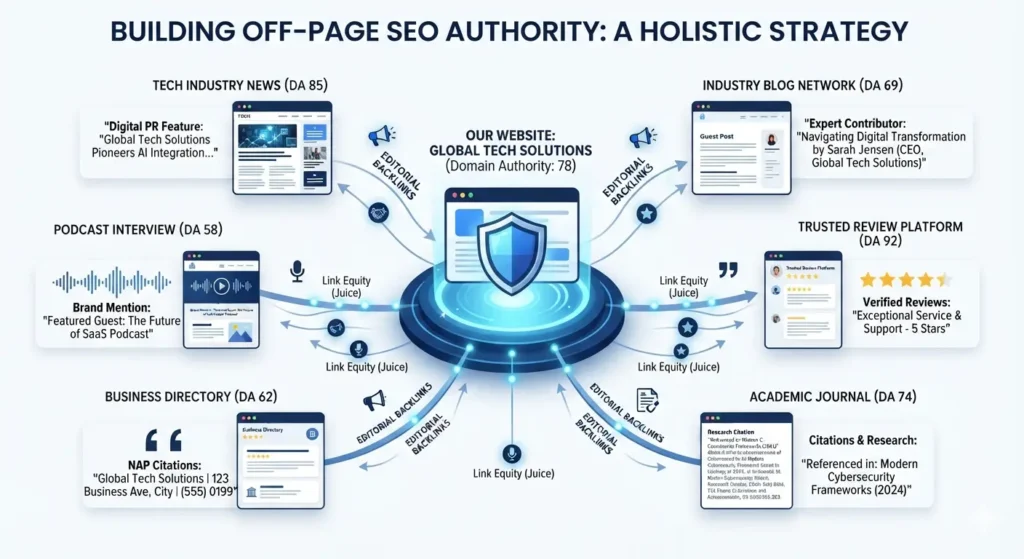
Off-page SEO refers to activities and signals outside your own website that help establish its authority, reputation and prominence.
Backlinks are the best-known part of off-page SEO, but they are not the entire discipline.
Off-page SEO may involve:
- Editorial backlinks
- Digital PR
- Linkable assets
- Industry coverage
- Relevant business citations
- Expert contributions
- Brand mentions
- Partnerships
- Online reputation
- Reviews, particularly for local businesses
Google confirms that links are among the signals its systems can use when determining page relevance and discovering new pages.
The key word, however, is quality.
Off-page SEO is not a competition to acquire the largest possible number of backlinks.
What Makes a Backlink Valuable?
A useful backlink is generally more attractive when it has several qualities:
Relevance
A link from a website related to your business or topic typically makes more contextual sense than a random unrelated link.
Editorial Value
Links earned because another publisher genuinely wants to reference your page are fundamentally different from links created solely to manipulate rankings.
Context
The surrounding content should make the reason for linking understandable.
Placement
A meaningful link within relevant editorial content can provide more context to users than a random sitewide or unrelated link.
Natural Anchor Text
Anchor text should describe the linked resource naturally instead of repeating an exact commercial keyword unnaturally across hundreds of backlinks.
Google’s spam policies explicitly prohibit link-building practices created primarily to manipulate search rankings.
Therefore, sustainable off-page SEO should focus on earning legitimate authority, not manufacturing artificial signals.
Technical SEO vs On-Page SEO: What’s the Difference?
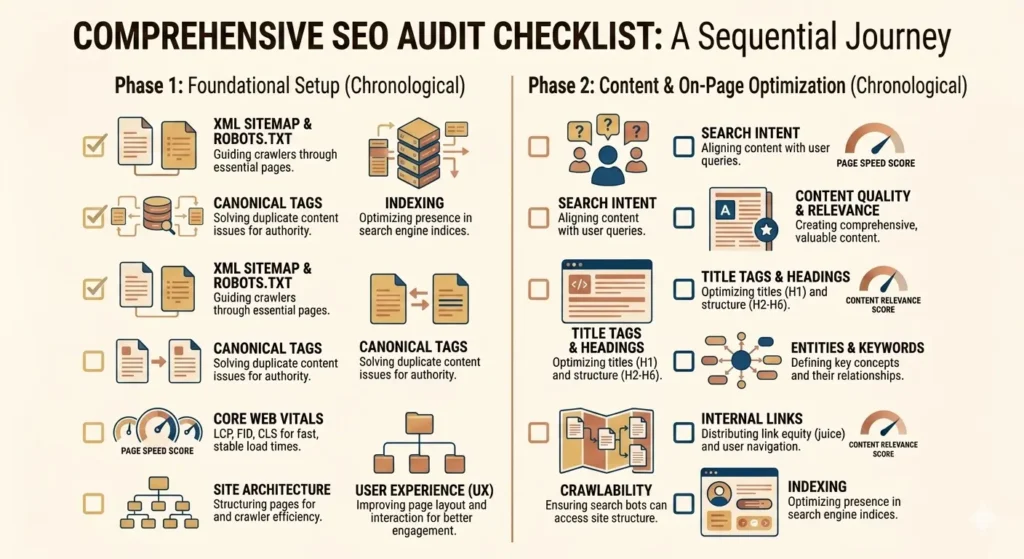
The technical SEO vs on-page SEO question causes confusion because both happen on your website.
The easiest distinction is:
Technical SEO optimizes how the site can be accessed and processed. On-page SEO optimizes what a page communicates and how well it satisfies the searcher.
| Technical SEO | On-Page SEO |
|---|---|
| Crawlability | Search intent |
| Indexability | Content quality |
| Robots directives | Keywords and entities |
| Canonicals | Titles |
| XML sitemaps | Headings |
| Core Web Vitals | Copy |
| HTTPS | Images and alt text |
| Rendering | Internal linking strategy |
| Site architecture | Topical relevance |
Some activities overlap.
For example, internal linking influences both site architecture and page relevance.
Structured data can also sit near the boundary between technical and on-page optimization.
SEO categories are useful for organizing work, but they are not rigid walls.
On-Page SEO vs Off-Page SEO
The easiest way to understand off-page SEO vs on-page SEO is by considering control.
On-page SEO:
You directly control the page.
You can edit:
- Content
- Titles
- Headers
- URLs
- Images
- Internal links
- Page structure
Off-page SEO:
The signals exist beyond your website.
You can influence them, but you do not completely control legitimate editorial decisions by other websites.
Examples include:
- Backlinks
- Publisher coverage
- External mentions
- Reviews
- Industry references
A useful shorthand is:
On-page SEO communicates what you know. Off-page SEO provides external evidence that others consider you worth referencing.
Off-Site SEO vs On-Site SEO
On-site SEO is a broader term that can include both technical SEO and on-page SEO because both happen within your website.
Off-site SEO is generally another term for off-page SEO.
Therefore:
On-site SEO = Technical SEO + On-page SEO
while:
Off-site SEO = External authority and reputation building
This is useful when agencies or SEO tools use different terminology for essentially related concepts.
Three Pillars of SEO: Content, Links and Technical SEO
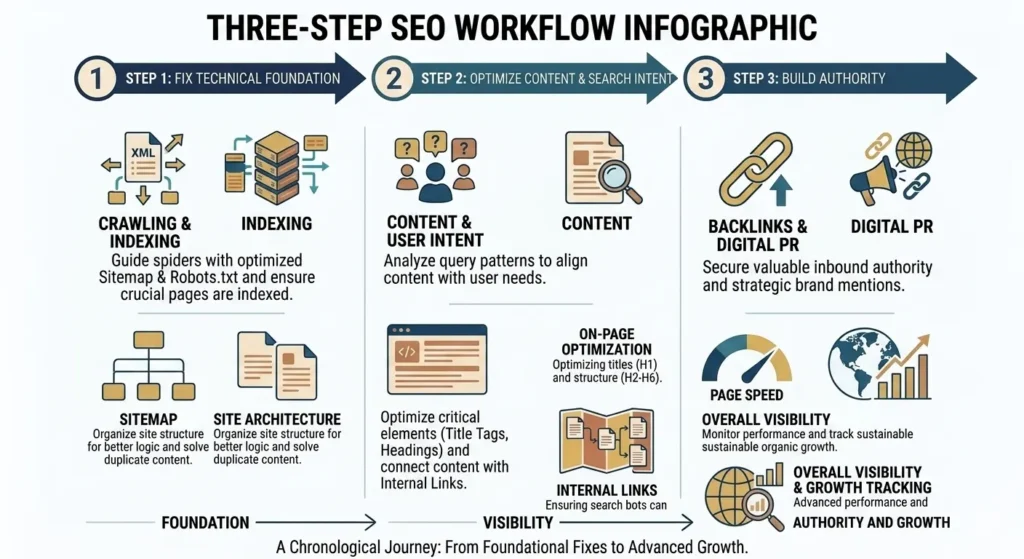
You may also see the framework described as:
Content + Links + Technical SEO
rather than:
On-page + Off-page + Technical SEO
The ideas largely overlap.
| Model 1 | Model 2 |
|---|---|
| On-page SEO | Content |
| Off-page SEO | Links/authority |
| Technical SEO | Technical SEO |
The three pillars of SEO content, links, technical model is simply a more compact way of describing much of the same work.
However, the on-page/off-page/technical framework is broader because:
- On-page includes more than content.
- Off-page includes more than backlinks.
For example, on-page SEO includes metadata and internal linking, while off-page SEO may include digital PR, reviews and reputation building.
What Does “3 Kings of SEO” Mean?
There is no universal industry definition of the “3 Kings of SEO.”
That phrase is used in different ways.
Some marketers use 3 Kings of SEO to mean:
- Content
- Links
- Technical SEO
Others have used the phrase for particular page elements such as:
- Title tag
- H1
- URL
And another interpretation describes the business, searchers and search engines as the three “kings.”
Because the terminology is inconsistent, it is better to define exactly what you mean rather than assume every SEO professional uses 3 kings SEO in the same way.
For strategic SEO planning, the clearer framework remains:
Technical SEO + On-page SEO + Off-page SEO.
What About the Four Pillars of SEO?
You may also encounter articles discussing the four pillars of SEO.
There is no contradiction.
Some frameworks separate content from on-page optimization, resulting in:
- Technical SEO
- On-page SEO
- Content
- Off-page SEO
Others add user experience or local SEO as a fourth pillar.
These frameworks are organizational models—not official categories required by Google.
The important question is not whether you call SEO a three-pillar or four-pillar system.
The important question is whether your strategy successfully addresses:
accessibility + relevance + usefulness + authority + user experience.
A Practical 3-Step Marketing SEO Strategy
If you want a simple 3-step marketing SEO process, use the pillars in the following sequence.
Step 1: Make the Website Search-Accessible
First, eliminate technical obstacles.
Check:
- Can Google crawl important URLs?
- Are key pages indexable?
- Are canonical tags correct?
- Are important pages internally linked?
- Is the mobile experience functional?
- Are major Core Web Vitals problems present?
- Is HTTPS working?
- Are redirects and status codes correct?
There is little value in promoting a page that search engines cannot properly process.
Step 2: Build the Best Page for the Search Intent
Next, strengthen on-page SEO.
Ask:
- What does the searcher really want?
- What type of page is ranking?
- Have we answered the main question immediately?
- What follow-up questions will the reader have?
- Have we covered the important entities?
- Is the content easier to understand than competing pages?
- Are titles and headings descriptive?
- Are relevant internal links included?
- Does the page offer something genuinely useful or original?
Google’s people-first guidance specifically encourages substantial content that provides value beyond what other search results already offer.
Step 3: Build Authority Around the Page
Once the page deserves attention, promote it.
Possible tactics include:
- Digital PR
- Expert outreach
- Original research
- Statistics pages
- Free tools
- Templates
- Industry guides
- Data studies
- Guest expertise
- Partnerships
- Resource-page outreach
- Local citations where relevant
The objective should be to create something worth referencing and then make relevant audiences aware of it.
Which SEO Pillar Should You Work on First?
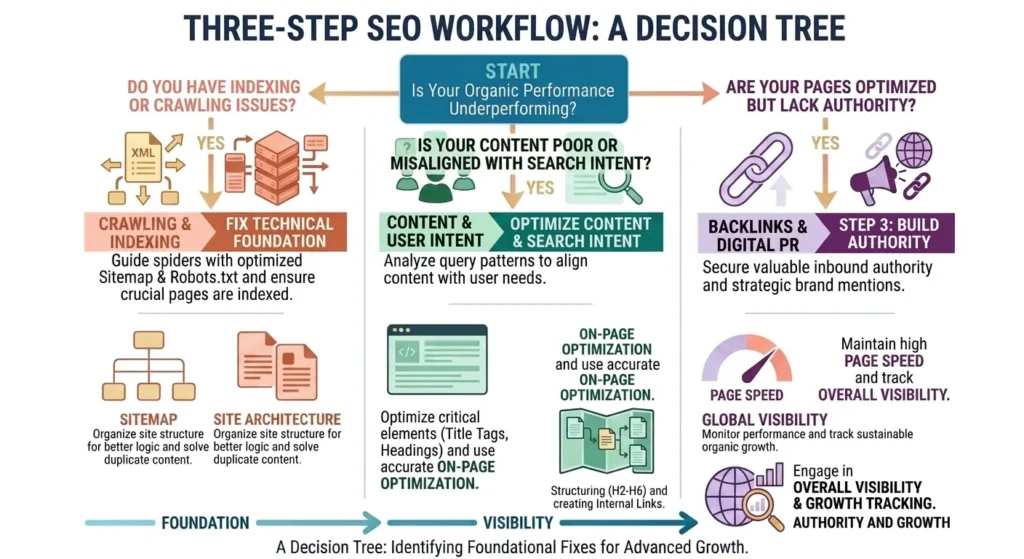
There is no universal answer because the biggest constraint differs by website.
Use this diagnosis.
Start with technical SEO if:
- Important pages are not indexed
- Search Console reports major crawling problems
- A migration created redirects or canonical issues
- The website has severe performance problems
- Important content is difficult to reach
- JavaScript prevents essential content from rendering correctly
Start with on-page SEO if:
- Pages are indexed but target the wrong intent
- Content is thin or generic
- Pages have overlapping keyword targets
- Titles and headings poorly describe the content
- Competitors answer the query significantly better
- Internal linking is weak
Prioritize off-page SEO if:
- Your technical foundation is healthy
- Your pages match intent well
- Content quality is competitive
- Rankings consistently stall beneath more authoritative competitors
- Your site has little relevant external recognition
In practice, mature SEO campaigns work on all three pillars continually while prioritizing whichever constraint is limiting growth most.
How the Three SEO Pillars Work Together?
Consider a website offering accounting services.
The business creates an excellent guide:
“Small Business Tax Deductions Explained”
Technical SEO ensures:
- The URL is crawlable
- It is indexable
- Canonicals are correct
- The page loads reliably
- It works on mobile
- Internal links help crawlers find it
On-page SEO ensures:
- The page matches informational search intent
- The title clearly describes the topic
- Important tax concepts are explained
- Questions are answered clearly
- Related services are internally linked
- Content is readable and useful
Off-page SEO strengthens:
- Relevant publications reference the guide
- Business organizations mention it
- Journalists cite original insights
- Other websites link to it as a useful resource
The result is not three independent campaigns.
It is one system:
Technical accessibility → Content relevance → External authority.
How to Measure Each SEO Pillar?
SEO should be measured by outcomes rather than completed checklists.
Technical SEO KPIs
Monitor metrics such as:
- Indexed vs intended URLs
- Crawl/indexing errors
- Core Web Vitals
- Server errors
- Broken internal links
- Redirect problems
- Search Console coverage trends
On-Page SEO KPIs
Monitor:
- Organic impressions
- Search queries
- Rankings
- Organic clicks
- Landing-page engagement
- Conversion rate
- Internal-link coverage
- Performance across target topic clusters
Off-Page SEO KPIs
Monitor:
- Relevant referring domains
- Links to priority pages
- Quality and relevance of new links
- Brand mentions
- Referral traffic
- Digital PR placements
- Local reviews/citations when relevant
Do not let a single third-party metric become the goal.
The real objective is qualified organic visibility that contributes to leads, sales, subscribers, bookings or another meaningful business result.
The Three Pillars of SEO in the AI Search Era
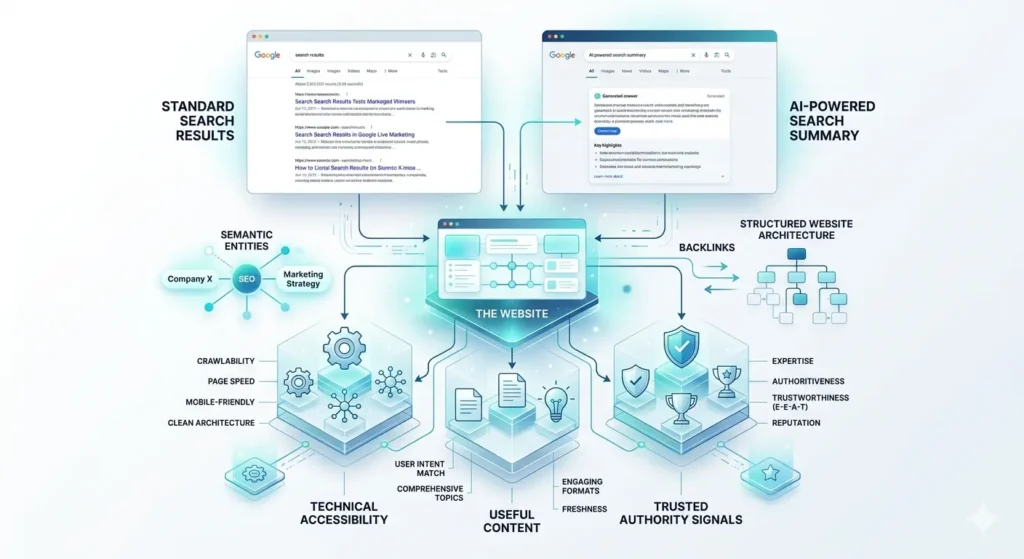
AI search does not make the foundations of SEO obsolete.
Google’s current guidance for AI Overviews and AI Mode says its generative search experiences continue to rely on core Search ranking and quality systems. Google specifically recommends maintaining a clear technical foundation and producing unique, valuable, people-first content.
That means the same three pillars continue to matter.
Technical SEO for AI Search
Your information still needs to be accessible and indexable before search systems can reliably retrieve it.
Focus on:
- Crawlability
- Indexability
- Internal linking
- Clear site architecture
- Accessible main content
- Mobile usability
- Page performance
On-Page SEO for AI Search
Make answers easy for both humans and systems to interpret.
Useful practices include:
- Give direct answers to direct questions
- Use descriptive headings
- Clearly define important entities
- Explain relationships between concepts
- Include useful examples
- Add first-hand expertise where available
- Provide original analysis
- Keep claims accurate
- Support important claims with trustworthy sources
That does not mean writing robotic one-sentence “AI chunks.”
Google explicitly says there is no requirement to break pages into tiny chunks or rewrite content in a special style purely for generative AI search.
Off-Page SEO for AI Search
Independent evidence around your brand remains valuable.
Build genuine:
- Editorial coverage
- Expert mentions
- Industry references
- Useful backlinks
- Reviews
- Research citations
- Brand authority
Avoid trying to manufacture large numbers of artificial mentions simply because someone claims it is a “GEO hack.” Google’s current guidance specifically warns against pursuing inauthentic mentions for generative search visibility.
SEO Marketing Strategies to Compete for the First Page
If your goal is to improve first-page visibility, do not look for one secret tactic.
Use the pillars as a prioritization system.
1. Remove Technical Barriers
Make sure valuable pages can actually compete.
2. Map One Clear Intent to Each Important Page
Avoid multiple weak pages trying to rank for essentially the same purpose.
3. Build Topic Depth
Create supporting resources around your main commercial pages.
4. Improve Internal Links
Connect supporting content to priority pages using useful contextual anchors.
5. Refresh Underperforming Content
Do not publish endlessly while allowing older valuable pages to become outdated.
6. Create Link-Worthy Assets
Original research, calculators, templates, statistics and genuinely useful guides are easier to promote than commodity blog content.
7. Earn Relevant Authority
Focus on websites and audiences connected to your industry rather than pursuing arbitrary backlink counts.
8. Measure Business Outcomes
Traffic without conversions is not the final goal.
Connect organic search performance to:
- Leads
- Sales
- Revenue
- Bookings
- Sign-ups
- Qualified inquiries
Common Mistakes Across the Three SEO Pillars
Mistake 1: Treating SEO as Keyword Placement
Adding the target keyword repeatedly does not solve technical, intent, quality or authority problems.
Mistake 2: Publishing Content Without Checking Indexation
A page that cannot be indexed cannot deliver the organic visibility you expect.
Mistake 3: Fixing Technical SEO and Assuming SEO Is Finished
A technically healthy site still needs useful pages and authority.
Mistake 4: Buying Large Numbers of Low-Quality Links
Manipulative link building can violate Google’s spam policies.
Mistake 5: Chasing Every Keyword Variation
You do not need separate paragraphs for every wording such as:
- on page vs technical SEO
- technical SEO vs on page SEO
- technical on page SEO
- on-page technical SEO
When they represent the same intent, answer the underlying question comprehensively.
Mistake 6: Writing for Search Engines Before Users
The page should help the visitor accomplish something.
If rankings improve but visitors immediately leave because the content is repetitive, vague or frustrating, the SEO strategy has missed its purpose.
Need Help With All Three Pillars of SEO?
Knowing what technical, on-page and off-page SEO mean is easier than diagnosing which one is actually limiting your website.
TVS offer SEO services covering the complete three-pillar framework, including:
- Technical SEO audits
- On-page SEO optimization
- SEO content strategy and writing
- Keyword and search-intent research
- Internal linking optimization
- Off-page SEO and authority building
- Competitor and SERP analysis
- SEO strategies designed for traditional and AI-powered search
Want to know why your website is not ranking as strongly as it should? Contact us for an SEO audit and we can identify whether the biggest opportunity is technical, on-page, off-page—or a combination of all three.
Frequently Asked Questions About the Three Pillars of SEO
What are the three pillars of SEO?
The three pillars of SEO are technical SEO, on-page SEO, and off-page SEO. Technical SEO helps search engines access and process a website, on-page SEO improves relevance and usefulness, and off-page SEO develops external authority and reputation.
What are the three most important pieces of SEO marketing?
A practical way to describe the three most important pieces is technical accessibility, content relevance, and external authority. These correspond closely with technical, on-page and off-page SEO.
What is technical SEO vs on-page SEO?
Technical SEO focuses mainly on website infrastructure, crawlability, indexability, rendering and performance. On-page SEO focuses primarily on content, search intent, headings, titles, internal linking and page-level relevance.
What is on-page vs off-page SEO?
On-page SEO consists of optimizations made directly to your website and its pages. Off-page SEO involves external authority and reputation signals such as backlinks, digital PR, relevant mentions and reviews.
Is technical SEO part of on-page SEO?
Some people group technical SEO under on-site SEO, but SEO professionals commonly separate technical and on-page SEO because they address different problems. Technical SEO concerns website infrastructure and search-engine accessibility, while on-page SEO focuses more heavily on content relevance and page-level optimization.
What are the three pillars of SEO: content, links and technical?
This is an alternative version of the same basic framework. Content broadly maps to on-page SEO, links to off-page SEO, and technical remains technical SEO. The on-page/off-page/technical model is slightly broader because on-page SEO includes more than content and off-page SEO includes more than backlinks.
What are the 3 Kings of SEO?
“3 Kings of SEO” does not have one standardized meaning. Some marketers use it for content, links and technical SEO, while others use it for page elements such as the title, H1 and URL. Always check how the author is defining the phrase.
What are the four pillars of SEO?
One common four-pillar model is technical SEO, on-page SEO, content and off-page SEO. Other models separate user experience or local SEO instead. The number of categories matters less than ensuring your strategy covers technical accessibility, useful content, relevance, authority and user experience.
Which SEO pillar is most important?
There is no universally most important pillar. Technical SEO becomes the priority when crawling or indexing is broken. On-page SEO becomes critical when content does not satisfy search intent. Off-page SEO often becomes more important when a technically sound, high-quality site lacks sufficient authority to compete in its market.
Can you rank without off-page SEO?
It can happen, particularly for less competitive or highly specific queries, but competitive markets often require stronger external authority. The amount of off-page work needed depends on the query, competitors, website, topic and existing authority.
Can good backlinks overcome poor content?
Not reliably. Backlinks may strengthen authority, but users still need a relevant and useful destination. A sustainable SEO strategy improves the page being promoted rather than expecting links to compensate for a poor answer.
Is SEO still important for AI Overviews and AI search?
Yes. Google states that its generative Search features remain connected to its core Search ranking and quality systems. Strong technical foundations, original and useful content, good page experience, and genuine authority therefore remain relevant for visibility in both conventional search and Google’s generative search experiences.
Final Takeaway
The three pillars of SEO—technical, on-page and off-page SEO—work as one connected system.
Technical SEO answers:
Can search engines access and process the website?
On-page SEO answers:
Does this page satisfy the searcher’s intent?
Off-page SEO answers:
What evidence exists beyond this website that supports its authority and reputation?
If one pillar is weak, it can limit the value created by the other two.
So instead of asking whether you should choose technical SEO vs on-page SEO vs off-page SEO, ask a better question:
Which pillar is currently preventing my website from earning more qualified organic visibility?
Find that constraint, fix it, measure the outcome, and continue strengthening all three.
Need expert help identifying that constraint? TVS provide technical SEO, on-page SEO, content optimization and off-page SEO services designed to turn organic visibility into measurable business growth.