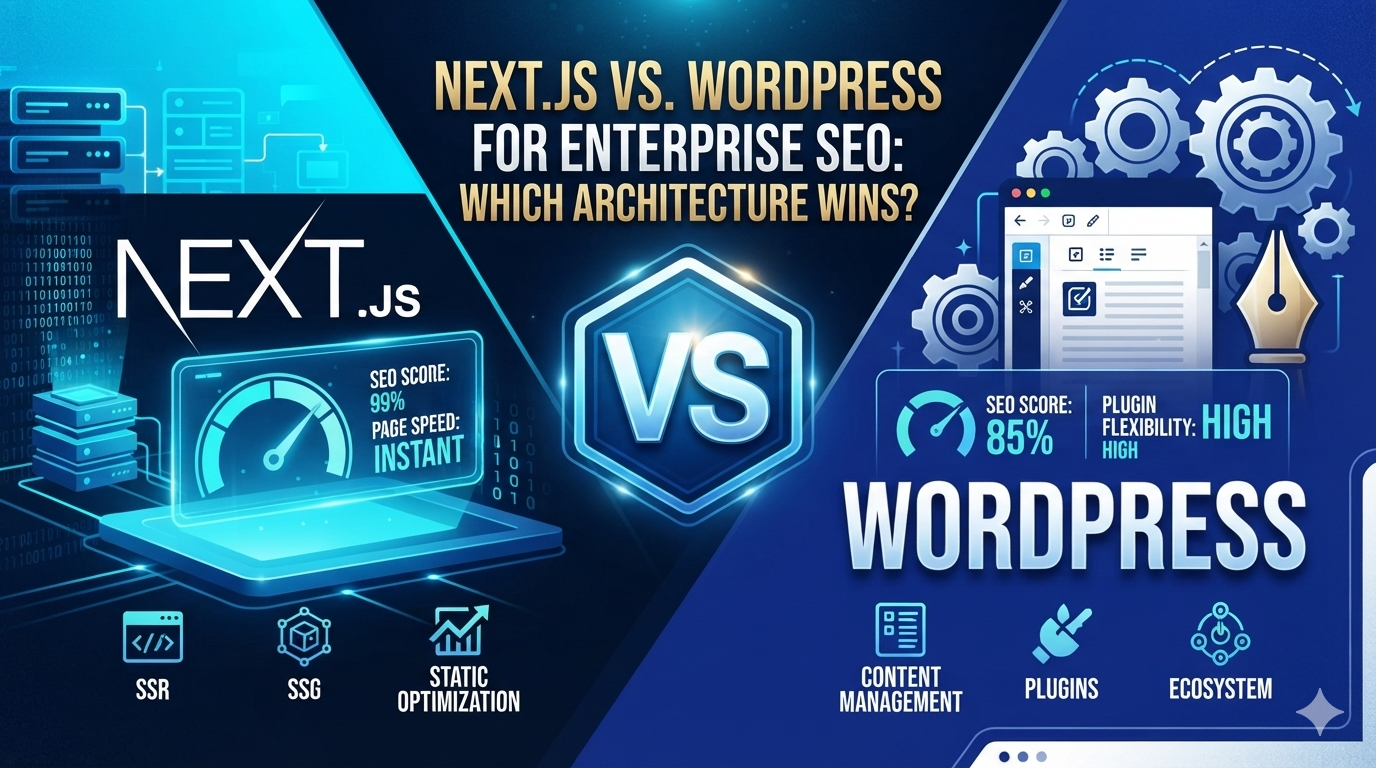
Next.js vs. WordPress for Enterprise SEO: Which Architecture Wins?
Next.js wins on technical execution, speed, and advanced security, while WordPress wins on out-of-the-box content management and ease of deployment. For enterprise brands where PageSpeed and Core Web Vitals act as search ranking tiebreakers, a properly optimized Next.js engineering layer yields a structural ranking edge over traditional WordPress setups.
The Core Differences: SEO Automation vs. SEO Engineering
The fundamental divide between WordPress and Next.js lies in how technical optimization is executed. WordPress relies on a framework of SEO automation. Non-technical teams utilize monolithic plugins like Yoast SEO or RankMath to automatically generate XML sitemaps, inject basic meta tags, and handle simple canonical rules through a graphical user interface (GUI). While this abstraction lowers the barrier to entry, it restricts deep customization and adds execution overhead, as the platform must process runtime database queries to generate these basic tags.
Conversely, Next.js treats technical optimization as a discipline of SEO engineering. By utilizing the native Next.js Metadata API, developers define static or dynamic metadata directly within the application layout or page files using TypeScript or JavaScript. This allows for programmatic generation of hyper-customized JSON-LD structured data, precise open graph management, and dynamic sitemap generation built directly into the server routing logic. Instead of conforming to the rigid data structures imposed by third-party plugins, Next.js grants developers 100% control over the final Document Object Model (DOM) output, enabling clean semantic rendering without platform-forced code bloat.
Performance Breakdown: Core Web Vitals & PageSpeed
For high-growth enterprise sites, Core Web Vitals are not just performance metrics—they are algorithmic ranking factors. The structural differences between a traditional database-driven monolith and a modern server-side rendered application directly impact these scores.
| Architectural Metric | WordPress (Traditional Monolith) | Next.js (Server-Side Rendered Framework) |
|---|---|---|
| Page Speed Performance | Vulnerable to plugin bloat and heavy databases. | Blazing fast native speeds out-of-the-box. |
| Core Web Vitals (INP/LCP) | Hard to optimize without expensive cache layers. | Built directly into the framework architecture. |
| Code Control & Semantics | Hidden behind theme files and builders. | 100% control over DOM output and clean code. |
| Security & Vulnerabilities | Frequent targets for bot attacks and hacks. | Headless structure drastically reduces attack surfaces. |
Interaction to Next Paint (INP) & Largest Contentful Paint (LCP)
WordPress inherently struggles with Largest Contentful Paint (LCP) due to its synchronous execution model. Every time a user requests a page, the server executes PHP scripts, queries a MySQL database, compiles the HTML template, and serves it to the browser. As database tables grow and themes layer on complex visual page builders, the server response time (Time to First Byte, or TTFB) degrades. Furthermore, bloated JavaScript and CSS libraries introduced by multiple plugins block the main browser thread, resulting in a poor Interaction to Next Paint (INP) score.
Next.js completely bypasses these bottlenecks through flexible rendering strategies like Server-Side Rendering (SSR) and Incremental Static Regeneration (ISR). With ISR, Next.js compiles pages into static HTML and JSON at build time, distributing them across a global Content Delivery Network (CDN). When a request comes in, the user receives a fully rendered static page instantly, reducing TTFB to milliseconds and optimizing LCP out-of-the-box. For interactive components, the framework utilizes native asset optimization components—such as
next/image for automatic WebP conversion and responsive sizing, and next/script for non-blocking third-party code loading—ensuring the main browser thread remains clear for lightning-fast INP.When Should an Enterprise Choose WordPress?
Despite the performance advantages of modern frameworks, WordPress remains a powerful, pragmatic choice under specific organizational circumstances. An enterprise should stick with WordPress if the primary business objective is driven by a non-technical, rapid-deployment content team that requires full autonomy over site layouts.
If your editorial team relies heavily on an intuitive, visual Gutenberg dashboard to publish daily news, manage a complex multi-author workflow, or run standard marketing landing pages without ongoing developer support, forcing a migration to a decoupled framework can introduce friction. WordPress delivers immediate operational efficiency out-of-the-box, allowing small marketing teams to deploy content rapidly without opening a single ticket in a development queue.
When is Next.js the Ultimate ROI Choice?
Next.js becomes an essential asset when your website transitions from a static digital brochure into a highly dynamic business application.
Dynamic SaaS Applications & Multi-Vendor Marketplaces
For platforms handling thousands of authenticated users, real-time data states, or complex algorithmic features, traditional content management architectures crumble under the server load. Next.js natively handles dynamic API routing, client-side state hydration, and microfrontend integrations, enabling a seamless app-like experience that scales indefinitely without degrading performance.
Enterprise-Scale Programmatic SEO
If your growth engine relies on generating tens of thousands of localized, industry-specific, or comparison landing pages dynamically pulled from a centralized database, Next.js is uniquely equipped to scale. By combining dynamic routes (
/locations/[city]) with Incremental Static Regeneration, the framework can generate and refresh massive page structures on-demand in the background, serving cached, highly optimized HTML to search engines and users instantly without overloading your infrastructure.Conclusion & The Lead Trap (The Retainer Connection)
Choosing a cutting-edge web architecture sets a pristine technical foundation, but it is only half of the modern organic growth equation. Code optimization alone cannot carry a site to the top of highly competitive search verticals; to dominate rankings, your high-performance platform must be paired with an active, data-driven content ecosystem and a high-authority backlink strategy.
🛠️ The Retainer Connection
Thinking about migrating from WordPress to a high-performance Next.js setup, or need an agency to audit your enterprise technical SEO footprint? Get a free 15-minute code architectural review from the web engineering and SEO team at The Vital Solutions.