Why Your Website Isn’t Generating Leads (And What You Need To Fix)
You have a website. Your business appears online. Maybe you are even getting visitors from Google, ads, or social media.
But the leads are not coming.
No contact forms.
No demo requests.
No calls.
No qualified inquiries.
So, why isn’t your website generating leads?
The most common reason is that your website is built to provide information, not to convert visitors into customers.
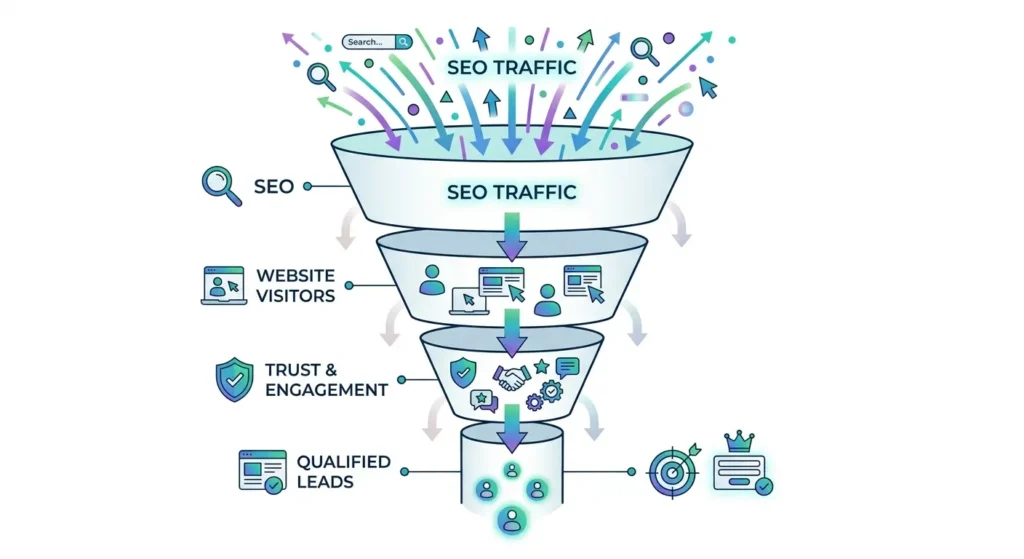
A website generates leads when four things work together:
- The right people find your website
- They immediately understand your offer
- They trust your business
- They have a clear reason to take action
If even one of these elements is missing, your website can receive hundreds or thousands of visitors without generating meaningful leads.
Want to convert your traffic into leads? Contact TVS
This guide explains the real reasons your website is not converting visitors into leads and how to fix them.
First, Identify Which Website Problem You Actually Have
Before changing your website, identify where the problem exists.
Most businesses assume:
“My website is not generating leads because I need more traffic.”
But traffic is only one part of the equation.
Use this simple diagnosis:
| Situation | Actual Problem |
|---|---|
| Website gets no visitors | SEO and visibility problem |
| Website gets visitors but no inquiries | Conversion problem |
| Website gets inquiries but poor-quality leads | Targeting problem |
| Website gets leads but no sales | Follow-up or sales process problem |
A website can fail at any stage of the customer journey.
1. Your Website Is Attracting The Wrong Visitors
One of the biggest reasons websites fail to generate leads is attracting people who are not ready to buy.
Many businesses focus only on getting traffic instead of getting qualified traffic.
For example:
A software company targeting the keyword:
“what is CRM”
may receive thousands of visitors.
But someone searching:
“best CRM software for small businesses”
has a much stronger buying intent.
The difference is search intent.
How to fix it:
Target keywords based on customer problems and buying stages.
Focus on:
- Service-related keywords
- Commercial investigation keywords
- Location-based keywords
- Problem-solving searches
Examples:
Instead of targeting:
“website design”
Target:
“website design agency that generates leads”
Instead of:
“SEO”
Target:
“SEO agency for increasing qualified leads”
The goal is not more visitors.
The goal is more visitors who need what you sell.
2. Visitors Cannot Understand What Your Business Does
Most websites lose potential customers because their message is unclear.
Visitors decide within seconds whether a website is relevant.
If your homepage does not answer:
- What do you offer?
- Who is it for?
- Why should someone choose you?
- What should they do next?
People leave.
A strong website headline should communicate your value immediately.
Weak:
“Innovative digital solutions for modern businesses”
Strong:
“We help B2B companies generate qualified leads through SEO-driven websites.”
The second message tells visitors exactly what problem you solve.
3. Your Website Has No Clear Conversion Path
Many websites expect visitors to magically become leads.
They provide information but do not guide users toward action.
A visitor should always know:
What is my next step?
Common conversion problems:
- No visible CTA
- Multiple confusing options
- Hidden contact information
- No clear offer
- No reason to contact you now
A conversion-focused website should guide visitors through this journey:
Visitor arrives
      ↓
Understands your offer
      ↓
Builds trust
      ↓
Sees value
      ↓
Takes action
4. Your Calls-To-Action Are Too Weak
A website without strong calls-to-action is like a salesperson who never asks for the sale.
Many websites use generic CTAs:
- Submit
- Contact Us
- Learn More
These do not communicate value.
Better CTAs focus on the visitor’s goal:
- Get Your Free Website Audit
- Schedule a Strategy Call
- Request Your Custom Proposal
- See How We Can Help
Your CTA should answer:
“Why should I click this?”
5. Your Website Does Not Build Enough Trust
People do not submit their information to businesses they do not trust.
A professional design alone is not enough.
Visitors want proof that your business can deliver results.
Add trust elements such as:
Customer Reviews
Show real experiences from customers.
Case Studies
Explain:
- Customer problem
- Your solution
- Measurable outcome
Testimonials
Use specific results instead of generic praise.
Weak:
“Great service!”
Strong:
“Generated 45 qualified leads in 90 days through SEO improvements.”
Authority Signals
Include:
- Industry certifications
- Client logos
- Media mentions
- Expert author profiles
Trust reduces hesitation.
6. Your Service Pages Are Not Designed To Generate Leads
Many businesses invest heavily in homepage design but ignore service pages.
This is a mistake.
Service pages are often where buying decisions happen.
A high-converting service page should include:
Problem
Explain the customer’s challenge.
Solution
Explain how your service solves it.
Benefits
Show business outcomes.
Proof
Add results and testimonials.
CTA
Give visitors the next step.
A service page should not simply describe what you do.
It should convince visitors why they need you.
7. Your Website Gets Traffic But Visitors Do Not Convert
Getting traffic is only half the process.
The important metric is:
Conversion rate = percentage of visitors who become leads
For example:
Website A:
10,000 visitors
0.3% conversion rate
= 30 leads
Website B:
3,000 visitors
5% conversion rate
= 150 leads
The goal is not always more traffic.
The goal is better conversion.
Improve conversion by optimizing:
- Headlines
- CTAs
- Forms
- Landing pages
- Offers
- Trust signals
8. Your Landing Pages Are Not Focused Enough
A common mistake is sending every visitor to the homepage.
A homepage has multiple purposes.
A landing page has one purpose:
Generate an action.
A high-performing landing page includes:
- One clear offer
- One target audience
- One primary CTA
- Customer benefits
- Proof
- FAQs
Example:
Instead of:
“Digital Marketing Services”
Create:
“SEO Services That Help Local Businesses Generate More Customer Leads”
Specific pages convert better.
9. Your Website Is Slow Or Difficult To Use
User experience directly affects lead generation.
Visitors leave websites that are:
- Slow
- Difficult to navigate
- Not mobile-friendly
- Filled with technical issues
Important areas to improve:
- Page speed
- Mobile experience
- Navigation
- Website readability
- Form usability
A visitor cannot become a lead if they leave before understanding your offer.
10. Your Website Content Does Not Answer Buyer Questions
Many businesses create content only for search engines.
But customers search because they have problems.
Your content should answer questions like:
- Why is my website not generating leads?
- How can I increase website inquiries?
- How much traffic do I need to generate leads?
- What makes a website convert better?
Create content around:
- Problems
- Comparisons
- Solutions
- Case studies
- FAQs
Helpful content builds trust before someone contacts you.
11. Your SEO Strategy Is Bringing The Wrong Type Of Traffic
SEO does not automatically generate leads.
Ranking for irrelevant keywords can increase traffic while producing zero customers.
A lead-focused SEO strategy requires:
Commercial Content
Pages targeting people ready to buy.
Examples:
- Service pages
- Location pages
- Comparison pages
Topical Authority
Content covering your customer’s complete journey.
Strong Internal Linking
Helping users discover relevant services.
SEO should not only increase visitors.
It should increase business opportunities.
12. You Are Not Tracking Why Visitors Leave
Without data, website improvements become guesswork.
Track:
- Which pages generate leads
- Which pages lose visitors
- CTA clicks
- Form completion rates
- Conversion rates
- Traffic sources
Tools such as analytics platforms and heatmaps help identify:
- Where users stop
- What they interact with
- What prevents conversion
13. Your Website Is Not Optimized For AI Search Results
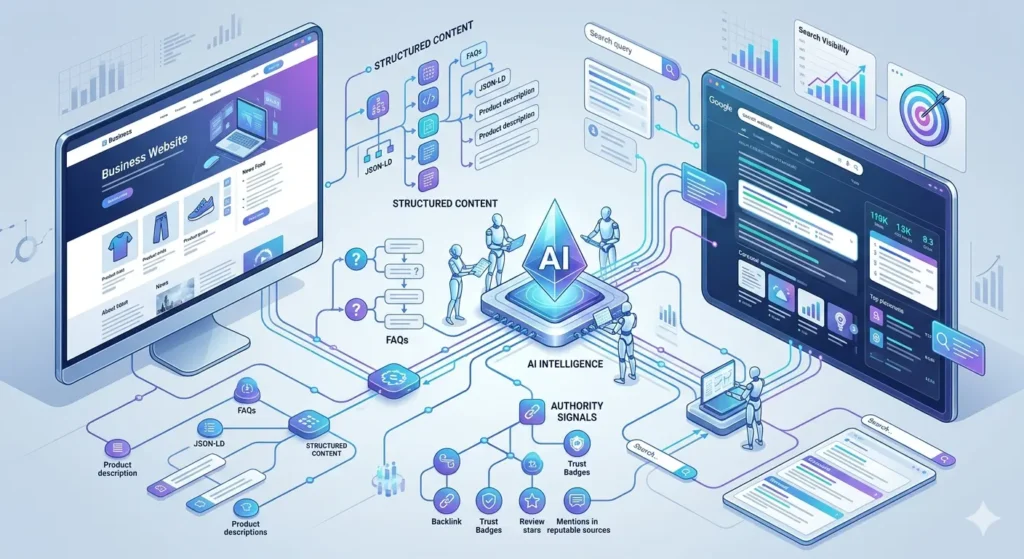
Search behavior is changing.
People are now asking questions through:
- Google AI Overviews
- ChatGPT
- Perplexity
- Gemini
To appear in AI-generated answers, your website needs clear, structured, trustworthy information.
AI systems prefer content that:
- Directly answers questions
- Demonstrates expertise
- Uses clear headings
- Provides specific examples
- Includes structured information
Optimize your website for AI search by:
Answering Real Questions
Create FAQ sections around customer problems.
Strengthening Expertise
Include:
- Author information
- Experience
- Case studies
- Original insights
Improving Content Structure
Use:
- Clear headings
- Short answers
- Definitions
- Lists
- Tables
AI engines need content they can understand and confidently reference.
How To Audit Why Your Website Is Not Generating Leads?
Use this checklist:
Traffic
✓ Are you attracting the right audience?
✓ Are your keywords buyer-focused?
Messaging
✓ Is your offer clear within seconds?
✓ Does your website explain your value?
Conversion
✓ Are CTAs visible?
✓ Is your offer compelling?
Trust
✓ Do you show reviews and proof?
✓ Are your results visible?
Technical
✓ Is your website fast?
✓ Is it mobile-friendly?
AI Visibility
✓ Does your content answer questions directly?
✓ Is your expertise clear?
Frequently Asked Questions
Why is my website getting traffic but no leads?
Your website may be attracting the wrong visitors, failing to communicate value, lacking trust signals, or not providing a clear conversion path. Traffic only becomes leads when visitors understand your offer and have a reason to take action.
How can I get more leads from my website?
Improve keyword targeting, website messaging, landing pages, CTAs, trust signals, user experience, and conversion tracking.
How long does it take for a website to generate leads?
The timeline depends on traffic sources, SEO competition, website quality, industry, and conversion optimization. SEO-driven lead generation usually requires consistent optimization over time.
Does more website traffic mean more leads?
No. More traffic only helps if visitors are relevant and your website converts them effectively.
Final Thoughts
A website that does not generate leads usually does not have a traffic problem.
It has a conversion problem.
The businesses generating consistent leads online are not simply getting more visitors. They understand their audience, create useful content, build trust, and guide visitors toward action.
Your website should not only exist online.
It should actively help your business grow.