What Is Keyword Bidding? Complete Guide to Bidding on Keywords in Google Ads
Introduction
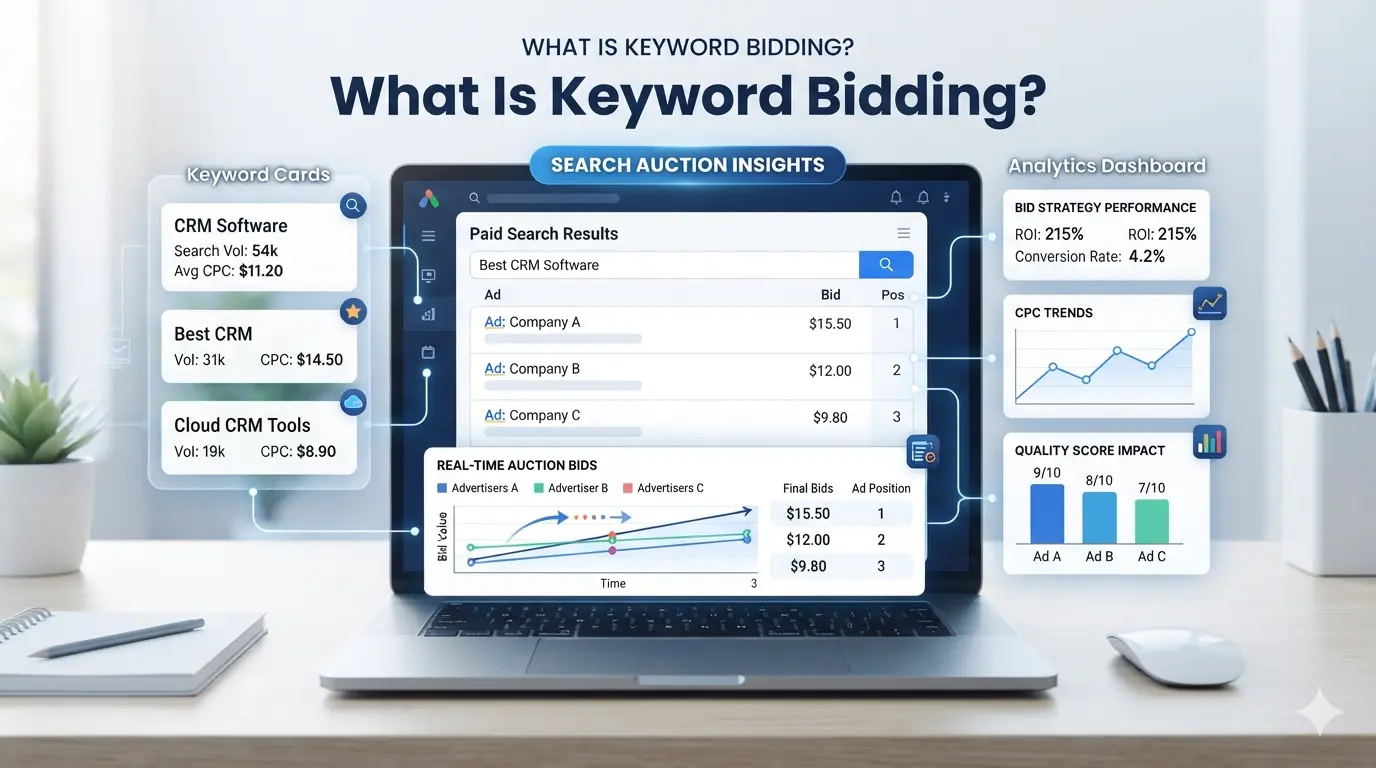
Keyword bidding is the foundation of paid search advertising. It determines how advertisers compete for visibility when potential customers search for products, services, or information on search engines like Google.
Keyword bidding is the process of setting the maximum amount an advertiser is willing to pay when someone clicks on an ad triggered by a specific keyword. In Google Ads, advertisers do not simply pay the highest amount to win a position. Google evaluates multiple factors, including bid amount, ad relevance, landing page experience, and Quality Score, to decide which ads appear and where they rank.
Understanding what is keyword bidding, how bidding works, and how to create an effective keyword bidding strategy helps businesses control advertising costs, reach the right audience, and improve campaign performance.
Whether you are running your first Google Ads campaign or managing large PPC accounts, knowing how to bid on keywords effectively is essential for getting better results from paid search.
What Is Keyword Bidding?
Keyword bidding is an auction-based system where advertisers compete for ad placements by placing bids on keywords related to their products or services.
When you create a Google Ads campaign, you select keywords that match the searches your potential customers might use. You then decide how much you are willing to pay for a click on your advertisement. This amount is known as your keyword bid or maximum cost-per-click (max CPC) bid.
For example, a company selling running shoes may bid on keywords such as:
- running shoes online
- best running shoes for beginners
- buy sports shoes
If someone searches for one of these terms, Google runs an instant auction among advertisers targeting that keyword. The winning ads are selected based on a combination of bid amount, relevance, and overall ad quality.
A higher bid can improve your chances of appearing in search results, but it does not guarantee the top position. Google Ads uses Ad Rank, which considers several factors beyond the bid itself.
What Is a Keyword Bid?
A keyword bid is the maximum amount you are willing to spend for a click when your ad appears for a specific search term.
For example:
A business sets a keyword bid of $3 for the keyword:
“emergency plumber near me”
This means the advertiser is willing to pay up to $3 for a click from someone searching that keyword.
However, the actual amount charged is often lower than the maximum bid because Google calculates the final CPC based on the auction competition and Ad Rank of other advertisers.
Your keyword bid influences:
- How competitive your ad is in auctions
- Your potential ad position
- The amount of traffic you can receive
- Your overall advertising costs
Choosing the right bid is about balancing visibility and profitability. A very low bid may limit impressions, while an unnecessarily high bid can increase costs without improving results.
How Does Keyword Bidding Work in Google Ads?
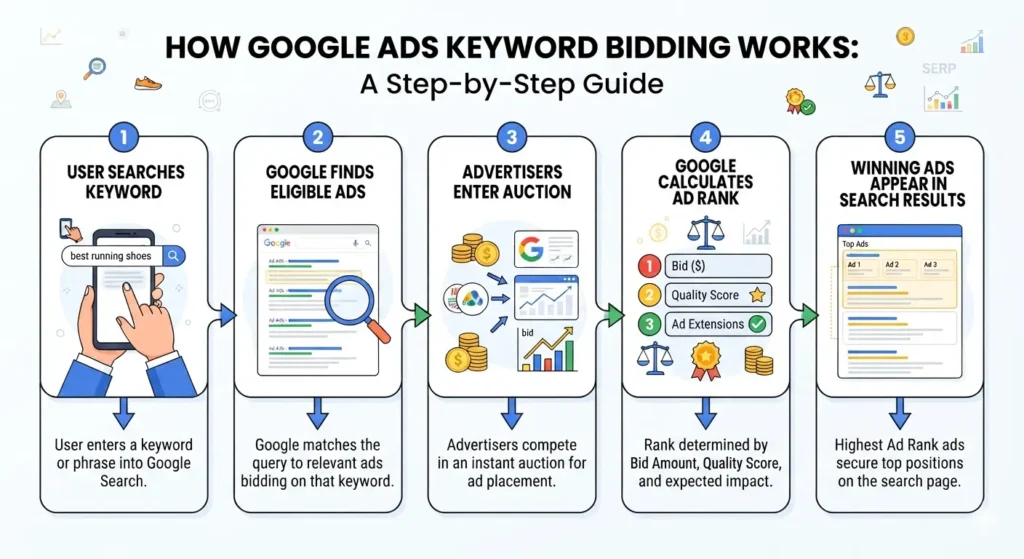
Keyword bidding in Google Ads works through a real-time auction system. Every time someone searches on Google, an auction happens instantly to determine which ads are eligible to appear and in what order.
The process usually follows these steps:
1. A User Searches on Google
A person enters a search query, such as:
“best digital marketing agency near me”
Google identifies advertisers who are targeting related keywords.
2. Google Checks Eligible Keywords
Google reviews advertisers’ campaigns to find keywords that match the user’s search intent.
Factors considered include:
- Keyword relevance
- Match type
- Location targeting
- Budget
- Negative keywords
- Ad approval status
The system then identifies which ads can enter the auction.
3. Advertisers Enter the Auction
Eligible advertisers compete by bidding on keywords.
For example:
| Advertiser | Keyword Bid |
|---|---|
| Company A | $5 |
| Company B | $4 |
| Company C | $3 |
Although Company A has the highest bid, it does not automatically win because Google also evaluates ad quality and relevance.
4. Google Calculates Ad Rank
Ad Rank determines:
- Whether your ad appears
- Your position compared with competitors
- Your potential cost per click
Google considers factors such as:
- Bid amount
- Expected click-through rate
- Ad relevance
- Landing page experience
- Competition level
- Search context
This means an advertiser with a lower bid can sometimes outrank a competitor with a higher bid if their ad provides a better experience.
5. Ads Appear Based on Auction Results
After the auction is completed, Google displays ads according to their Ad Rank.
The advertiser pays only when someone clicks the advertisement, which is why keyword bidding is commonly associated with pay-per-click (PPC) advertising.
How to Bid on Keywords in Google Ads: A Step-by-Step Guide
Knowing how to bid on keywords is one of the most important parts of running successful PPC campaigns. A keyword bid determines how much you are willing to pay when someone clicks your advertisement after searching for a relevant term.
However, successful bidding on keywords in Google Ads is not about choosing the highest possible amount. The goal is to find the right balance between visibility, traffic quality, and return on investment.
Google Ads allows advertisers to choose between manual bidding, where they control keyword bids themselves, and automated bidding strategies, where Google’s system adjusts bids based on campaign goals and auction signals.
Get Expert Google Ads Management with TVS →
How to Bid on Keywords in Google Ads
The process of bidding on keywords in Google Ads involves selecting valuable search terms, assigning bids, monitoring performance, and continuously improving your campaign.
Follow these steps to create an effective keyword bidding process.
1. Identify the Right Keywords
Before setting bids, you need to choose keywords that match your audience’s search intent.
For example, a web design company may target:
- website design services
- professional website developer
- hire web designer
These keywords have different values depending on the user’s buying intent.
A person searching:
“what is website design”
may only be researching.
A person searching:
“hire website designer near me”
is more likely ready to purchase.
High-intent keywords usually deserve higher bids because they have a stronger chance of generating leads or sales.
2. Choose Your Keyword Match Types
Google Ads allows advertisers to control how closely a search must match their keywords.
The main match types include:
Broad Match
Your ad can appear for searches related to your keyword, including variations and similar meanings.
Example:
Keyword:
women shoes
Possible searches:
- buy ladies footwear
- women’s running shoes
- shoes for women online
Broad match can increase reach but may require careful monitoring.
Phrase Match
Your ad appears when the search includes the meaning of your keyword.
Example:
Keyword:
digital marketing agency
Possible searches:
- best digital marketing agency
- digital marketing agency near me
Exact Match
Your ad targets searches with the same meaning or intent as your keyword.
Example:
Keyword:
emergency plumber
Possible searches:
- emergency plumber
- plumber emergency service
Choosing the right match type affects your traffic quality and how efficiently your keyword budget is used.
3. Set Your Maximum CPC Bid
A maximum CPC bid is the highest amount you are willing to pay for one click.
For example:
You sell premium furniture and decide that a customer click is worth $2.
You set:
Keyword bid: $2 maximum CPC
This means Google will not charge more than this amount for a click, although your actual CPC may be lower depending on the auction.
With manual CPC bidding, advertisers can set maximum CPC bids for individual keywords or ad groups and adjust them based on performance.
4. Select the Right Keyword Bidding Strategy
Your bidding strategy should match your campaign goal.
There is no single best keyword bidding strategy for every business. The right option depends on whether you want more traffic, leads, sales, or revenue.
Manual CPC Bidding
Manual CPC gives advertisers complete control over keyword bids.
You decide:
- Which keywords receive higher bids
- Which keywords receive lower bids
- How much you are willing to spend per click
Example:
A dentist may bid:
“emergency dentist near me” → $8 CPC
“types of dental fillings” → $1 CPC
because the first keyword has stronger purchase intent.
Manual bidding works well when you understand your campaign data and want detailed control.
Maximise Clicks
Maximise Clicks is an automated bidding strategy designed to get as many clicks as possible within your budget.
Instead of manually setting every keyword bid, Google automatically adjusts bids to increase traffic opportunities.
This strategy can be useful when:
- You want website traffic
- You have limited PPC experience
- Your main goal is increasing visitors
However, more clicks do not always mean more sales, so conversion tracking is important.
Maximise Conversions
Maximise Conversions focuses on getting the highest number of conversions possible within your budget.
Google automatically adjusts bids based on signals that indicate a higher chance of conversion.
This strategy works better when your account has enough conversion data.
Target CPA Bidding
Target CPA (Cost Per Acquisition) helps advertisers get conversions while aiming for a specific average cost per customer acquisition.
Example:
You want leads at approximately $30 each.
You set a target CPA of $30, and Google adjusts bids to find users who are more likely to convert.
Target ROAS Bidding
Target ROAS focuses on conversion value rather than conversion volume.
It is commonly used by eCommerce businesses that want to maximise revenue.
Example:
A store spends $1,000 on ads and wants $5,000 in sales.
The target ROAS goal would be 500%.
Smart Bidding
Smart Bidding uses machine learning to optimise bids automatically for conversions or conversion value.
Google evaluates signals such as:
- Device
- Location
- Time of day
- Language
- Search context
- User behaviour
to adjust bids during each auction.
Smart Bidding can save time, but results depend heavily on accurate conversion tracking and good campaign data.
How Much Should You Bid for Keywords?
There is no fixed price for keyword bids. The cost depends on:
- Industry competition
- Keyword popularity
- Customer value
- Search intent
- Geographic targeting
- Quality Score
- Competitor activity
For example:
A keyword like:
“buy insurance online”
may have a higher bid because each customer can generate significant revenue.
A keyword like:
“insurance definition”
may have a lower bid because the search intent is informational.
Factors That Affect Keyword Bid Prices
1. Competition
When many advertisers compete for the same keyword, bids usually increase.
Competitive industries such as:
- Legal services
- Insurance
- Real estate
- Finance
- Software
often have higher CPC costs.
2. Quality Score
Quality Score measures how relevant and useful your ad experience is.
A strong Quality Score can help you achieve better ad positions without always increasing your bid.
Improve Quality Score by:
- Creating relevant ads
- Using targeted keywords
- Improving landing pages
- Increasing expected CTR
3. Search Intent
Not every keyword has the same value.
Compare:
“best laptop”
vs
“buy Dell XPS laptop online”
The second keyword shows stronger buying intent, so businesses may be willing to bid more.
4. Location and Audience Targeting
Keyword bids can change depending on:
- Country
- City
- Device
- Time of day
- Audience segment
A local business may bid higher for searches coming from nearby customers.
Competitor Keyword Bidding: How Businesses Bid on Competitors’ Keywords in Google Ads
Keyword bidding is not limited to your own products, services, or brand terms. Many businesses also use competitor keyword bidding to appear when potential customers search for competing brands.
Competitor keyword bidding is the practice of creating Google Ads campaigns that target keywords related to another company, product, or brand. The goal is to reach users who are already comparing options and may be open to switching providers.
For example, a project management software company may bid on searches like:
- “[Competitor name] alternatives”
- “[Competitor name] pricing”
- “[Competitor name] reviews”
- “[Competitor name] vs alternatives”
This strategy allows businesses to enter the conversation when customers are actively researching solutions. However, it requires careful planning because competitor traffic behaves differently from normal search traffic.
What Is Competitor Keyword Bidding?
Competitor keyword bidding means bidding on keywords that include another company’s name, product name, or branded search terms.
Unlike traditional keyword campaigns where businesses target general searches such as:
- best CRM software
- accounting software for small business
- digital marketing services
competitor campaigns target users who already know a specific brand.
For example:
A customer searches:
“HubSpot alternatives”
A competing CRM company can create an ad campaign targeting this keyword and show an alternative solution.
The reason businesses use this strategy is simple: competitor searches often indicate strong buying intent. A person searching for alternatives is usually comparing solutions before making a decision.
Want to Outperform Your Competitors in Search Results?
TVS helps brands build stronger Google Ads strategies, improve search visibility, and create campaigns that reach customers before competitors do.
Talk to TVS About Your Google Ads Strategy →
Why Do Businesses Bid on Competitor Keywords?
Businesses use competitor keyword bidding for several reasons.
1. Reach Customers During the Comparison Stage
Many buyers do not purchase immediately after discovering a product. They compare:
- Features
- Pricing
- Reviews
- Customer support
- Alternatives
Competitor searches happen during this evaluation stage, making them valuable for businesses that can clearly explain why they are a better option.
2. Capture High-Intent Search Traffic
A user searching for a competitor’s name already understands the product category.
Compare these searches:
Informational keyword:
“what is accounting software”
Competitor keyword:
“QuickBooks alternatives”
The second search shows stronger commercial intent because the user is actively looking at other options.
3. Increase Market Visibility
Competitor bidding allows smaller brands to appear alongside established companies.
A newer business may not rank organically for competitive industry terms, but Google Ads can help them appear when customers search for well-known competitors.
Is Bidding on Competitor Keywords Allowed in Google Ads?
One of the most common questions is:
Can you bid on competitor keywords in Google Ads?
In most cases, yes. Google allows advertisers to use competitor brand names as keywords. However, trademark rules apply to how those names are used inside the advertisement itself.
The important difference is:
Keyword targeting and ad copy are separate.
For example:
Allowed:
A company adds a competitor’s brand name as a keyword to trigger ads.
Not usually allowed:
Using the competitor’s trademark in your headline or description in a way that violates Google’s trademark policies.
Google’s trademark policy states that it generally does not restrict the use of trademarks as keywords, but it may restrict trademark use within ad text depending on the situation.
How to Create a Competitor Keyword Campaign
A successful competitor bidding campaign requires more than adding competitor names to a keyword list.
1. Research Your Competitors
Start by identifying competitors that:
- Offer similar products
- Target the same customers
- Have strong brand awareness
- Receive significant search volume
Useful competitor keyword types include:
- Brand name keywords
- Brand + pricing
- Brand + reviews
- Brand + alternatives
- Brand + comparison
2. Separate Competitor Campaigns
Do not mix competitor keywords with your regular search campaigns.
Create a separate campaign because competitor traffic usually has different:
- Conversion rates
- CPC costs
- Customer intent
- Performance patterns
Separate campaigns allow better budget control and accurate reporting.
3. Create Relevant Landing Pages
Sending competitor traffic to a generic homepage usually produces poor results.
Instead, create pages that answer comparison questions.
Examples:
- Your product vs competitor comparison
- Alternative solutions page
- Feature comparison page
- Pricing comparison page
The landing page should explain your advantages clearly.
4. Write Ads Focused on Your Brand
When running competitor keyword campaigns, your ads should focus on your own value.
Good messaging:
- Lower pricing options
- Better features
- Faster support
- More flexible plans
- Better customer experience
Avoid misleading users or creating confusion between your brand and the competitor.
How to See What Keywords Competitors Are Bidding On?
Many advertisers want to know:
“Who is bidding on my keywords?”
or:
“How can I see what keywords competitors are bidding on?”
Google does not provide a complete list of every competitor keyword. However, advertisers can use several methods to analyse competitor activity.
1. Google Ads Auction Insights
Auction Insights helps advertisers understand how their campaigns compare with other advertisers appearing in the same auctions.
You can review:
- Impression share
- Overlap rate
- Position above rate
- Outranking share
This helps identify competitors frequently appearing against your ads.
2. Google Ads Transparency Centre
The Google Ads Transparency Centre allows users to explore ads shown by advertisers and learn more about their advertising activity.
It can help with competitor research by showing:
- Active ads
- Advertiser information
- Creative examples
3. PPC Competitor Research Tools
Many SEO and PPC platforms provide competitor insights, including:
- Paid keywords
- Ad copies
- Estimated traffic
- Competitor campaigns
These tools help identify opportunities and understand how competitors approach paid search.
What Does It Mean When Someone Is Bidding on My Keywords?
If you search your own brand name and see another company’s advertisement, it may mean:
- A competitor is bidding on your brand keywords
- They are running a competitor campaign
- They are targeting users searching for your products
This practice is commonly called brand bidding or competitor brand bidding.
Competitors may do this because your brand already has demand. Instead of creating awareness from zero, they try to appear when customers are already interested in a product or service category.
How to Protect Your Brand From Competitor Bidding
If competitors are bidding on your brand keywords, you can take several steps.
1. Run Your Own Brand Campaign
A brand campaign helps you maintain visibility when customers search for your company.
Benefits include:
- Lower CPC
- High Quality Score
- Better control over messaging
- Protection against competitors
2. Monitor Brand Search Results
Regularly check:
- Your brand searches
- Competitor ads
- Search impression share
- Auction Insights
Early detection allows faster response.
3. Improve Your Brand Campaign Quality
A strong brand campaign usually performs better because:
- Ads match the search intent
- Landing pages are highly relevant
- Users already know the brand
This often creates stronger Ad Rank compared with competitors targeting your name.
Competitor Keyword Bidding Best Practices
For better results:
Target Specific Competitor Searches
Instead of bidding only on competitor names, focus on high-intent variations:
- competitor alternatives
- competitor pricing
- competitor reviews
- competitor comparison
These searches often show stronger buying intent.
Use Controlled Bidding
Competitor keywords can become expensive because the searcher is already familiar with another brand.
Start with controlled budgets and increase spending only when conversions justify the cost.
Track Real Business Results
Do not judge competitor campaigns only by clicks.
Measure:
- Cost per lead
- Conversion rate
- Customer acquisition cost
- Revenue generated
A high click volume does not always mean a profitable campaign.
What Is Brand Bidding? Complete Guide to Branded Keyword Bidding and Trademark Bidding
Brand bidding is an important part of paid search advertising that focuses on targeting keywords related to a specific company, product, or trademark. Businesses use brand bidding to protect their online visibility, capture high-intent searches, and compete for customers who are already familiar with their brand.
Brand bidding means placing bids on keywords that include a company’s brand name or branded search terms in Google Ads or other paid search platforms.
For example, a company may bid on keywords such as:
- Nike shoes
- Apple iPhone deals
- HubSpot pricing
- Microsoft Teams plans
When users search these terms, the business can show advertisements at the top of search results.
Brand bidding can include bidding on your own brand name, bidding on competitor brands, or allowing affiliates to bid on branded keywords. Each approach has different goals and considerations.
What Is Brand Bidding Meaning?
The brand bidding meaning is the practice of competing in paid search auctions for keywords that contain brand-related terms.
A branded keyword usually includes:
- Company names
- Product names
- Service names
- Trademarked terms
- Brand variations
For example:
A company called “ABC Software” may target:
- ABC Software
- ABC Software pricing
- ABC Software login
- ABC Software alternatives
These searches usually have stronger purchase intent because users already know the brand or product.
What Is Branded Keyword Bidding?
Branded keyword bidding refers specifically to bidding on keywords that contain your own brand name or another company’s brand name.
There are two main types:
- Own brand bidding
- Competitor brand bidding
1. Bidding on Your Own Brand Keywords
Many businesses bid on their own branded keywords even when they already rank organically.
For example:
A customer searches:
“CreativeWalay SEO services”
The company may run a Google Ads campaign targeting this branded keyword.
Some businesses question why they should pay for clicks they may already receive organically. However, brand campaigns can provide several benefits.
Benefits of Brand Keyword Bidding
Protect Search Visibility
Competitors can sometimes appear when users search for your brand.
A brand campaign helps ensure your advertisement appears above competing offers.
Control Your Message
Organic search results have limited control over messaging.
With Google Ads, businesses can highlight:
- Offers
- New services
- Discounts
- Promotions
- Unique selling points
Capture High-Intent Customers
Someone searching for your brand is already familiar with your business.
These users often have:
- Higher conversion intent
- Lower acquisition costs
- Better engagement rates
2. Bidding on Competitor Brand Keywords
Bidding on competitor brand keywords means targeting another company’s brand terms through paid search campaigns.
For example:
A website hosting company may bid on:
- Bluehost alternatives
- Hostinger alternatives
- GoDaddy pricing
The goal is to reach customers who are considering another provider.
This strategy is also called:
- Competitor bidding
- Competitor brand bidding
- Brand conquesting
- Search competitor targeting
What Is Affiliate Brand Bidding?
Affiliate brand bidding occurs when affiliates advertise using a company’s branded keywords to generate sales or commissions.
For example:
An affiliate promoting a software product may bid on:
- Product name + discount
- Product name + coupon
- Product name + review
When someone clicks the advertisement and purchases through the affiliate link, the affiliate earns a commission.
Why Affiliate Brand Bidding Can Be Controversial
Brand bidding by affiliates can create challenges because:
- Affiliates may compete with the company’s own ads
- CPC costs can increase
- Customers may click affiliate ads instead of direct brand ads
- Brand messaging may become inconsistent
Because of this, many companies create affiliate agreements that clearly define whether affiliates can bid on branded keywords.
What Is Trademark Keyword Bidding?
Trademark keyword bidding refers to using trademarked brand names as keywords in paid advertising campaigns.
For example:
A company may add another brand’s trademark as a keyword to trigger ads.
This raises an important question:
Can You Bid on Trademarked Keywords in Google Ads?
In many cases, Google allows advertisers to bid on trademarked keywords. However, trademark rules mainly focus on how trademarks are used inside advertisements rather than simply being selected as keywords.
For example:
A company may be able to target a competitor’s brand name as a keyword, but using that trademark misleadingly in ad text may create policy issues.
Google Ads trademark policies may restrict certain uses of trademarks in ad copy, depending on the situation and region. Advertisers should review current Google Ads trademark rules before using branded terms.
Competitor Bidding on Brand Keywords in Google Ads
One common concern among businesses is:
“Why is a competitor bidding on my brand keywords?”
This happens because branded searches represent valuable traffic.
A user searching:
“Brand X pricing”
already understands the product category and may be close to making a decision.
Competitors may try to capture this audience by showing alternative solutions.
For example:
A customer searches:
“ProjectTool pricing”
A competitor may display an ad saying:
“Looking for a ProjectTool Alternative? Compare Features and Pricing.”
How Google Handles Brand Bidding
Google Ads evaluates all ads through its normal auction system.
A competitor bidding on your brand keyword does not automatically guarantee that they will appear above you.
Google considers:
- Bid amount
- Ad relevance
- Landing page quality
- Expected CTR
- Overall Ad Rank
A brand owner often has an advantage because:
- The keyword matches the brand closely
- The landing page is highly relevant
- Users are familiar with the brand
How to Find Brand Bidding Activity?
Businesses often want to:
- Find brand bidding
- See who is bidding on their keywords
- Monitor competitor activity
Several methods can help.
Google Search Monitoring
Regularly search your brand name and variations.
Check:
- Which ads appear
- Competitor messages
- Offers being promoted
- Landing pages
Auction Insights
Google Ads Auction Insights helps advertisers identify competitors appearing in the same auctions.
It provides information such as:
- Impression share
- Position overlap
- Competitor visibility
PPC Research Tools
Professional PPC tools can help analyse:
- Competitor paid keywords
- Ad copy
- Search visibility
- Estimated campaign activity
These insights can help identify new competitors and advertising strategies.
Brand Bidding Best Practices
1. Create a Dedicated Brand Campaign
Do not mix branded keywords with generic keywords.
A separate campaign gives better control over:
- Budget
- Reporting
- Bid adjustments
- Performance tracking
2. Use Exact and Phrase Match Carefully
Branded keywords usually have strong intent, but irrelevant searches can still occur.
Monitor search terms and add negative keywords where necessary.
3. Protect Important Brand Terms
Focus on:
- Main brand name
- Product names
- Common misspellings
- Brand + service combinations
4. Track Competitor Activity
Keep monitoring:
- Who appears for your brand searches
- Changes in CPC
- Competitor offers
- New advertisers entering auctions
Brand Bidding vs Keyword Bidding: What Is the Difference?
| Keyword Bidding | Brand Bidding |
|---|---|
| Targets general search terms | Targets brand-related searches |
| Focuses on attracting new customers | Focuses on capturing existing brand interest |
| Example: “best CRM software” | Example: “Salesforce alternatives” |
| Usually more competitive | Often lower CPC |
| Requires stronger education | Users already know the brand |
Both strategies can work together as part of a complete Google Ads campaign.
Final Thoughts on Brand Bidding
Brand bidding helps businesses control their visibility when customers search for specific companies, products, or services. Whether you are protecting your own brand, targeting competitor searches, or managing affiliate advertising, a clear strategy is essential.
Successful brand bidding requires more than simply adding brand names as keywords. Businesses need relevant ads, strong landing pages, proper tracking, and continuous optimisation to achieve profitable results.
A well-managed brand bidding strategy can protect valuable search traffic, improve customer acquisition, and help businesses compete more effectively in Google Ads auctions.
Turn Keyword Searches Into Real Business Growth
A successful Google Ads campaign requires more than choosing keywords. TVS combines PPC expertise, keyword research, campaign optimisation, and branding strategies to help businesses build a stronger digital presence.
Start Growing Your Brand With TVS
Keyword Bid Optimisation: How to Improve PPC Performance
Keyword bid optimisation is the process of adjusting your keyword bids to improve campaign performance while controlling advertising costs. The goal is not always to increase bids but to invest more in keywords that generate valuable clicks, leads, or sales.
A strong keyword bidding strategy focuses on finding the right balance between keyword cost, competition, search intent, and conversion value.
What Is Paid Search Bid Optimisation?
Paid search bid optimisation means improving your Google Ads bids based on campaign performance data.
Instead of setting the same bid for every keyword, advertisers analyse:
- Conversion rate
- Cost per conversion
- Click-through rate (CTR)
- Search intent
- Profitability
- Competition level
For example, a keyword generating consistent sales may deserve a higher bid, while a keyword receiving many clicks but no conversions may need a lower bid or removal.
How to Optimise Keyword Bids Effectively?
1. Focus on High-Intent Keywords
Not every keyword deserves the same bid.
Keywords with strong buying intent usually perform better.
Example:
Lower intent:
- what is CRM software
Higher intent:
- buy CRM software for small business
The second keyword may justify a higher bid because users are closer to making a purchase.
2. Adjust Bids Based on Performance
Review keyword performance regularly and adjust bids accordingly.
Increase bids for keywords that:
- Generate conversions
- Have strong conversion rates
- Bring profitable customers
Reduce bids for keywords that:
- Spend money without results
- Have low-quality traffic
- Generate irrelevant clicks
3. Improve Quality Score
A higher Quality Score can help achieve better ad positions without relying only on higher bids.
Improve Quality Score by:
- Creating relevant ads
- Matching keywords with search intent
- Improving landing page experience
- Increasing expected CTR
Better ad quality can reduce your cost per click and improve campaign efficiency.
4. Use Negative Keywords
Negative keywords prevent ads from appearing for irrelevant searches.
For example, a premium furniture store may add:
- free furniture
- used furniture
- DIY furniture
as negative keywords if those searches do not generate customers.
This helps protect your budget and improves traffic quality.
Should You Always Bid Higher on Keywords?
No. A higher bid does not always mean better results.
High bid keywords can be valuable when they bring profitable customers, but expensive keywords with poor conversion rates can waste budget.
Before increasing bids, analyse:
- Conversion value
- Customer lifetime value
- Competition
- Profit margins
The best bid is the one that supports your business goals.
Common Keyword Bidding Mistakes
Ignoring Search Intent
Bidding on keywords without understanding user intent often leads to poor results.
Increasing Bids Without Data
Raising bids only to get more traffic can increase costs without improving revenue.
Not Monitoring Competitors
Competitors can change their strategies, enter auctions, or increase bids. Regular monitoring helps you adjust your campaigns.
Using the Same Bid for Every Keyword
Different keywords have different values. High-performing keywords should receive more attention and budget.
Final Keyword Bidding Checklist
Before adjusting your bids, check:
- Are your keywords matching user intent?
- Are you tracking conversions correctly?
- Which keywords generate the most revenue?
- Are competitors appearing for your important terms?
- Are irrelevant searches wasting budget?
- Is your landing page helping conversions?
A successful keyword bidding strategy is based on continuous testing, data analysis, and optimisation. The goal is not to win every auction but to win the right auctions at the right cost.
Frequently Asked Questions About Keyword Bidding
What is keyword bidding?
Keyword bidding is the process of setting the maximum amount you are willing to pay when someone clicks your advertisement for a specific keyword.
How do you bid on keywords in Google Ads?
To bid on keywords in Google Ads, select relevant keywords, choose a bidding strategy, set your maximum CPC or automated bidding goal, and optimise based on performance data.
What is a keyword bid?
A keyword bid is the maximum amount an advertiser is willing to pay for a click from a specific keyword.
Can competitors bid on my brand keywords?
Yes, competitors can often bid on brand keywords as search terms. However, Google Ads trademark rules may limit how trademarks are used inside ad copy.
How can I see what keywords competitors are bidding on?
You can analyse competitor activity using Google Ads Auction Insights, Google Ads Transparency Centre, and PPC competitor research tools.
What is the best keyword bidding strategy?
The best strategy depends on your goal. Manual CPC provides control, while Smart Bidding strategies such as Target CPA and Target ROAS use machine learning to optimise bids automatically.
Are high bid keywords always better?
No. A high bid keyword is only valuable if it generates profitable results. The quality of traffic matters more than the bid amount alone.