Small Business Branding: 12 Steps to Build a Memorable Brand
Small business branding is the strategic process of defining how your company looks, sounds, behaves and makes customers feel. It brings together your positioning, values, messaging, visual identity and customer experience to create a recognizable and trustworthy business.
A logo may represent your company, but it is only one part of your brand. Customers also form opinions from your website, prices, packaging, reviews, communication style, service and the promises you keep.
Effective branding for small businesses gives all these elements a consistent direction. It helps people understand what you offer, why it is relevant to them and why they should choose your business rather than another option.
This guide explains how to build that foundation step by step.
What Is Small Business Branding?
Small business branding is the deliberate development of a distinct business identity and reputation. It includes the strategic decisions, messages, designs and experiences that influence how customers perceive your company.
A complete brand usually has four connected layers:
- Brand strategy: Your audience, market position, purpose, values and competitive difference.
- Brand messaging: Your value proposition, story, voice, tagline and key customer promises.
- Visual identity: Your logo, colours, typography, photography, illustrations and layouts.
- Brand experience: What customers encounter before, during and after buying from you.
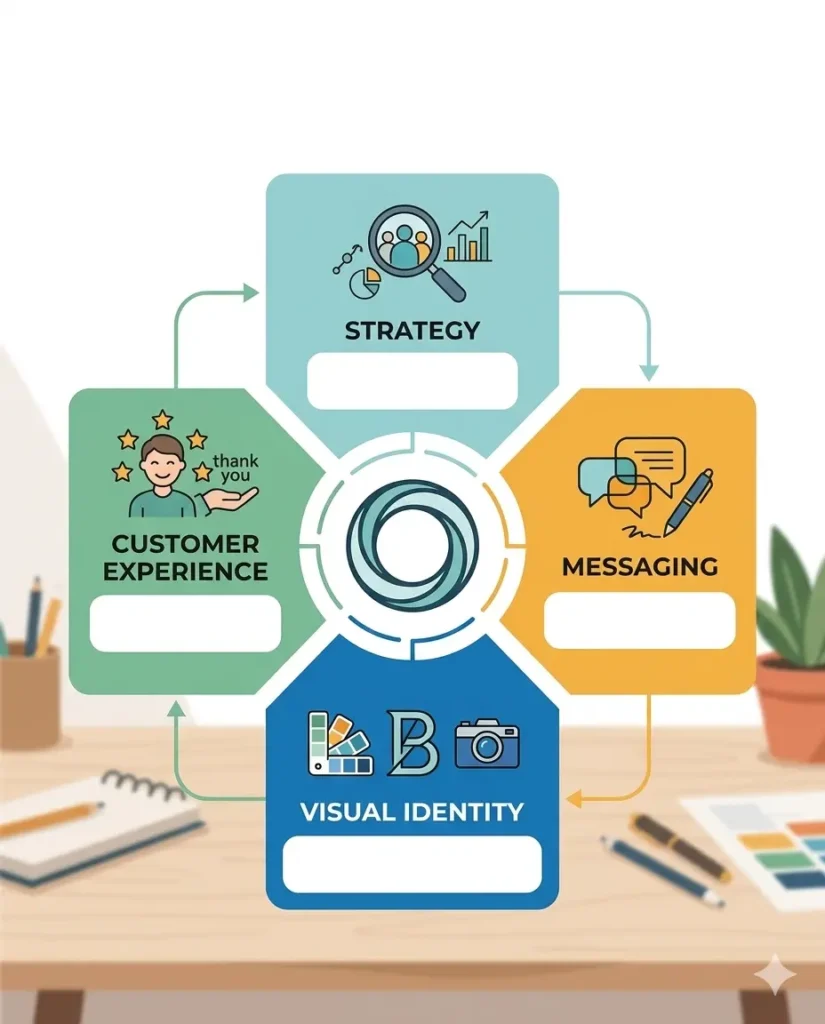
Strong branding therefore extends beyond appearances. It should help a customer recognize your business, understand your value and receive a consistent experience across different touchpoints.
Why Is Branding Important for a Small Business?
Small businesses often compete with companies that have larger teams and advertising budgets. A clear brand helps reduce that disadvantage by making the business more distinctive and memorable.
It makes your business recognizable
Repeated use of consistent messages, colours, typography and imagery creates familiarity. Customers can begin to identify your business before reading its name.
Recognition is especially valuable when people encounter your company several times before making a purchase.
It communicates your difference
Customers rarely choose a business simply because it exists. They want to understand why its offer is more suitable than the alternatives.
A clear small business brand strategy can highlight a meaningful difference such as:
- Greater specialization
- More personal service
- Faster delivery
- Local expertise
- Simpler processes
- Sustainable materials
- Better accessibility
- A distinctive customer experience
It supports trust
Professional, consistent communication reduces uncertainty. Customers are more comfortable taking action when a business presents the same identity and promises across its website, search listings, emails, social profiles and offline materials.
It improves marketing efficiency
Marketing attracts attention. Branding determines what people remember after seeing the promotion.
When your positioning and message are already clear, advertisements, articles, emails and social content can reinforce the same idea rather than presenting disconnected messages.
It encourages loyalty
Customers may return because of product quality, convenience or service. A recognizable personality and dependable experience give them additional reasons to remember and recommend the business.
Branding vs Marketing vs Brand Identity
These terms are connected, but they are not interchangeable.
| Term | Primary purpose | Examples |
|---|---|---|
| Branding | Defines how the business should be perceived | Positioning, values, personality, promise and experience |
| Brand identity | Expresses the brand verbally and visually | Name, logo, colours, fonts, voice and imagery |
| Marketing | Promotes the business and generates demand | Content, search optimization, email, events and advertising |
Branding establishes the foundation. Brand identity makes that foundation recognizable. Marketing distributes the message to the intended audience.
A business can run marketing campaigns without a defined brand, but its communications are more likely to feel inconsistent or generic.
The Vital Solutions Small Business Branding Framework
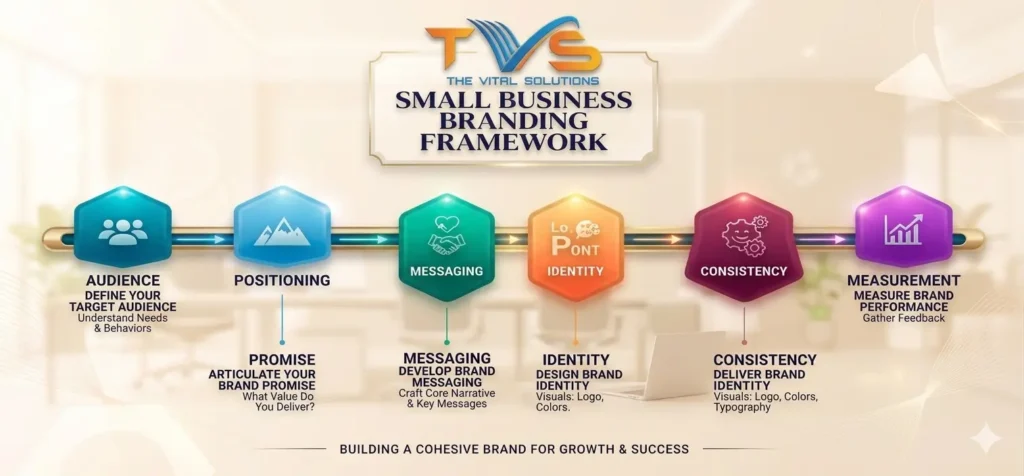
A useful brand is not created by making isolated decisions about logos, colors, fonts, or taglines. Each decision should connect to a wider system.
At The Vital Solutions, we organize small business branding around eight connected elements:
Audience → Positioning → Promise → Messaging → Identity → Experience → Consistency → Measurement
1. Audience
Define exactly who the business needs to attract and what matters to those customers when choosing a company.
Ask:
- Who is our highest-value customer?
- What problem brings them to us?
- What concerns could prevent them from buying?
- Which benefits matter most to them?
- What would make them trust us?
2. Positioning
Decide what you want customers to associate with your business compared with competing options.
Strong positioning should answer:
- Who is this business for?
- What problem does it solve?
- What outcome does it provide?
- How is it meaningfully different?
- Why should customers believe the claim?
3. Promise
Define the experience or outcome customers should consistently expect.
A useful brand promise is specific enough to influence operations.
For example, “excellent customer service” is difficult to evaluate. “Every customer receives a written project update each Friday” is an operational promise that can actually be delivered and measured.
4. Messaging
Translate the positioning into language customers immediately understand.
Your messaging system should include:
- Primary value proposition
- Main customer problem
- Key benefits
- Differentiators
- Proof points
- Objection responses
- Primary call to action
5. Identity
Create a visual and verbal identity that supports the strategy.
That may include your:
- Logo
- Colors
- Typography
- Photography
- Graphic elements
- Voice
- Tone
The identity should express the position you want to own rather than simply follow current design trends.
6. Experience
Check whether the customer’s actual experience supports the brand promise.
This includes:
- Website experience
- Enquiry process
- Response times
- Sales conversations
- Proposals
- Onboarding
- Service delivery
- Customer support
- Follow-up
A premium-looking brand paired with a confusing or unreliable customer experience creates a credibility gap.
7. Consistency
Apply the same positioning, identity, and standards across the places customers encounter your company.
Consistency matters across your website, search listings, social media, advertising, proposals, emails, packaging, signage, and customer service.
8. Measurement
Finally, measure whether the brand is producing the intended business effect.
Depending on your goals, useful indicators can include branded searches, direct traffic, enquiries, conversion rates, lead quality, referrals, repeat purchases, review themes, and customer feedback.
The framework works in this order for a reason: strategy should determine design, and customer experience should prove the promise.
Treating Branding as Finished After Launch
Launching the new identity is not the end of the process.
After rollout, review:
- Customer feedback
- Sales objections
- Search behavior
- Website conversions
- Review themes
- Lead quality
- Employee feedback
- Brand consistency
Those signals show whether the intended positioning is actually being understood in the market.
How to Brand a Small Business in 12 Steps
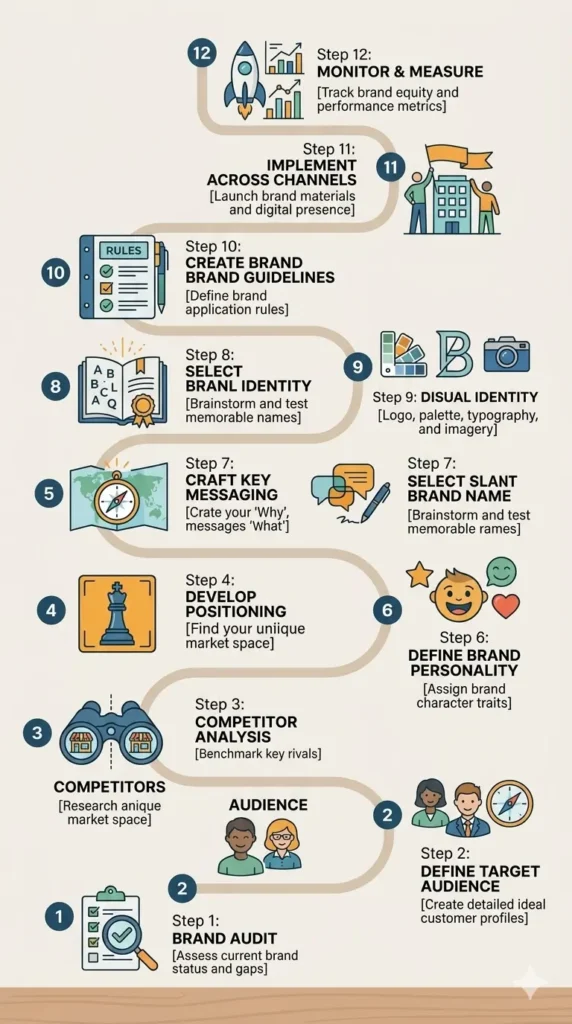
1. Audit Your Existing Brand
Before creating something new, examine what customers currently experience.
Review your:
- Website
- Search listings
- Social profiles
- Sales materials
- Product packaging
- Email templates
- Signage
- Proposals and invoices
- Reviews
- Customer-support messages
Ask whether these touchpoints look and sound as though they belong to the same business.
Score the following statements from one to five:
- Customers can quickly understand what we offer.
- We clearly explain whom we help.
- Our business has a meaningful competitive difference.
- Our visual identity is consistent.
- Our messaging uses a recognizable voice.
- Our website reflects the quality of our work.
- Our customer experience supports our promises.
- Employees and suppliers know how to represent the brand.
- Customers remember why they chose us.
- We measure changes in awareness and perception.
Low scores reveal where your brand identity for small business needs the most attention.
2. Define Your Target Audience
Generic branding usually begins with a generic audience.
Instead of trying to attract everyone, identify the people most likely to value your offer. Examine their:
- Goals
- Problems
- Priorities
- Objections
- Values
- Purchasing habits
- Preferred communication style
- Decision-making criteria
Basic demographics may be helpful, but motivations are often more valuable.
For example, two customers of the same bookkeeping service might have similar incomes and company sizes. One may primarily want to save time, while the other may be worried about avoiding errors. The branding and message should recognize these different motivations.
Create an ideal-customer statement:
We primarily help [type of customer] who need [desired result] but struggle with [main problem].
Your audience research should influence every later branding decision, including your voice, message, visual style and customer experience.
3. Research Direct and Indirect Competitors
Competitive research is not an invitation to copy another company. Its purpose is to find patterns, weaknesses and opportunities.
Direct competitors sell a similar product or service. Indirect competitors solve the same customer problem in a different way.
Review their:
- Positioning
- Main website headline
- Services
- Pricing approach
- Visual identity
- Content topics
- Customer reviews
- Calls to action
- Social communication
- Customer promises
Look for overused phrases. If every competitor describes itself as professional, innovative and customer-focused, those claims will not create meaningful differentiation.
Customer reviews are particularly useful. Positive comments reveal what the market values, while complaints can expose needs that existing businesses are not satisfying.
Summarize your opportunity in one sentence:
Most competitors focus on [common message], while our business can own [more relevant difference].
4. Establish Your Brand Positioning
Brand positioning defines the place you want your business to occupy in a customer’s mind.
It should clarify:
- Who the business serves
- What category it operates in
- What problem it solves
- What result it delivers
- How it is different
- Why customers should believe the promise
Use this positioning statement template:
For [target customer] who needs [desired result], we provide [product or service] that delivers [main benefit]. Unlike [alternative], we [meaningful difference], supported by [reason to believe].
A local maintenance company, for example, might position itself around fixed appointment windows and clear communication rather than making a vague claim about excellent service.
Your positioning does not need to appear word for word in public marketing. It is an internal decision-making tool that keeps your branding focused.
5. Define Your Purpose, Mission and Values
Your purpose explains why the business matters beyond making sales.
Your mission describes what it does and for whom.
Your values guide how it behaves.
These ideas should be practical rather than decorative. If reliability is a value, the business should have systems for keeping appointments and communicating delays. If simplicity is a value, its website, pricing and onboarding should be easy to understand.
Choose three to five values and define the expected behaviour behind each one.
Instead of writing:
Our value is transparency.
Write:
We explain costs, limitations and next steps before asking a customer to commit.
This turns an abstract word into an operational standard.
6. Create Your Brand Personality and Voice
Your brand personality is the set of human characteristics associated with your business.
It might be:
- Approachable
- Reassuring
- Practical
- Energetic
- Precise
- Playful
- Sophisticated
- Bold
Select three or four qualities that match both your audience and positioning.
Then translate those qualities into a brand voice.
A useful voice guide explains:
| We sound | We do not sound |
|---|---|
| Knowledgeable | Condescending |
| Friendly | Overly casual |
| Confident | Aggressive |
| Clear | Simplistic |
| Helpful | Promotional in every sentence |
Include examples of preferred vocabulary, sentence length, punctuation and calls to action.
The voice should remain recognizable across web pages, articles, emails, proposals and customer support, although the tone may adjust to the situation.
7. Develop Your Core Brand Messaging
Brand messaging turns your strategy into customer-facing language.
Develop these core components:
Value proposition
A concise explanation of the value customers receive.
We help [audience] achieve [result] without [major frustration].
One-sentence business description
A plain-language explanation that anyone can understand.
Primary customer promise
The result or experience customers should consistently expect.
Three message pillars
The supporting themes you want the business to become known for.
For example:
- Specialized expertise
- Straightforward processes
- Responsive support
Proof points
Evidence supporting each message pillar, such as:
- Relevant qualifications
- Years of experience
- Documented processes
- Customer outcomes
- Guarantees
- Reviews
- Case studies
Objection responses
Prepare clear answers to common concerns involving cost, risk, time or complexity.
Good messaging should be specific. “We provide quality solutions” could describe almost any company. “Receive a fixed quote within one working day” is clearer and easier to evaluate.
8. Choose Your Name and Tagline
A suitable business name should be:
- Easy to pronounce
- Easy to remember
- Relevant without being restrictive
- Distinct from competitors
- Suitable for future growth
- Available for appropriate legal and digital use
Before committing, conduct suitable company-name, domain, social-handle and trademark checks in the markets where you operate. Obtain professional legal advice when ownership or registration is uncertain.
A tagline is optional. It should not exist merely to sound clever. Use one when it clarifies the audience, benefit, category or personality.
Effective tagline structures include:
- Result without problem
- Product for audience
- Verb plus customer outcome
- Distinctive method plus benefit
Keep it brief enough to work beside your logo and in small digital spaces.
9. Build Your Visual Identity
Your visual identity should express the strategy rather than replace it.
Its main elements include:
Logo system
Create versions suitable for horizontal spaces, square profile images, small icons and single-colour applications.
Colour palette
Choose primary, secondary and neutral colours. Make sure text remains readable and contrast is sufficient across digital and printed materials.
Typography
Select a limited, practical font system for headlines, body text and occasional emphasis. Legibility is more important than novelty.
Imagery
Define whether the brand uses photography, illustration, icons or a combination. Establish guidance for subjects, composition, lighting and editing.
Layout system
Consistent spacing, shapes, borders and page structures can make a brand recognizable even when the logo is absent.
Accessibility
Check that the identity works for people with different visual, cognitive and physical needs. Avoid relying on colour alone to communicate meaning, use readable text sizes and provide meaningful descriptions for important images.
Brand-identity guides commonly include purpose, story, name, logo, colours, typography, graphics and tone of voice.
10. Create Practical Brand Guidelines
Brand guidelines document how the identity should be used.
A small business does not necessarily need a lengthy manual. A concise guide can cover:
- Brand purpose and positioning
- Audience summary
- Logo versions and minimum sizes
- Incorrect logo usage
- Colour specifications
- Typography
- Photography or illustration style
- Voice and tone
- Core messages
- Example applications
- Contact details for brand questions
The guide should be understandable to employees, designers, writers, printers and external suppliers.
A document that nobody can interpret will not create brand consistency. Include visual examples showing both correct and incorrect applications.
11. Apply the Brand Across Every Touchpoint
Customers should experience the same fundamental brand whether they find you online, speak with an employee or receive a product.
Prioritize these touchpoints:
- Homepage and service pages
- Local search profile
- Directory listings
- Social profiles
- Email signatures
- Enquiry forms
- Proposals
- Product packaging
- Invoices
- Presentations
- Customer-support templates
- Physical signs
- Review responses
- Recruitment materials
Consistency does not mean repeating identical content everywhere. It means maintaining the same positioning, personality and standards while adapting the format to each channel.
This is also where branding and customer experience connect. A company that promises convenience should not have a complicated enquiry process. A company that promises personal service should not send cold, generic responses.
12. Measure, Test and Improve
Brand building is an ongoing process. Measure both visibility and business outcomes.
Useful indicators include:
Awareness indicators
- Branded search impressions
- Direct website visits
- Social mentions
- Referral traffic
- Surveyed brand recall
Engagement indicators
- Returning website visitors
- Email engagement
- Content completion
- Enquiries from branded searches
Commercial indicators
- Enquiry conversion rate
- Sales conversion rate
- Repeat-purchase rate
- Average customer value
- Referral volume
Perception indicators
- Review themes
- Customer interviews
- Sales-call feedback
- Reasons customers choose or reject the business
Record a baseline before changing the brand. Review progress monthly or quarterly and separate branding indicators from short-term promotional results.
Brand-strategy guidance increasingly connects branding work with website traffic, search visibility, lead costs and other performance measurements.
Small Business Branding Examples by Industry
Branding principles become easier to understand when they are applied to real business situations.
The following scenarios show how the same branding process can produce very different outcomes depending on the audience and market.
Example: HVAC Company
Target audience: Homeowners who need reliable heating and cooling services.
Customer problem: Homeowners may need urgent help but are concerned about unreliable contractors, unclear pricing, or unnecessary repairs.
Possible positioning: Responsive local HVAC specialists focused on straightforward recommendations and dependable service.
Brand promise: Clear communication from booking through completion.
Visual direction: Clean, practical, trustworthy, and easy to recognize.
Primary CTA: Book HVAC Service.
The important branding lesson is that the company should not simply try to “look professional.” Every part of the brand should reduce the customer’s perceived risk.
Example: Roofing Company
Target audience: Homeowners considering roof repairs or replacements.
Customer problem: Roofing is expensive and difficult for non-specialists to evaluate.
Possible positioning: A roofing company that makes complex projects easier to understand through documented inspections, clear recommendations, and organized project communication.
Brand promise: Customers understand what is being recommended and why.
Visual direction: Dependable, established, practical.
Primary CTA: Schedule a Roof Inspection.
The website should reinforce the positioning with project galleries, reviews, credentials, warranties, and an explanation of the process.
Example: Dental Practice
Target audience: Families and adults seeking routine or restorative dental care.
Customer problem: Dental anxiety, uncertainty about treatment, and confusing costs can make people delay appointments.
Possible positioning: Modern dental care delivered through a calm, clear, patient-friendly experience.
Brand promise: Patients understand their options before treatment begins.
Visual direction: Clean, reassuring, approachable.
Primary CTA: Book an Appointment.
In this case, the emotional experience is as important as the visual identity.
Example: Law Firm
Target audience: Individuals or businesses dealing with a specific legal problem.
Customer problem: Legal services can feel complicated, expensive, and intimidating.
Possible positioning: Specialist legal guidance explained in straightforward language.
Brand promise: Clients understand their options and next steps.
Visual direction: Authoritative and professional without becoming cold or intimidating.
Primary CTA: Request a Consultation.
Proof of expertise becomes especially important. Relevant credentials, attorney profiles, practice experience, useful educational content, and appropriate case evidence can support the brand.
Example: Remodeling Company
Target audience: Homeowners planning substantial kitchen, bathroom, basement, or whole-home renovations.
Customer problem: Customers worry about poor workmanship, delays, cost overruns, and communication problems.
Possible positioning: A design-led remodeling partner offering organized communication from initial planning through project completion.
Brand promise: A clearer renovation process with defined stages and regular updates.
Visual direction: Premium, architectural, lifestyle-focused.
Primary CTA: Request a Project Consultation.
For this business, photography and completed-project evidence are central branding assets rather than decorative additions.
What These Examples Show
Notice that none of these examples begins with choosing a logo color.
The starting point is always:
customer → problem → positioning → promise
The visual identity comes later.
That sequence makes branding more likely to influence how customers understand and choose the business.
Small Business Branding on a Budget
A limited budget does not prevent a business from developing a clear brand. It does require careful prioritization.
What you can often do internally
- Interview customers
- Clarify your audience
- Review competitors
- Define values
- Draft a positioning statement
- Identify message pillars
- Audit touchpoints
- Collect customer feedback
- Maintain a consistency checklist
What may benefit from specialist assistance
- Market research
- Positioning strategy
- Business naming
- Trademark advice
- Logo development
- Complete visual identity
- Website design
- Professional photography
- Packaging design
Recommended spending order
When practising branding on a budget, prioritize:
- Audience and positioning
- Clear messaging
- A simple, usable identity
- A professional website
- Consistent customer materials
- Additional campaigns and branded merchandise
Do not spend most of the budget on an elaborate logo while leaving the website confusing and the customer experience inconsistent.
Affordable tactics such as useful content, strategic partnerships, community activity and memorable customer interactions can expand awareness without requiring a large advertising budget.
How Much Does Small Business Branding Cost in the US?
Small business branding costs vary widely because a “branding project” can mean anything from creating a basic logo to conducting research, developing positioning and messaging, designing a complete visual identity, and rolling the brand out across a website and marketing materials.
As of 2026, it is reported that most branding projects reviewed on its platform fall between $10,000 and $49,999, while branding agencies commonly charge around $100 to $149 per hour. These figures reflect agency projects and should not be interpreted as the minimum amount every small business needs to spend.
A practical way to think about the market is by scope:
| Branding approach | What it may include | Best suited to |
|---|---|---|
| DIY | Basic logo, colors, fonts and templates | New or pre-revenue businesses |
| Freelancer | Custom logo and basic visual identity | Businesses with clear positioning that mainly need design execution |
| Small agency | Research, positioning, messaging, identity and guidelines | Growing businesses competing in established markets |
| Full strategic rebrand | Research, positioning, messaging, identity, website applications and rollout | Established companies making a significant market or business change |
The cheapest option is not automatically the best option, and neither is the most expensive.
The right investment depends on the problem you are trying to solve.
If the business already has clear positioning and messaging, it may only require better design execution.
If customers struggle to understand why the business is different, paying only for a new logo is unlikely to solve the underlying problem.
Before requesting branding proposals, define whether you need:
- Strategy
- Messaging
- Naming
- Visual identity
- Brand guidelines
- Website application
- Marketing templates
- Packaging
- Rollout support
Comparing proposals becomes much easier when every provider is pricing a similar scope.
A 90-Day Small Business Branding Plan
Days 1–30: Research and strategy
- Complete the brand audit.
- Interview customers.
- Define the ideal audience.
- Analyse direct and indirect competitors.
- Finalize positioning.
- Select purpose, mission and values.
- Establish initial success metrics.
Deliverable: One-page small business brand strategy.
Days 31–60: Messaging and identity
- Create the value proposition.
- Write the business description.
- Develop message pillars.
- Define personality and voice.
- Review or create the business name.
- Design the visual identity.
- Prepare the first version of the brand guidelines.
Deliverable: Messaging framework and visual identity system.
Days 61–90: Implementation
- Update priority website pages.
- Standardize social profiles and listings.
- Revise email and proposal templates.
- Update packaging and printed materials.
- Train employees and suppliers.
- Begin tracking the selected metrics.
- Collect customer feedback after launch.
Deliverable: A consistent public brand supported by an improvement plan.
Common Small Business Branding Mistakes
Treating branding as a logo project
A new logo cannot solve weak positioning, vague messaging or poor service.
Trying to appeal to everyone
Broad, generic branding rarely creates a strong connection. Focus on the customers most likely to value your difference.
Copying larger competitors
Imitation makes a small business less memorable. Study competitors to find gaps, not to reproduce their choices.
Following design trends too closely
Trends can make a business look current, but they can also date quickly. Choose visual elements that reflect the strategy and remain usable.
Using inconsistent language
A company that sounds formal on its website, humorous on social media and aggressive in sales emails can confuse customers.
Making unsupported promises
Claims should be supported by processes or evidence. Do not promise immediate replies without the resources to provide them.
Ignoring employees
Employees influence the brand through every customer interaction. Give them practical guidance rather than expecting them to interpret a design document.
Failing to measure results
Without a baseline, it is difficult to know whether a rebrand improved awareness, perception or conversion.
When Should a Small Business Rebrand?
Consider rebranding a small business when:
- The visual identity appears outdated or unprofessional.
- The company now serves a different audience.
- Products or services have significantly changed.
- The current name limits expansion.
- Competitors are frequently confused with the business.
- Customers misunderstand the value proposition.
- A merger or acquisition has changed the organization.
- The existing identity is difficult to use digitally.
- Reputation problems require more than cosmetic changes.
- Different departments present inconsistent versions of the company.
Not every problem requires a complete rebrand. Sometimes clearer messaging, improved guidelines or a visual refresh is sufficient.
A full rebrand changes the strategic foundation. A refresh improves how an existing strategy is expressed.
Small Business Branding Checklist
Use this small business branding checklist before launching:
- Target audience is clearly defined.
- Customer problems and motivations are documented.
- Direct and indirect competitors have been reviewed.
- Positioning statement is complete.
- Main differentiator is specific and relevant.
- Purpose, mission and values influence actual behaviour.
- Brand personality has three or four clear traits.
- Voice guidelines include practical examples.
- Value proposition is easy to understand.
- Message pillars are supported by proof.
- Business name has been checked appropriately.
- Visual identity works across different sizes and formats.
- Colours and typography are accessible and readable.
- Brand guidelines are available to the team.
- Website and search listings use consistent information.
- Customer experience supports the brand promise.
- Baseline performance metrics have been recorded.
- Brand performance is reviewed regularly.
Frequently Asked Questions
What does small business branding include?
Small business branding includes brand strategy, positioning, purpose, values, messaging, voice, visual identity, guidelines and customer experience. It covers how a company presents itself and how customers perceive their interactions with it.
How do I start branding my small business?
Start by defining your target audience, reviewing competitors and clarifying what makes your business meaningfully different. Develop your positioning and messaging before choosing a logo, colours or fonts.
Can I create my small business branding myself?
You can complete much of the initial research and strategy yourself. Professional assistance may be valuable for naming, legal checks, positioning, visual identity, packaging or website design when those decisions have significant commercial consequences.
How much does small business branding cost?
The cost depends on the project’s scope. A basic identity costs less than a complete project involving research, positioning, naming, messaging, visual design, website development and implementation. Define the business problem before requesting quotations so that proposals can be compared fairly.
How long does it take to build a brand?
Initial strategy and identity development can take several weeks or months, depending on the research, number of decision-makers and required materials. Building recognition and trust takes longer and depends on consistent implementation.
Is a logo the same as a brand?
No. A logo is a visual identifier. A brand includes the wider strategy, reputation, messages, experiences and associations connected to the business.
What comes first, branding or marketing?
Branding should generally establish the audience, positioning, message and identity before major marketing activity begins. Marketing then communicates that foundation through appropriate channels.
How often should a small business update its branding?
Review the brand annually and whenever the audience, market, services or business strategy changes significantly. Frequent cosmetic changes can weaken recognition, so updates should address a genuine strategic or usability problem.
Final Thoughts
Successful branding for small businesses begins with clarity, not decoration.
Understand your audience. Establish a distinctive position. Create clear messaging. Develop a visual identity that supports the strategy. Apply it consistently and make sure the customer experience delivers what the business promises.
When these elements work together, your company becomes easier to recognize, understand, trust and recommend.
Want to build up Your Brand? Contact us and get free cosultation now!