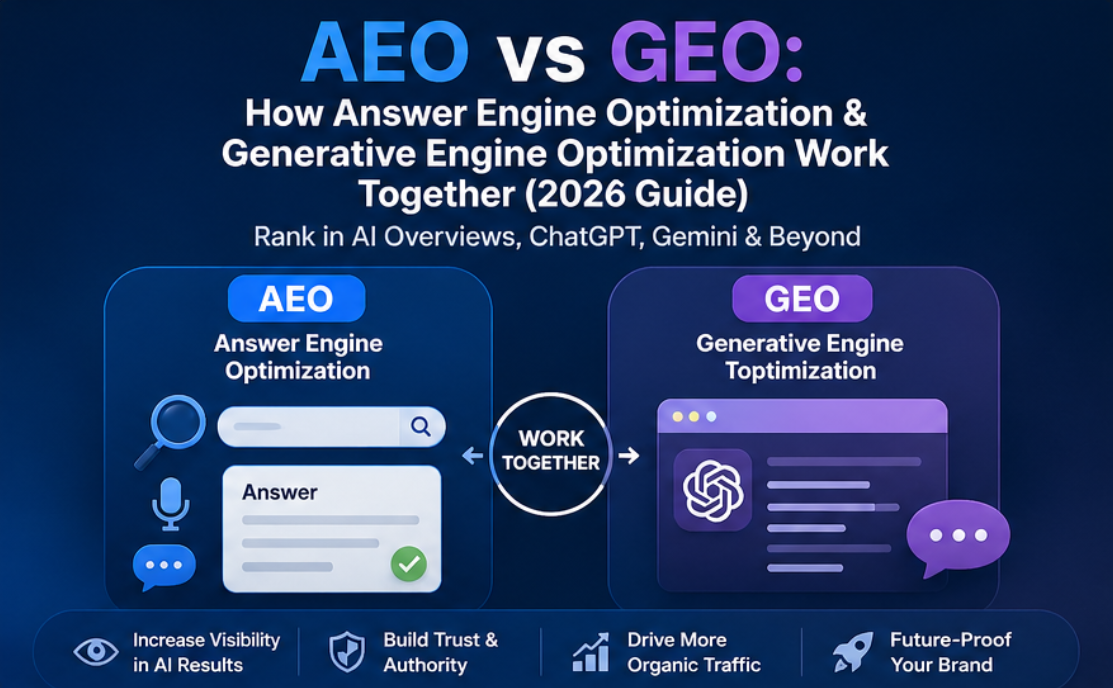
AEO vs GEO: How Answer Engine Optimization & Generative Engine Optimization Work Together (2026 Guide)
The way people discover information online is changing faster than at any point since the invention of search engines. In 2026 more than 64 % of Google searches end without a click. Voice assistants process over 10 billion queries per day and generative AI tools like ChatGPT, Gemini and Perplexity provide answer snippets that satisfy user intent on the results page. As a result, traditional SEO is no longer enough: businesses must prepare their content to be picked up by answer engines and cited by generative models. This guide explains the difference between Answer Engine Optimization (AEO) and Generative Engine Optimization (GEO), how they complement each other and how you can use both to attract traffic and convert visitors into clients.
What is Answer Engine Optimization (AEO)?
Answer Engine Optimization (AEO) focuses on helping search engines provide direct answers. Its roots lie in winning featured snippets, knowledge panels and “People Also Ask” boxes on Google. AEO content is structured to:
- Directly address common user questions – AEO content answers “What is…?”, “How does…?” and “Why…?” queries succinctly.
- Use clear, scannable formatting – lists, tables and FAQ sections make it easy for answer engines to extract information.
- Establish authority and credibility – including data citations, author bios and structured schema helps the answer engine trust your page, especially for “Your Money or Your Life” topics.
Historically AEO meant optimizing for Google’s featured snippets. However, the approach also applies to voice assistants. Voice search answers are often drawn from featured snippets; 40.7 % of voice responses come from snippet pages, and the average voice query contains around 29 words. To win voice answers you must write conversational, complete sentences that align with how people speak.
What is Generative Engine Optimization (GEO)?
While AEO works within traditional search results, Generative Engine Optimization (GEO) is about being cited in AI‑generated summaries and conversational interfaces. GEO emerged as search engines began integrating generative AI into their results pages. Instead of returning only blue links, tools like Google’s AI Overviews, ChatGPT Search and Perplexity summarize information from multiple sources into a single paragraph. GEO’s goal is to ensure your content is included in these AI overviews. It emphasizes:
- Training AI models to recognize your brand as a trusted authority – the focus is on building entities (company, products, people) with consistent naming and structured data.
- Optimizing for a variety of generative platforms – Google SGE, ChatGPT Search, Perplexity, Bing Copilot and Gemini each have different citation algorithms.
- Providing machine‑friendly structures – clear headings, concise summaries, schema markup and front‑loaded key information make it easier for large language models to synthesize and cite your content.
GEO also reflects the growing prevalence of AI‑driven features. AI Overviews now appear on about 48 % of Google queries, up from 31 % a year earlier. When AI Overviews appear, organic click‑through rates drop 34.5–61 %. However, brands cited in AI Overviews see a 5× higher conversion rate. GEO therefore isn’t optional – it is an essential way to maintain visibility and drive high‑intent visitors in an AI‑first search world.
AEO vs GEO: Similarities and Differences
It’s common to ask whether AEO and GEO are the same. They share principles but serve different search behaviours. AEO tries to win direct answers in search results. GEO expands those techniques into AI‑generated experiences. The table below summarises the distinctions:
| Aspect | AEO (Answer Engine Optimization) | GEO (Generative Engine Optimization) |
|---|---|---|
| Primary goal | Optimise content for featured snippets, knowledge panels and direct answers. | Optimise content to be cited in AI‑generated summaries and conversational answers. |
| Platform focus | Primarily Google Search (featured snippets, knowledge panels). | Google AI Overviews, ChatGPT Search, Perplexity AI, Bing Copilot and Gemini. |
| Core tactics | Use FAQ schema, answer user questions clearly, highlight keywords and provide concise lists. | Build strong entity profiles, use structured data, front‑load key facts, link to authoritative sources and maintain freshness. |
| Traffic focus | AEO aims to drive visitors from snippets to your site (traffic generation). | GEO may or may not generate clicks; citations deliver visibility and brand authority, with conversions often happening off‑site. |
| Timeframe | AEO techniques date back to the pre‑AI era. | GEO techniques emerged in 2024–2025 to address generative search. |
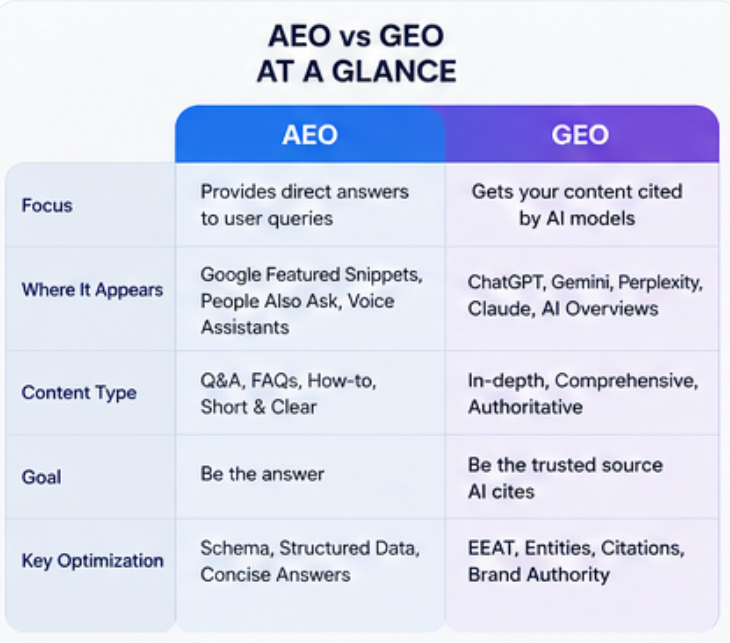
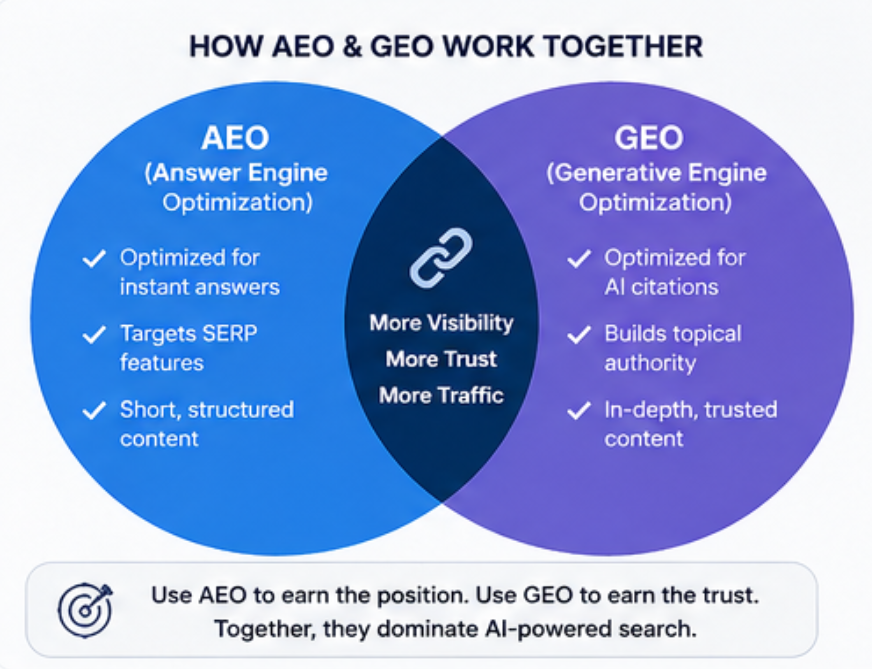
The overlap between AEO and GEO means you don’t need to choose one or the other. In fact, businesses need both: featured snippets and AI overviews coexist, and entity optimisation matters for both. As AI adoption grows, focusing solely on rankings misses opportunities for brand visibility and trust.
Why You Need Both AEO and GEO?
There are three reasons companies should invest in both answer engine and generative engine optimisation:
- Visibility across channels – Traditional organic results, featured snippets and AI overviews can all drive discovery. 64.82 % of Google searches end without a click, but brands cited in AI answers receive higher‑quality traffic that converts. AEO helps capture snippet visibility; GEO ensures your brand appears in AI‑generated summaries.
- Answer engines and AI overviews are converging – Google’s AI Overviews now appear on nearly half of queries and reduce CTR on traditional links, yet the same AI surfaces still draw content from pages that also rank in the top 10 of Google. Optimising for AEO increases your chances of being cited by AI. Conversely, GEO strategies such as entity building and structured data make your AEO content more likely to win snippets.
- Entity and trust signals matter more than keywords – AI models evaluate not just how well you answer a question, but how trustworthy you are. Clear author bios, expert quotes, citations and consistent branding help both answer engines and generative models choose your content. Local businesses must also demonstrate strong local relevance, accurate business data, high‑quality content and positive reviews.
Key Tactics for AEO and GEO Success
Regardless of platform, both AEO and GEO benefit from structured, authoritative content. The following tactics blend traditional SEO best practices with emerging AI‑search requirements.
1. Identify and Answer High‑Intent Questions
Use keyword tools, customer support transcripts, Reddit discussions and voice search suggestions to build a list of the questions your audience asks. Cover both head terms and long‑tail conversational queries. For each query, create a dedicated section or page that answers the question clearly. Focus on “how,” “why,” and “what” questions to capture knowledge intent.
2. Structure Content for Easy Extraction
AI and answer engines extract information algorithmically. To facilitate this:
- Use descriptive headings and subheadings. Phrasing headings as questions helps answer engines understand the intent.
- Break up text with bullet lists, numbered steps and tables. These elements are easy for AI to parse and often get pulled into snippets.
- Create a FAQ section and implement FAQ schema markup, which is specifically recognised by Google’s answer engine.
- Front‑load key information within the first 30 % of your article. Data shows that 44.2 % of all LLM citations come from the opening section of content.
3. Optimise Entities and Schema
Large language models rely on entities to determine the authority of your page. Use structured data (schema.org) to mark up your organization, products, services and articles. Ensure your brand name, address, phone number and descriptions are consistent across your website and external citations. Building a robust entity profile makes it more likely that AI tools will reference you in summaries.
For local businesses, this includes:
- Maintaining an accurate Google Business Profile – categories, service areas, operating hours and photos should be updated regularly.
- Encouraging detailed, authentic reviews – AI models analyse sentiment as well as volume.
- Adding local schema (e.g.,
LocalBusiness,PostalAddress) and ensuring citations on directories like Yelp and TripAdvisor are consistent.
4. Provide Credibility and Trust Signals
Generative models and answer engines favour content from authoritative sources. To build trust:
- Cite reputable sources and include data points from recognised organisations. Use footnotes and outbound links to reinforce your claims.
- Feature author bios with credentials that demonstrate expertise (e.g., certifications, years in practice).
- Include case studies and testimonials. For local businesses, highlight community involvement and partnerships to enhance trustworthiness.
- Publish fresh content regularly. Research shows that content under three months old is three times more likely to be cited in AI answers.
5. Optimise for Voice and Conversational Search
Voice search is inherently conversational. With 8.4 billion active voice assistants worldwide and voice queries averaging 29 words, your content must read naturally when spoken aloud. Use complete sentences, short paragraphs and a friendly tone. Since voice results often come from featured snippets, incorporate the question in the subheading and answer it immediately beneath.
6. Build a Multi‑Platform Presence
Generative engines span multiple platforms. Aside from optimizing for Google’s AI Overviews, consider how your content is presented on ChatGPT Search, Perplexity, Bing Copilot, Gemini and Reddit. Each platform has unique signals; for example, Reddit discussions reveal authentic user questions and natural language patterns. Engage in communities relevant to your industry, answer questions, and link back to authoritative content on your site.
7. Measure AI Visibility, Not Just Rankings
Because zero‑click searches dominate, tracking rankings alone is misleading. Use analytics tools to monitor citation counts in AI answers, referral quality and conversion rates. The zero‑click rate on Google (64.82 %) and on AI search engines like ChatGPT and Perplexity (60 %–93 %) means that brand impressions within AI answers are as important as clicks. Tools like Semrush, Surfer, and new AI‑citation monitors can help you track both snippet wins and AI citations.
Step‑by‑Step AEO+GEO Content Strategy
You’ve learned the principles—now it’s time to build your own answer and generative optimisation plan. Here’s a step‑by‑step process that integrates both:
- Audit your existing content. Identify which pages currently earn featured snippets, AI citations or voice responses. Look for gaps where you can add question‑and‑answer sections, update outdated information or restructure paragraphs. Use a zero‑click audit tool to see where your traffic is being lost to AI overviews.
- Research questions and conversational keywords. Use tools like AnswerThePublic, Google’s People Also Ask, ChatGPT, Reddit and your own customer support tickets to build a list of questions your audience asks. Map these questions to each stage of the buyer journey (awareness, consideration, decision).
- Create pillar pages and topic clusters. Pillar pages cover broad themes (e.g., “Digital Marketing for Local Businesses”), while cluster posts answer specific questions. Interlink them to build topical authority and help AI engines understand relationships between your pages.
- Write authoritative answers. For each question, provide a concise answer (one or two sentences) followed by a deeper explanation. Include data points, examples and internal/external links to credible sources.
- Implement schema markup. Use FAQS Page schema for question sections, Article schema for blog posts and Local Business schema for service pages. Validate your markup with Google’s Rich Results Test.
- Encourage reviews and brand mentions. Ask satisfied clients to leave detailed reviews on Google, Facebook and industry platforms. Participate in local events and partnerships to generate news articles and citations that increase your entity’s authority.
- Distribute your content. Share articles on social media, industry forums and relevant subreddits. Participate in discussions to build recognition as a helpful brand. Since 76 % of AI Overview citations come from pages already ranking in the top 10, a combined promotion and link‑building strategy helps both AEO and GEO.
- Monitor and refresh. Track which pieces earn snippets and citations, update them regularly and expand successful sections. Because fresh content is three times more likely to be cited, schedule updates every few months.
Frequently Asked Questions (FAQ)
Q: Do I still need traditional SEO if I focus on AEO and GEO?
Yes. Traditional SEO provides the foundation—technical health, keyword targeting and link building—that allows answer engines and AI models to discover your content. Without strong SEO, you may never rank high enough to be considered for snippets or AI citations. Think of SEO as your ticket into the conversation; AEO and GEO determine how you’re quoted once you’re there.
Q: How quickly will I see results from AEO and GEO?
Featured snippet wins can occur within weeks of publishing well‑structured content. GEO results may take longer, as AI models crawl and retrain on your pages. Keep publishing and refreshing content; a sustained effort is necessary, especially because freshness influences AI citations.
Q: Can small businesses compete in AI search?
Absolutely. Local businesses may even have an advantage because AI models prioritise strong local relevance and accurate data. By optimising your Google Business Profile, collecting reviews, adding local schema and answering local questions, you can earn citations in AI overviews for “near me” searches.
Q: What metrics should I track?
Beyond rankings, monitor zero‑click impressions, citation counts in AI answers, click‑through rates when AI overviews appear and conversion rates of AI‑referred visitors. Tools like Semrush’s AI Visibility Checker or custom scripts can alert you when your pages are cited.
Conclusion & Next Steps
In 2026 the distinction between answering questions and being cited by AI is blurred. AI Overviews appear on nearly half of all searches, and voice search adoption continues to explode. If you want your business to remain discoverable, you must optimise for both answer engines and generative engines. Fortunately, many of the same best practices apply: create authoritative, structured content; focus on entities and trust; update pages regularly; and understand your audience’s questions.
At The Vital Solutions, we specialise in AI‑driven SEO, AEO and GEO strategies. Our team can audit your website, build a tailored content plan and ensure your brand is recognised by search engines, voice assistants and generative AI platforms. If you’re ready to turn AI visibility into qualified leads, contact us today for a free consultation.