How to Track ChatGPT Rankings Over Time
Tracking ChatGPT AI rankings over time is different from monitoring traditional Google keyword positions. ChatGPT does not show a fixed list of ten organic results where your website permanently sits at position 1, 3 or 8. Its answers can change depending on the prompt, conversation context, available sources and how the system retrieves information.
That does not mean ChatGPT visibility cannot be measured.
The better approach is to track how often your brand appears across a consistent set of relevant prompts, how often your website is cited, which competitors appear alongside you and whether those numbers improve or decline over time.
For most businesses, the core metrics are brand mention rate, citation rate, prompt coverage, AI share of voice and competitor visibility.
If your goal is to understand whether ChatGPT is becoming more likely to recommend or reference your business, these metrics provide a much more useful picture than trying to assign your website one artificial “ChatGPT ranking.”
Can You Actually Track Rankings in ChatGPT?
Yes, but not in exactly the same way you track Google rankings.
Traditional SEO rank tracking normally asks:
“What position does my page hold for this keyword?”
ChatGPT tracking asks a different question:
“How frequently does my brand appear when users ask relevant questions?”
The distinction matters because AI-generated responses are dynamic. A brand may be mentioned first in one response, second in another and not mentioned at all in a third.
For that reason, a useful ChatGPT rank tracker should measure repeated visibility rather than pretending that every brand has one permanent numerical position.
For example, suppose an accounting software company monitors 50 purchase-intent prompts.
Its brand appears in 18 ChatGPT answers in January.
Its mention rate is:
18 ÷ 50 × 100 = 36%
In February, the company appears in 29 of the same 50 prompts.
Its new mention rate is:
29 ÷ 50 × 100 = 58%
That tells the marketing team something meaningful: visibility across its tracked prompt set increased from 36% to 58%.
Saying the brand “moved from ChatGPT position 5 to position 2” would provide far less reliable information.
ChatGPT Rankings vs. Google Rankings
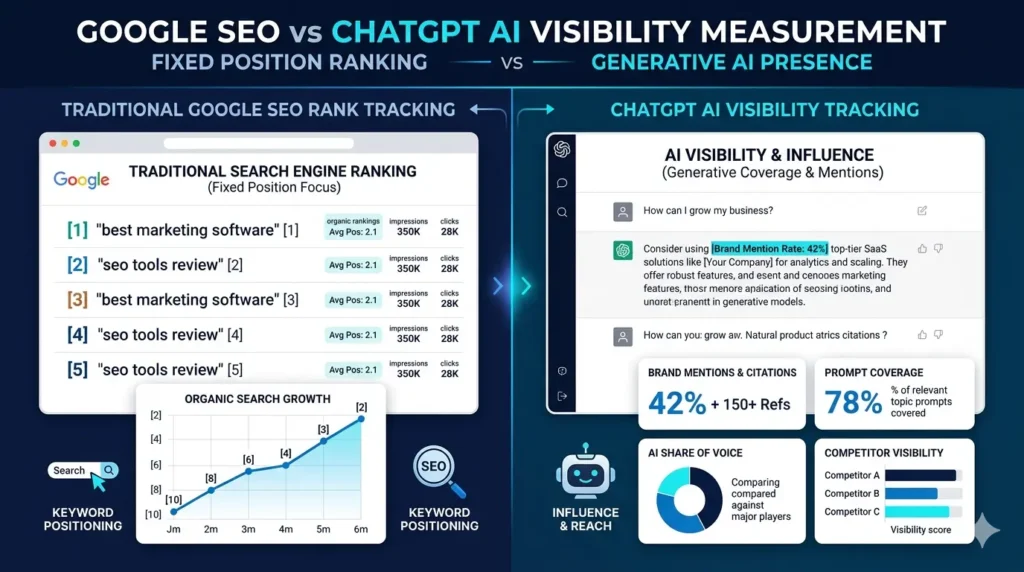
Google and ChatGPT both help people discover information, but the measurement models are different.
| Google SEO Tracking | ChatGPT Visibility Tracking |
|---|---|
| Tracks keyword positions | Tracks prompt visibility |
| Measures URLs in search results | Measures brands, products and cited sources |
| Often reports positions such as #1 or #5 | Usually reports mention or recommendation frequency |
| Focuses heavily on individual keywords | Works better across related prompt groups |
| Measures impressions, clicks and rankings | Measures mentions, citations and AI share of voice |
| Search Console provides Google performance data | Dedicated AI monitoring usually requires manual testing or third-party tools |
This difference is why businesses searching for ChatGPT website rank tracking should avoid evaluating their performance through a Google-only ranking mindset.
The real goal is not to achieve an imaginary permanent ChatGPT position.
The goal is to become a frequently mentioned, accurately represented and trusted source across the questions potential customers actually ask.
What Should You Track Instead of One ChatGPT Ranking?
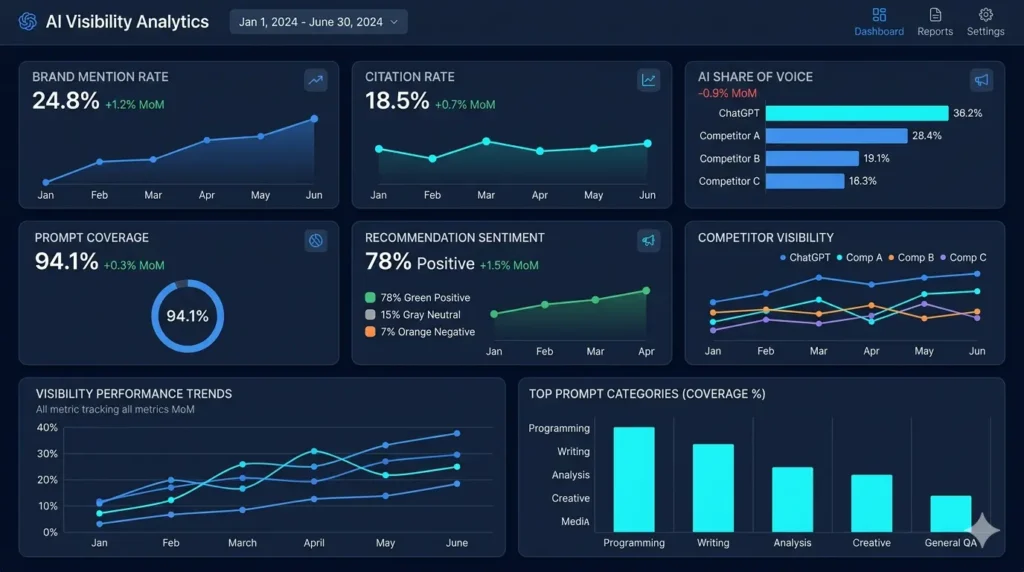
A useful ChatGPT SEO tracker should show more than whether your company appeared once.
Brand Mention Rate
Brand mention rate measures how frequently ChatGPT names your company across your tracked prompts.
If your brand appears in 30 of 60 monitored prompts, your mention rate is 50%.
Track this number consistently using the same prompt group. A rising trend can indicate that your brand is becoming more visible within the topic.
Citation Rate
A brand mention and a website citation are not the same thing.
ChatGPT may recommend a company without linking to its website. In another response, it may cite an article from that company’s domain as supporting evidence.
Citation rate measures the percentage of tracked responses where your domain or page is used as a source.
OpenAI’s ChatGPT Search documentation confirms that search-supported responses may display inline citations and a Sources panel containing cited and related websites.
For SEO teams, this makes ChatGPT brand citation tracking particularly valuable because it shows which pages are actually supporting AI-generated answers.
AI Share of Voice
AI share of voice compares your brand’s visibility with competing companies.
Suppose your company and three competitors receive the following mentions across a defined prompt set:
| Brand | Mentions |
|---|---|
| Your brand | 42 |
| Competitor A | 58 |
| Competitor B | 35 |
| Competitor C | 25 |
Instead of looking at your 42 mentions in isolation, share of voice shows how much of the overall competitive conversation your company owns.
This becomes especially useful for reporting changes month over month.
Prompt Coverage
Prompt coverage shows how broadly your business appears across different customer questions.
A company may perform strongly for informational prompts but disappear when users ask commercial questions such as:
“Which company is best for…?”
“What are the best alternatives to…?”
“Which software should I use for…?”
“Compare X and Y.”
Tracking prompt coverage helps you identify those gaps.
Recommendation Context
Being mentioned is useful, but how you are mentioned matters.
ChatGPT might describe your brand as the best choice for small companies, an enterprise solution, a budget option or an alternative to another product.
Record that context.
Marketing teams should know not only whether their brand appears but what attributes AI systems repeatedly associate with it.
Competitor Visibility
A good ChatGPT visibility tracker should also show which competitors appear where you do not.
These gaps can reveal missing topics, weak supporting content, stronger competitor authority, third-party mentions or source pages that deserve further analysis.
How to Track ChatGPT AI Rankings Over Time?
Reliable tracking starts with consistency.
Do not ask five random ChatGPT questions this week and twelve completely different questions next month and treat the results as comparable.
Step 1: Identify the Topics That Matter to Your Business
Start with real customer problems rather than hundreds of isolated SEO keywords.
A B2B cybersecurity company, for example, might track separate topics around ransomware protection, endpoint security, cloud security and enterprise threat monitoring.
An ecommerce business could organize prompts around product categories, comparisons, alternatives and purchase recommendations.
Think in topics and user journeys, not only keyword lists.
Step 2: Build a Consistent Prompt Set
For each important topic, create multiple prompts representing the ways prospective customers may ask questions.
Include informational, comparison and commercial prompts.
Instead of tracking only:
“Best CRM software”
also monitor variations such as:
“What CRM is best for a 20-person sales team?”
“Best affordable CRM for a US small business”
“HubSpot alternatives for growing companies”
“Which CRM works best for B2B sales teams?”
These prompts have different wording but belong to the same customer-intent cluster.
Step 3: Establish Your Baseline
Run your initial prompt set and record the results.
Capture the date, prompt, whether your brand appeared, whether your website was cited, which competitors appeared and how your company was described.
This creates your starting benchmark.
Without a baseline, future increases or decreases have little context.
Step 4: Separate Brand Mentions From Citations
Do not combine them into one metric.
A ChatGPT mention tracker should distinguish between:
Mention: ChatGPT names your brand.
Citation: ChatGPT uses your website or content as a supporting source.
Both matter, but they tell you different things.
A high mention rate with a low citation rate may mean the brand has strong market recognition but its own content is not frequently being selected as supporting material.
A rising citation rate may suggest your pages are becoming more useful within AI-assisted research journeys.
Step 5: Compare Your Competitors
Record competitor mentions using the same prompt set.
This transforms simple ChatGPT brand tracking into competitive intelligence.
If three competitors repeatedly appear for “best X software for healthcare” while your company does not, you have found a specific visibility gap.
You can then investigate whether competitors have stronger category pages, comparison content, independent reviews, industry mentions, research or other supporting signals.
Step 6: Repeat the Test Consistently
Use the same important prompts at regular intervals.
Weekly tracking works well when you are actively improving content or operating in a competitive market. Monthly reporting may be enough for broader executive trend analysis.
The exact schedule matters less than consistency.
Avoid treating a single changed answer as proof that your entire strategy succeeded or failed.
Step 7: Evaluate Longer-Term Trends
Compare 30-, 60- and 90-day results rather than obsessing over individual response changes.
Your reporting should answer questions such as:
Did our mention rate improve?
Are more pages being cited?
Which topics gained visibility?
Which topics lost visibility?
Did competitor share of voice change?
Which new pages began appearing as citations?
What content or PR activity happened before the change?
This connects AI visibility data to actual marketing decisions.
A Simple ChatGPT Visibility Scorecard
You do not need a complicated proprietary score to start measuring performance.
A practical scorecard could look like this:
| Metric | Month 1 | Month 2 | Change |
|---|---|---|---|
| Brand mention rate | 38% | 51% | +13 pts |
| Citation rate | 14% | 23% | +9 pts |
| Commercial prompt coverage | 27% | 39% | +12 pts |
| AI share of voice | 22% | 31% | +9 pts |
| Competitor gap prompts | 31 | 19 | -12 |
This gives decision-makers a much clearer picture than a single “AI rank.”
How to Track Brand Mentions in ChatGPT Manually
You can begin ChatGPT rank tracking free without purchasing specialized software.
Create a spreadsheet containing your prompts and rerun them at predetermined intervals. Record whether your brand appears, the surrounding context, citations and competitors.
A useful tracking sheet can contain:
| Date | Prompt | Brand Mention | Website Citation | Competitors | Recommendation Context |
|---|---|---|---|---|---|
| Aug 1 | Best X for small businesses | Yes | No | A, B | Recommended for affordability |
| Aug 8 | Best X for small businesses | Yes | Yes | A, C | Recommended for ease of use |
| Aug 15 | Best X for small businesses | No | No | A, B | Not present |
Manual monitoring works well for a small strategic prompt set.
The limitation appears when you need to monitor hundreds or thousands of prompts, multiple competitors, several AI platforms and historical trends.
That is where ChatGPT rank tracking software becomes useful.
What Does a ChatGPT Rank Tracker Tool Do?
A ChatGPT rank tracker tool automates repeated AI visibility checks and converts responses into measurable data.
Depending on the platform, a ChatGPT tracking tool may monitor brand mentions, citations, prompt-level visibility, competitor appearances, share of voice and changes over time.
Platforms such as Ahrefs and Semrush now include AI visibility capabilities that help marketers analyze ChatGPT mentions, citations and competitor performance.
The right tool is not necessarily the one with the largest dashboard.
Choose a system that lets you track prompts important to your customers, preserve historical results and separate mentions from citations.
That makes the data actionable.
What Is the Best ChatGPT Keyword Rank Tracker?
There is no universally best ChatGPT keyword rank tracker for every company.
The right choice depends on what you need to measure.
A small company monitoring 20 high-value commercial prompts may be comfortable with a spreadsheet or lightweight ChatGPT mention tracker.
An agency managing many clients may require automated prompt monitoring, competitor comparison, historical reports and multiple LLMs.
An enterprise team may care more about large-scale AI share of voice, sentiment, citation intelligence and cross-platform visibility.
Evaluate tools by the quality of the questions they help you answer rather than by how many charts they provide.
How to Check Brand Mentions in ChatGPT
If you are wondering how to check brand mentions in ChatGPT, begin with prompts that do not contain your brand name.
This is important.
A prompt such as:
“Is Brand X good?”
already tells ChatGPT which company to discuss.
It does not measure genuine discovery.
A better test is:
“What are the best project management tools for a 50-person remote team?”
Then check whether your brand appears naturally.
Repeat this process across relevant informational, commercial and comparison prompts.
This produces a more meaningful picture of brand mentions in ChatGPT.
How to Monitor Brand Mentions in ChatGPT at Scale?
Once your prompt library becomes large, manual tracking gets difficult.
At this stage, marketing teams commonly use ChatGPT mentions monitoring tools or broader AI visibility platforms.
Your monitoring system should preserve historical data so you can distinguish a genuine trend from one unusual response.
It should also allow segmentation.
For example, instead of reporting:
“Our overall visibility is 47%”
you should be able to report:
“Visibility is 71% for informational prompts but only 23% for high-intent software comparison prompts.”
That second statement immediately tells the content and SEO team where to focus.
Why ChatGPT Visibility Changes Over Time?
AI visibility can fluctuate even if you make no changes to your website.
ChatGPT responses are generated rather than pulled from one fixed ordered list. Search-supported answers may also use web sources, and the selected sources can differ depending on the query and context.
Your visibility can therefore change because of new source material, competitor content, changes in retrieval, new third-party coverage, prompt wording and broader model or product changes.
This is another reason monitoring ChatGPT brand mentions over a meaningful period is more useful than checking one prompt once.
Look for persistent movement across groups of prompts.
What About Google AI Overviews?
ChatGPT tracking and tracking Google AI mentions should be related parts of your AI-search measurement strategy, but they should not be blended into one score without context.
Google says AI Overviews and AI Mode can use query fan-out, where the system performs multiple related searches to identify useful supporting information.
Google also says traditional SEO fundamentals remain relevant to these generative experiences. Pages need to be indexable and eligible to appear in Google Search, while helpful, reliable and people-first content remains central.
This matters because you do not need a separate collection of artificial “GEO tricks” for Google.
Good technical SEO, useful content, clear site structure, strong topical coverage, authoritative information and a positive user experience remain foundational.
Google has also introduced dedicated generative AI performance reporting in Search Console for some websites, providing additional visibility into impressions from generative Search features as that reporting becomes available.
Does Generative Engine Optimization Replace SEO?
No.
Generative Engine Optimization, often called GEO, describes efforts to improve visibility inside generative answers. Answer Engine Optimization, or AEO, is another term frequently used in the industry.
These concepts can be useful when discussing AI visibility, citations and brand mentions, but they should not encourage teams to abandon SEO fundamentals.
Google’s current guidance explicitly says SEO remains relevant to generative AI search and warns against treating AEO or GEO tactics as replacements for useful, high-quality search optimization.
For marketers, a better strategy is integration.
Build pages that deserve to rank in traditional search, answer real user questions clearly, contain original value and can also serve as reliable supporting material for AI-assisted discovery.
How to Improve Your ChatGPT Visibility After Tracking It
Tracking matters only when it leads to action.
Start with your largest visibility gaps.
When competitors repeatedly appear and your brand does not, examine the topic rather than simply adding the competitor’s keywords to your page.
Ask whether your website actually provides the information a user needs.
Perhaps you lack a comparison page.
Perhaps your product documentation is vague.
Perhaps no strong page explains your use case.
Perhaps third-party publications discuss competitors more often.
Perhaps important claims are difficult to verify.
Perhaps your site mentions the topic but never answers the underlying question directly.
Improve the content gap first.
Then track the same prompt group again and evaluate whether visibility changes over several measurement periods.
Make Your Content Easier to Understand and Cite
AI optimization does not mean writing robotic blocks of disconnected sentences.
It means making important information easy for both people and retrieval systems to understand.
Answer the main question early.
Use descriptive headings.
Define important entities clearly.
Provide concrete examples.
Use original research, experience or first-party data where available.
Explain comparisons instead of making unsupported claims.
Keep important information in crawlable text.
Google’s current generative-search guidance emphasizes valuable, unique, non-commodity content rather than producing pages simply to target every possible variation of a query.
That aligns closely with good on-page SEO.
Do You Need Every ChatGPT Tracking Keyword on the Page?
No.
A page about this topic could potentially be discovered through searches for ChatGPT SEO rank tracking, GPT rank tracking, ChatGPT presence tracker, ChatGPT search tracking, ChatGPT brand tracker, ChatGPT visibility tracking, ChatGPT ranking checker and similar queries.
That does not mean every phrase needs to appear repeatedly.
Google’s language systems can understand how a page relates to different search queries even when every exact phrase is not present.
Use terminology where it improves clarity.
Do not sacrifice readability to insert another variation of “ChatGPT SEO rank tracking tool.”
Common ChatGPT Rank Tracking Mistakes
The most damaging mistakes usually come from treating AI search exactly like traditional rank tracking.
Avoid making conclusions from one response, changing your entire prompt set between reporting periods, mixing citations and mentions into one unexplained number, using only branded prompts, ignoring competitor visibility, comparing different AI systems as if their results are identical or reporting normal response variation as a major ranking gain.
Most importantly, do not collect metrics merely because a dashboard makes them available.
Every metric should answer a business question.
How TVS Can Help You Improve AI Search Visibility
Tracking ChatGPT visibility is only the first step.
The larger opportunity is understanding why competitors are being mentioned, which pages earn citations, where your brand is missing and what content or SEO improvements can close those gaps.
TVS helps businesses connect traditional SEO with AI-search visibility strategies, including content optimization, on-page SEO, AI visibility analysis, competitor research and strategies designed to improve how brands are discovered across modern search experiences.
Instead of chasing an artificial ChatGPT position, TVS can help you build a repeatable system for measuring visibility and turning those findings into SEO and content opportunities.
Want to know where your brand appears in ChatGPT and where competitors are winning? Talk to TVS about an AI visibility and SEO analysis.
FAQs About Tracking ChatGPT AI Rankings
Can you track rankings in ChatGPT?
You can track ChatGPT visibility, but it is better to measure repeated brand mentions, citations, prompt coverage and competitor share of voice than to treat ChatGPT as a fixed Google-style ranking system.
How do I track my website ranking in ChatGPT?
Create a consistent group of prompts relevant to your products or services. Run them regularly and record whether your brand appears, whether your website is cited, which competitors are present and how results change over time.
How do I track brand mentions on ChatGPT?
Test non-branded prompts related to your industry and record the percentage of answers that mention your company. For larger prompt sets, use a ChatGPT brand mention monitoring platform to automate collection and historical reporting.
Is there a free ChatGPT rank tracker?
You can perform basic ChatGPT rank tracking for free with a spreadsheet and a controlled prompt set. Dedicated software becomes more useful when you need larger datasets, competitor monitoring, historical tracking or multiple AI platforms.
What is a ChatGPT visibility tracker?
A ChatGPT visibility tracker monitors how frequently a company, product or website appears across selected ChatGPT prompts. More advanced tools also track citations, competitors, share of voice and historical changes.
What is the difference between a ChatGPT mention and citation?
A mention occurs when ChatGPT names your company or product. A citation occurs when ChatGPT references or links to a website or page as a source supporting its answer.
Can Google Search Console track ChatGPT brand mentions?
No. Google Search Console reports performance related to Google Search. ChatGPT brand mentions and citations require separate monitoring. Google’s own generative AI features are increasingly receiving dedicated Search Console reporting.
Why does my ChatGPT ranking keep changing?
ChatGPT responses can vary because they are generated dynamically. Prompt wording, conversation context, available sources, competitor information and retrieval behavior can influence which brands and pages appear.
How often should I monitor ChatGPT brand mentions?
Weekly monitoring is useful for important commercial prompts and active campaigns. Monthly analysis works well for broader trend reporting. Whatever frequency you choose, keep the prompt set and measurement process consistent enough for meaningful comparisons.
Start Measuring AI Visibility, Not an Artificial Rank
The best way to track ChatGPT AI rankings over time is not to search for one permanent ranking number.
Build a stable set of prompts around the questions your customers actually ask. Measure brand mentions, citations, prompt coverage and AI share of voice. Compare those metrics with competitors and evaluate the trend over time.
That gives your SEO team something much more valuable than a fluctuating position: evidence showing where your brand is visible, where it is missing and what you should improve next.
If you want to turn those insights into better organic and AI-search visibility, TVS can help you analyze your current presence, uncover competitor gaps and develop an SEO and content strategy built around the way people search today.